After tough first year, young farmer takes lessons learned and finds his stride
Published 1:30 am Wednesday, April 6, 2016
*Editors Note: This story is the first in a series profiling new and young farmers on Vashon. Young farmers are rare, with the USDA reporting the average age of farm operators nationwide is 58. The average age of a farmer in Washington State is 59.
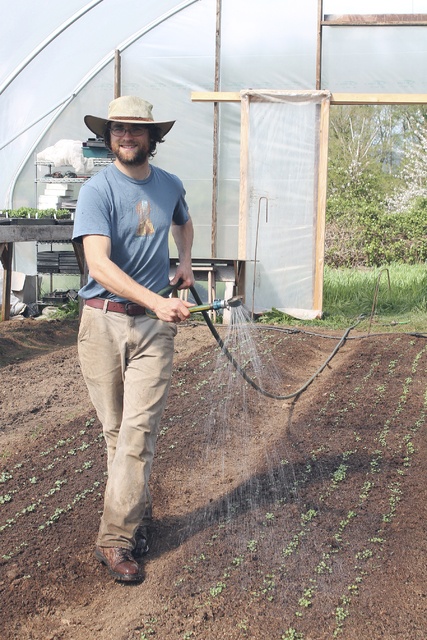
Islander Liam Rockwell is one of Vashon’s youngest farmers, and one of its newest. At 27 years old, he’s running his own farm and, for the second year, will sell his produce at Vashon’s farmers market starting next month.
Rockwell is less than half the age of the average American farmer, according to the U.S. Department of Agriculture’s 2012 Census of Agriculture, the most recent available as the census is conducted every five years. And while Rockwell answered the call to farming, not many young people do. The USDA reports that Washington State has 1,707 farmers under age 34, and according to the National Young Farmers Coalition (NYFC) website, the census reveals a 23 percent reduction nationally in the number of farmers who have been on their present operation for less than five years.
That fact shows that fewer people are taking on the job of farmer, NYFC’s website states before going on to explain that young farmers will be “a crucial element in maintaining a strong agricultural system,” as the majority of American farmers are nearing retirement.
But in the Pacific Northwest, and on Vashon, the picture may not be so bleak, according to Vashon Island Grower’s Association (VIGA) Co-Chair Emily Scott. She said that healthy, local food and supporting local businesses has become “trendy” in recent years, especially in the Pacific Northwest.
“I think there are a lot of young people that are really interested (in farming). Food is the most basic human need, and I think food and farming is being elevated with the whole health (movement) and supporting local businesses instead of corporations,” Scott said.
It was that curiosity about food and where the food he eats comes from that eventually drew Rockwell to farming.
Attending Evergreen State University, Rockwell did not know what he wanted to do. As his senior year started to wind down, he said he became extremely interested in cooking and then decided he wanted to have more of a role in growing what he was preparing.
“I starting growing food because I like to eat it,” he said. “I got really into cooking and started asking myself, ‘What are these ingredients? Where do they come from? What am I cooking with?’ I took all of sorts of stuff: biology, philosophy, but then I took a sustainable agriculture class in my last year, and there was a practice farm (on campus). It was the right time and the right place as I was trying to figure out what I wanted to do my senior year.”
Over the course of the nine month-long class, he said he learned everything there was to know about farming in the Northwest. Between learning how to utilize cover crops and grow vegetables to learning business paractices, Rockwell said he had an epiphany.
“I realized I was always outside and had been my whole life, from Boy Scouts to hiking,” he said. “Farming was vigorous enough that I thought it was interesting. The class finished. I graduated in 2011 and came back (to Vashon) to stay with my parents in 2012.”
That was when he decided he wanted to try farming as a full-time job and see what it would be like to farm “40 hours a week with three people, instead of 50 in a college class.” He found Vashon’s Hogsback Farm and interned during the 2012 growing season that usually runs from late winter to fall.
“After the nine-month internship, I was like, ‘That was great, turns out I really do like it,'” he said.
But he said he was specifically interested in how to better farm practices and to learn to work with the climate, soil and environment. His internship didn’t answer those questions, so he again reconsidered exactly what he wanted to do.
“I just floated for a bit. I worked around the island, bouncing between Seattle and Vashon and didn’t know where I wanted to go,” he explained. “I saw (farming) was an area that needs attention. It’s a very, very important part of our life, and there are a lot of problems with it across the world. I’m very passionate about how to do it better and work toward agricultural practices that are less harmful and more in tune with the natural world.”
He decided to go back to school and get a master’s degree in agroforestry so he could get a job designing farms, but before doing so, he contacted islander Doug Dolstad about living arrangements.
“I was living in Seattle and was hoping to drop the commute, so I contacted Doug about about a place to stay,” Rockwell said.
Little did Rockwell know, Dolstad had some extra land that he had been hoping to turn into a functioning farm. Shortly after Rockwell moved in late 2014, everything fell into place.
“Knowing I wanted to be involved in farming, but not being exactly sure how to get there, I saw the vision of someday (Dolstad’s) land (having a) farm,” Rockwell said. “Doug asked if I knew anybody who would be willing to farm the land in exchange for free rent, and that got the gears turning.”
Rockwell wrote up a plan for growing vegetables and pitched the idea to Dolstad and his partner, Barbara Larson, who threw their support behind the young farmer.
“They said, ‘absolutely’ and gave me a place to stay, a 1/2 acre of land and a no-money lease,” he said.
In a piece Larson wrote for The Beachcomber in February, she said Rockwell’s arrival and plans for the farm helped them “make the leap from dreaming to doing.”
“We remember the first cold farm meetings at the picnic table in the hay field when we shared our dreams and began to explore how this might work,” Larson wrote. “Besides providing housing and land, we committed to a no-interest loan that we calculated was needed to buy the equipment and infrastructure that would get him off to a healthy start.”
With the $10,000 loan to get the seeds and necessary equipment — and the agreement that Rockwell would pay back the loan as he made a profit — Rockwell got his farm underway as soon as the ink on the agreements dried in January 2015. But he was in for plenty of challenges, including one of the state’s driest summers and his lack of knowledge about the importance of soil acidity.
“It was a tough year to start,” he said. “I learned the limits of irrigation systems … but the biggest trouble last year was fertility issues. I didn’t test the soil and manage the pH. I had a lot of crop that just kind of failed. A lot of it was just trying to figure out what you’re doing. Troubleshooting and learning to manage problems was the biggest learning experience.”
With help from Dolstad and plenty of trial and error, Rockwell grew 28 vegetable varieties and sold for three months at the farmers market last year. With the knowledge gleaned from that first year, he said the current growing season has been going “really well” and he plans to continue growing vegetables, as well as expand to raising poultry. He said he is getting a shipment of chicks next week that he will raise into roasting chickens to sell at the market.
“For the first time, I felt like I was on top of things (this year). It was crazy last year,” Rockwell said. “I can see myself being here … I’m having a blast.”
Larson agreed that Rockwell had a rough start, writing in her February op-ed that water became an issue along with deer. But Larson and Dolstad say that the experience has been everything they could ever hope for and feel thankful to help bring up a farmer to come after them.
“Barb and I … imagine the gratitude of those in the future whose bountiful existence is possible by what happens now. Liam is a key part of that time bridge in this experiment … and he is … applying himself to the ‘stronger pull of what he truly loves.’ We are delighted to be in his company,” Dolstad said.