Review: Woody Guthrie’s Legacy Is Shared in Exuberant Musical
Published 1:30 am Wednesday, July 28, 2021


Vashon Theatre Fest began on Thursday night with a familiar, summer’s night trek for many islanders, toting collapsible camp chairs to find their spots in front of the stage in Ober Park. Kids rolled down the berms surrounding the park, and a few adults opened up picnic baskets.
Just like that, we were all back in the park together, to see a show.
For that, we owe a lot of gratitude to everyone participating in the fest, but especially Charlotte Tiencken, who conceived of the idea for it during some of the pandemic’s darkest days. To a few of us, it seemed impossible, way too ambitious, even scary. But she persevered.
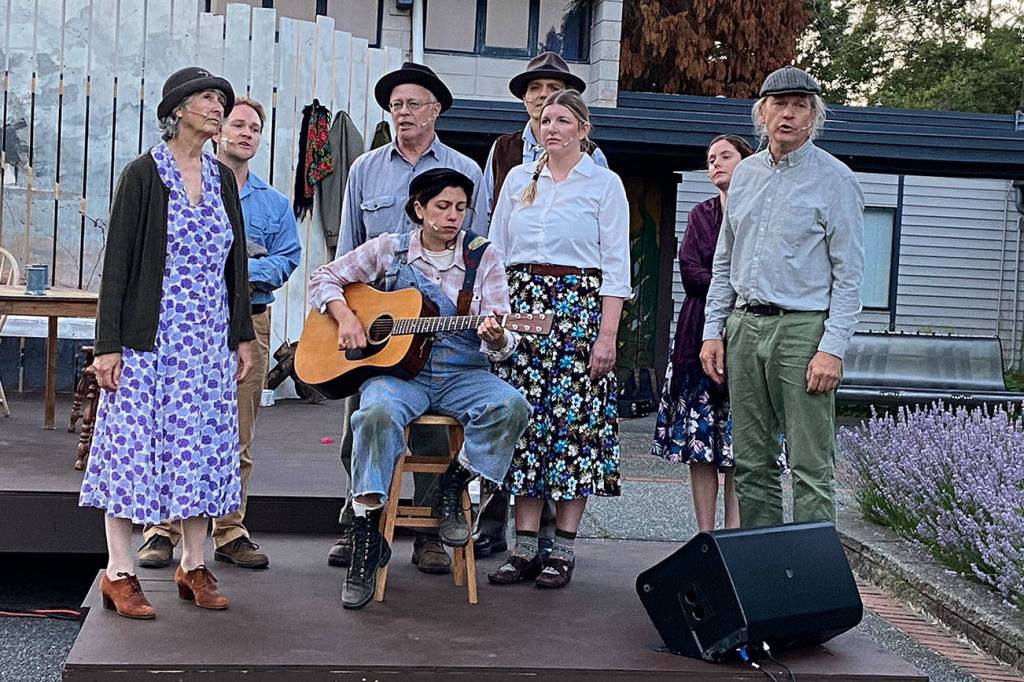
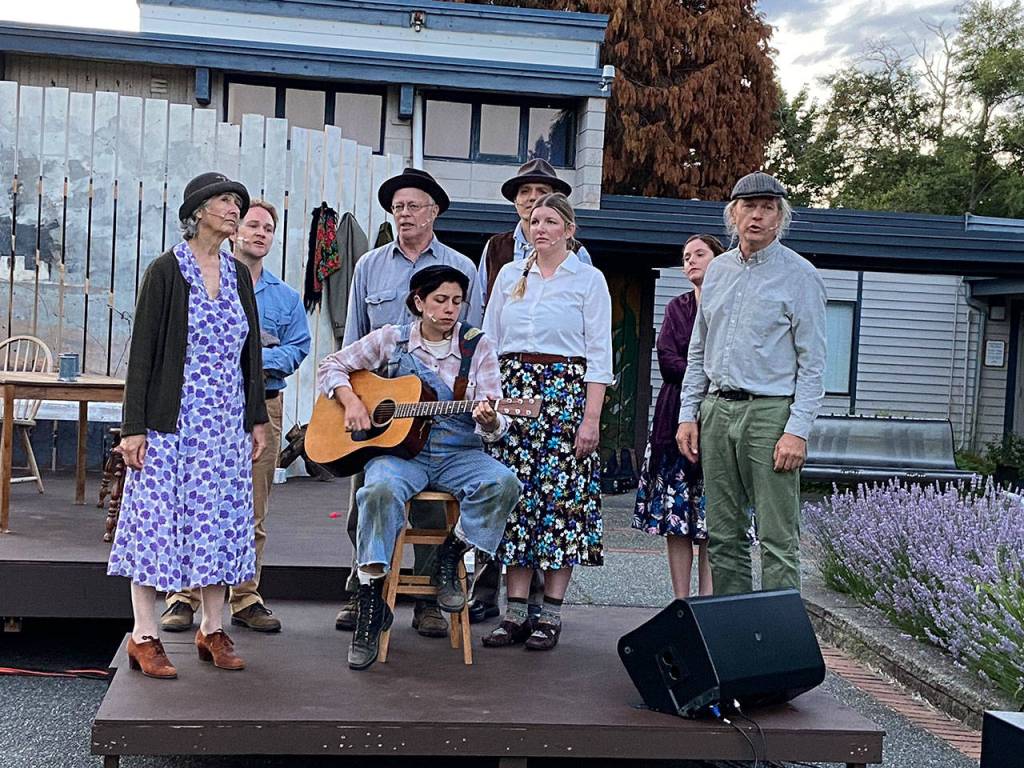
The festival opened with “Woody Guthrie’s American Song,” a musical adaptation of the songs and writing of Woody Guthrie, the celebrated folk singer, rabble-rouser, humorist and social critic whose work chronicled the travails of the 1930s, 40s and 50s.
Vashon Theatre Fest’s production features a stellar band, including the show’s musical director, local singer and songwriter Kat Eggleston. Orville Johnson, who also plays multiple instruments including the dobro and is the band’s director, is joined by harmonica wizard Mark Graham and bass player Steve Meyer.
The cast of eight local actors is a delight, with standout performances and vocalizations by Hailey Quakenbush and Michael Shook. But to single out anyone denies the ensemble effort, which is really what makes the evening special. Together, the cast served up indelible performances and exquisite harmonies that wafted through the summer night’s air.
But the show, conceived and adapted by Peter Glazier and first produced in the 1980s, didn’t merely entertain me. It made me think deeply, and comb through articles about Woody Guthrie’s music and life when I got home. I’ve heard his music all my life, but I heard it differently in 2021.
Guthrie was, of course, a champion of the downtrodden and disenfranchised. He lamented the lost dreams of Dust Bowl refugees, miners, migrant workers and skid-row Joes. His was always a radical voice, inspiring generations of political singer-songwriters to come.
“Woody Guthrie’s American Song” contains his painful ballad, “Deportee,” a song about the deportation of Mexican migrant workers that seems ripped from today’s headlines, and it is movingly performed by Jackie Domi in the show.
In his lifetime, Guthrie also wrote songs about Black Americans who were denied justice, the treatment of Native Americans, and even a scathing poem about the racism of his New York landlord, who happened to be Donald Trump’s father.
But these are not his most well-known works — and it is worth asking why.
Many of Guthrie’s better-known songs, many of which are included in “Woody Guthrie’s American Song,” are about the travails of impoverished, lower-class white workers — folks much like John Steinbeck’s Joad family, who made their way across a Dust Bowl-ravaged landscape only to find themselves still down on their luck out West.
These songs sadly remind us that poor white people have always been used as capitalism’s pawns, cogs and even its enforcers, and things have not gotten better in that regard — they have, in fact, gotten so much worse.
Woody Guthrie’s populist anthem “This Land is Your Land” — written as a rebuke to Irving Berlin’s jingoistic “God Bless America — is another song that lands differently now, even though the controversial topic of whether or not the song erases Indigenous people is not new.
Years ago, Native folk singer Buffy St. Marie refused to perform the song, and even Pete Seeger often added a verse to it, acknowledging the theft of Native land.
This is all worth talking about — and the show is very much worth seeing, to not only revel in the Theatre Fest’s fine production but also to ponder all the implications, contradictions and continuing messages found in Guthrie’s life and artistry.
And isn’t this the whole point of theater — to not only entertain us and make us feel good but also to push our buttons and make us think about things in new ways?
There will be a talk-back with the audience after the show’s final presentation on Sunday, Aug. 1. More performances of “Woody Guthrie’s American Song” take place at 6 p.m. Friday, July 30, 4 p.m. Saturday, July 31, and 6 p.m. Sunday, Aug. 1.
Tickets to the show can be purchased in advance at brownpapertickets.com, but no one will be turned away for lack of funds.