Commentary: Imagining what Vashon was — and could be
Published 1:30 am Wednesday, August 20, 2025

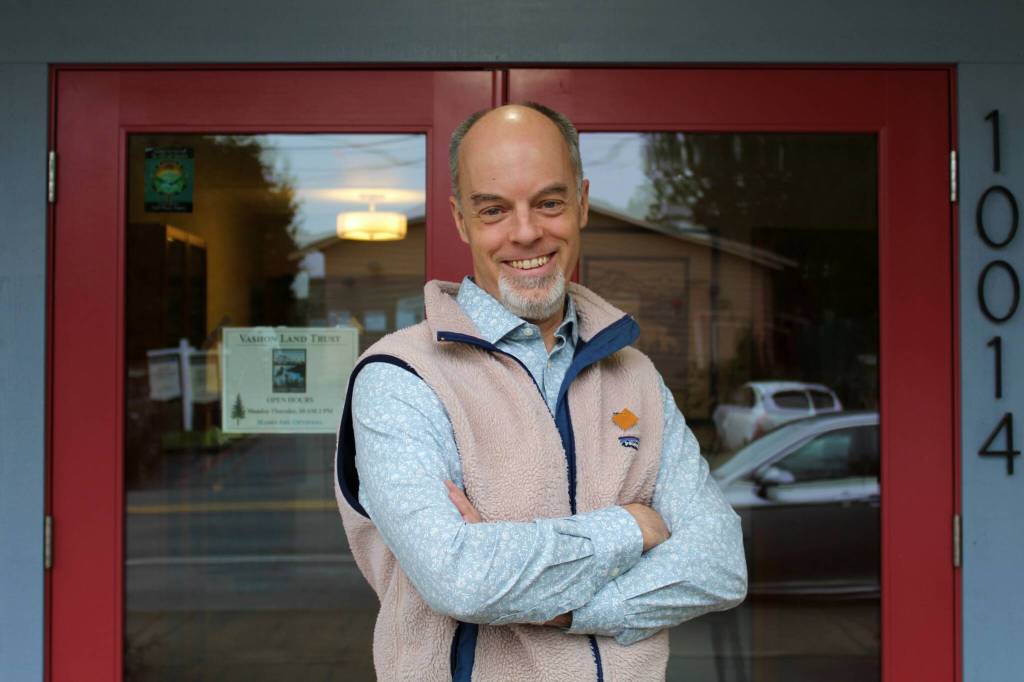


Editor’s note: This commentary is adapted from a speech given by Vashon-Maury Island Land Trust Executive Director Theron Shaw during the organization’s annual Big Sky Fundraiser on July 26.
I’ve been thinking a lot about Imagination.
Of all the gifts and tools that we can turn to as we care for these lands and waters, I think imagination might be the most important one. So I have a few places that I’d like to visit with you.
The first place that I want to take you is to Quartermaster Harbor, 1750.
We’ll get there with a beautiful map created by Bruce Morser and the folks at the Vashon Heritage Museum that I keep behind my desk, depicting the island in 1750. You should have a look at it at the museum, if you haven’t been there lately.
This map helps us imagine what the harbor was like when 12,000 sx̌wəbabš people lived in longhouses all along the shore. Imagine the incredible salmon runs in Judd Creek, the shellfish harvests, the hunting, the old growth cedar trees, and the plants and medicines that all fed that community. This was an abundance that none of us today has ever seen — feeding a population similar to ours in 2025 without ferries, or Costco, or grocery stores.
This abundance is not that far gone. I saw a photo recently in one of island historian Bruce Haulman’s books, showing a fishing barge in Quartermaster Harbor around the year 1925, hauling huge baskets of fish up out of the water and dumping them onto a barge. The herring, salmon and other fish stocks even 100 years ago were still abundant beyond anything we’ve seen.
I keep that map by my desk to remind me of what used to be here, and what can be here again.
The next place I want to take you is Shinglemill Creek. Some of the Land Trust team took a walk a couple of months ago from the very top of the creek all the way down to Fern Cove.
We started the day by visiting what we affectionately call the “Grand Canyon” — a steep wall of sand and gravel that erodes back one to two feet per year, depositing this load of sediment all the way down the stream and out to Fern Cove. As we worked our way down the creek, we were looking at ways that this sediment results in less habitat and lower quality habitat for fish, forests, and all the other critters in this watershed.
Over the next year, the Land Trust will be building on our ideas from that walk while we design a multi-year restoration plan for the Shinglemill watershed.
The last place I want to take you is to Judd Creek. The Land Trust gathered a group of salmon experts in mid-July, including fisheries staff from the Puyallup Tribe, experts from fish restoration group Long Live the Kings, Bianca Perla from Vashon Nature Center and Rocky Hrachovec from Wolf Water Resources.
There was passionate agreement that Vashon’s cool, clean, spring-fed streams, right in the heart of the southern Salish Sea, are an amazing resource for salmon. Vashon creeks have the potential to provide critical spawning habitat and rearing grounds for salmon at a time when they are struggling on so many fronts.
Over the next year, using state grants we have secured with the Puyallup Tribe, the Land Trust will be developing a restoration design for Judd Creek, implementing first steps in that design, and experimenting with adding new Chum salmon into the creek.
These three places give you a window into the work and ideas that are inspiring our Land Trust team, and guiding our plans for the next few years. We are thinking and working at the scale of watersheds and the whole island, and focusing our restoration efforts where they will have the biggest impact for the island itself and for the southern Salish Sea.
There is a beautiful book that I read this past year, “Becoming Kin” by Patty Krawec, which discusses the idea of standing at the middle of seven generations. We receive the gift of lands and waters from our great-great-grandparents, and we pledge ourselves to the privilege and responsibility of tending these lands and waters on behalf of our great-great-grandchildren.
That’s the essence of our work here: standing in this place, imagining what it was, and dedicating ourselves to its care today so that we can gift that kind of abundance and more to our great-great-grandchildren.
The Vashon community has generously supported the Land Trust for the past 35 years. All who have participated as donors, volunteers, staff members and Board members have helped to achieve an incredible success: weaving the island together into preserves and watersheds that are now stewarded on behalf of future generations.
Thanks to this success, the Land Trust today can begin restoring whole watersheds which play a critical role in the health of the southern Salish Sea.
Please join us in stretching our collective imagination and ambition as a community. We have received this place as gift and as responsibility. Let’s step together into this brave river of imagination, see what was and can be, and do our part to make it so for the ones to come.
Theron Shaw is the executive director of the Vashon-Maury Island Land Trust. Learn more at vashonlandtrust.org.