The community raising of a gray whale
Published 10:20 am Wednesday, November 12, 2025


When a gray whale washed ashore near Klahanie in the spring of 2024, its flesh was slowly reclaimed by the sea. But the whale’s journey was far from over. He has touched the hearts and minds of hundreds of people who are working to ensure his story lasts for generations.
Islanders can learn more at From Sea to Sky – The Raising of a Whale, an event that will take place at 6 p.m. Tuesday, Nov. 18, at Vashon Theatre. This project is a partnership between Vashon Nature Center (VNC) and Vashon Center for the Arts.
Gray whales have the longest migration of any mammal on Earth. Each year they make a 12,000-mile round-trip journey between nutrient-rich Arctic seas and the warm birthing lagoons of Baja California, Mexico.
Last month, around 13,000 gray whales began the long trek down the West Coast, logging around 75 miles a day. The number of those migrating is sadly the lowest since the 1970s, when these whales were listed as endangered. Their population decline is due in part to an “unusual mortality event” that led to hundreds of starved gray whales washing up on beaches from 2018 to 2023.
In April 2024, another gray whale was unable to complete his final migration; his emaciated body was found on Vashon’s eastern shore. After checking with local tribal advisers and receiving a salvage permit from the National Oceanic and Atmospheric Administration, VNC began working with community volunteers to monitor the whale’s natural decay on the beach and then collect and prepare his bones.
The whale’s afterlife has been a continued migration of sorts. His story has connected people up and down the West Coast through a shared interest in gray whales and the entire Pacific ecosystem. His reconstructed skeleton will help teach others about his species’ remarkable life history.
“This is a community endeavor that starts with our island and encompasses people far beyond our shores,” said Bianca Perla, VNC’s founder and science director. “Singer has touched so many lives — it’s kind of magical. This is a project that nobody was expecting and, after saying yes, so many connections and amazing experiences have come out of it.”
Perla said it has restored her faith in humanity to see the wider community develop and to witness the lengths people will go to make this project happen.
The origin of the whale’s name, Singer, pays tribute to one local supporter, The Coop, a music venue that provided a dry place to store the whale bones. A complete list of those involved in the project would fill this entire page, but the following examples represent all who have offered expertise, tools, cultural knowledge, time, artistic talent and muscle to make Singer’s story come to life.
Mike DeRoos of Cetacea on Salt Spring Island, B.C., advised on how to clean and protect the bones, even gifting bags of museum-grade plastic coating for the entire skeleton. Matthew Zeleny, a professor at Camosun College in Victoria, B.C., reviewed Singer’s 3D bone scans to ensure they were anatomically aligned. (An island eighth grader spent 75 hours completing the scans, thanks to expert guidance and equipment donated by Sawbones, a Vashon company that makes medical models for orthopedic and medical education.)
Zeleny shared the exciting news that a little comma-shaped piece rarely recovered in such efforts is the jugal, a free-floating bone that sits in the lower eye socket where the orbital muscles attach.
Brandon Reynon, director of the Puyallup Tribe’s historical preservation department, gave counsel and connected VNC with Rhonda Foster of the Squaxin Island Tribe, who will share knowledge of Coast Salish tribes’ relationship with whales for interpretive information to accompany the Singer display.
Sue Pemberton, with the California Academy of Sciences, offered the use of her organization’s baleen preservation protocol. Port Townsend Marine Science Center, which has a whale skeleton on display, gave budgeting advice.
Islander Gary Shugart, head curator of collections at Puget Sound Museum of Natural History at the University of Puget Sound in Tacoma, provided background on his museum’s whale articulation project.
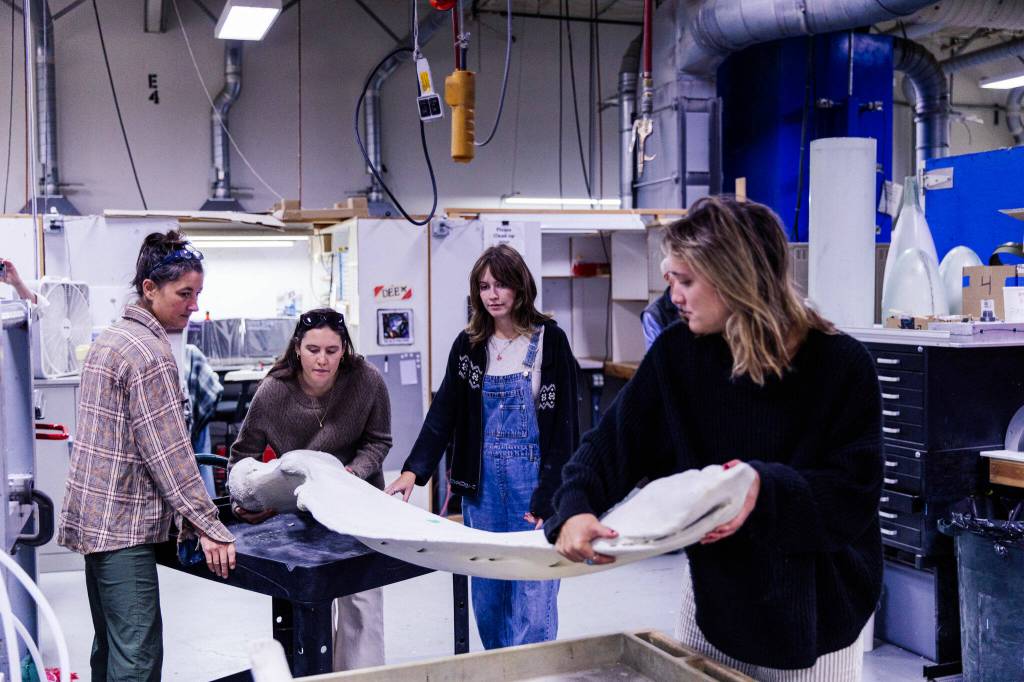
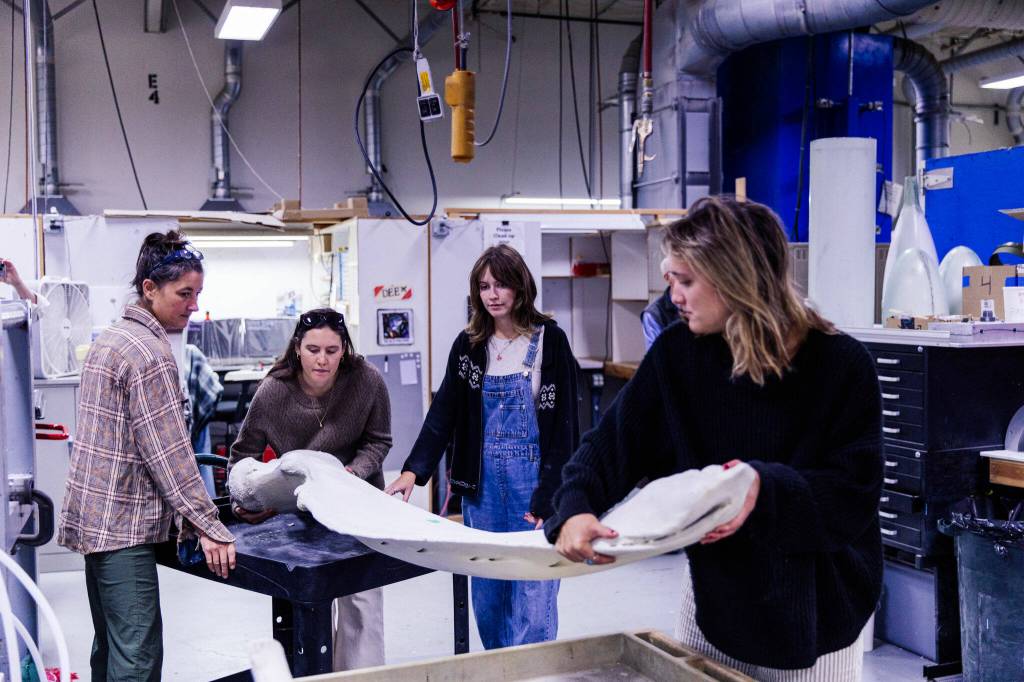
On Vashon, 27 volunteer whale ambassadors have worked tirelessly to move, catalog and clean the bones — one even spent days wearing a jewelry loupe magnifier to painstakingly remove every speck of flesh from the skeleton. Island artists, teachers, students, scientists and engineers have all lent their time and expertise.
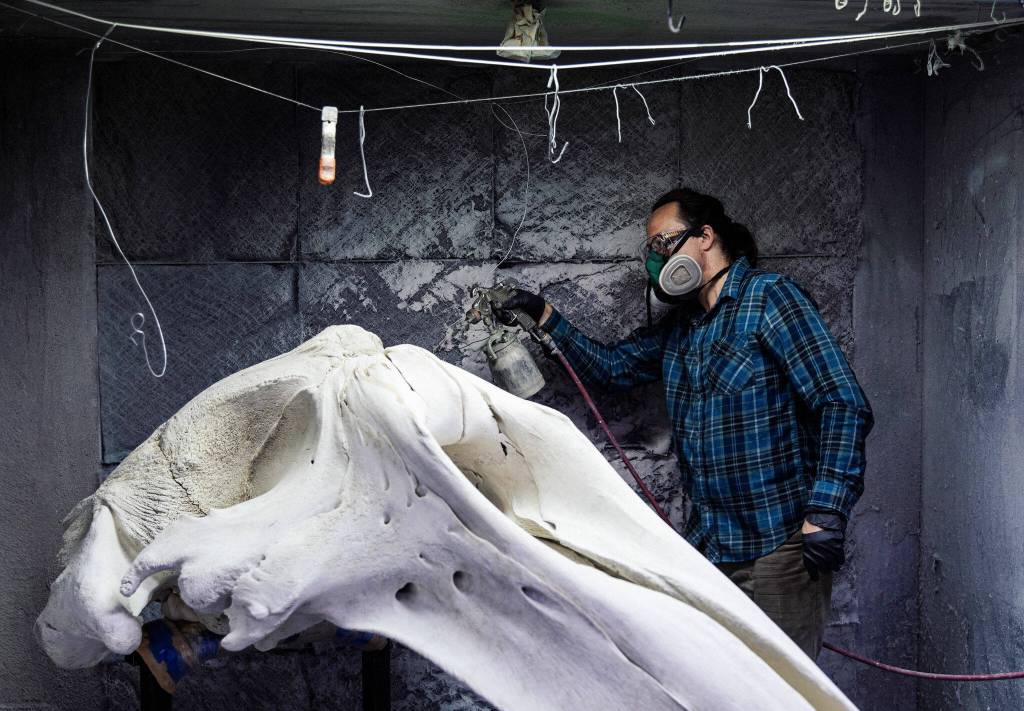
Singer’s bones are currently in the workshop of island artist Ela Lamblin, who will center them in an interactive artwork to be displayed in the lobby of Vashon Center for the Arts. Lamblin, who has completed science-based sculptures across the country, is thrilled to be working on a community-based grassroots project on his home island.
“My vision is to pay homage to this wonderful whale as a living creature,” Lamblin said. “Sculpturally, I want to create a form that shows the full size and scope and personality of a living whale. My goal is to reach people on a different level emotionally by bringing fun and whimsy to the scientific method of display often used for skeletons.”
Lamblin, whose kinetic metal sculptures are often interactive with sound elements, sees the work as a collaboration with the whale.
“Singer spent all this time and energy growing these amazing bones and because he washed up here, metaphorically they are a gift to us,” Lamblin said. “I hope to elucidate the awe and wonder these creatures bring and give credence to his fantastic ability to grow and create and live and thrive.”
Perla also views Singer as a messenger with something to teach all those who encounter him.
“This is an invitation to learn about Singer and his offspring who are now migrating the same route he took,” she said. “This is a rare chance to experientially learn about gray whales — it’s a powerful experience just to be in the presence of his bones.”
Learn more about Singer at Vashon Theatre on Tuesday, Nov. 18 at 6 p.m., for From Sea to Sky – The Raising of a Whale. This GreenTech night will feature a film on whale articulation from Canada’s Hakai Institute, a slideshow telling Singer’s story, a presentation by Ela Lamblin and the chance to sponsor a bone. For more information, visit vashonnaturecenter.org.
Kathryn True is an island writer and naturalist. She is a member of the Vashon Nature Center advisory council and a longtime volunteer for the organization.