Students earn wilderness first aid certification
Published 1:30 am Wednesday, February 11, 2026
Thirteen members of Vashon High School’s Outdoor Adventure Club earned their Wilderness First Aid certificates through the Bellingham-based organization Backcountry Medical Guides.
The two-day immersive course in mid-December was funded through a Vashon Partners in Education (PIE) grant and overseen by high school co-advisers Tara Vanselow and Jen Coe. Both have Wilderness First Aid certifications and accompany students on club outings.
Although facilitated by Vanselow and Coe, the extracurricular club is student-led. Members organize opportunities for exploring nature and outdoor activities, including hiking, volunteer trail work, snowshoeing and snowtubing, backpacking and camping.
Through two days of classroom instruction and field work, students participated in scenarios teaching basic outdoor skills and medical preparedness.
An intensive program
Full-time mountain guide Max Bond and mountaineer and paramedic Jesse Stacy led the course. Vanselow said the instructors had “depth and real-life experience that made them relatable.”
Vanselow appreciated the instructors’ response to the students’ active-learning styles. The course curriculum alternated between classroom instruction and outdoor, boots-on-the-ground scenarios.
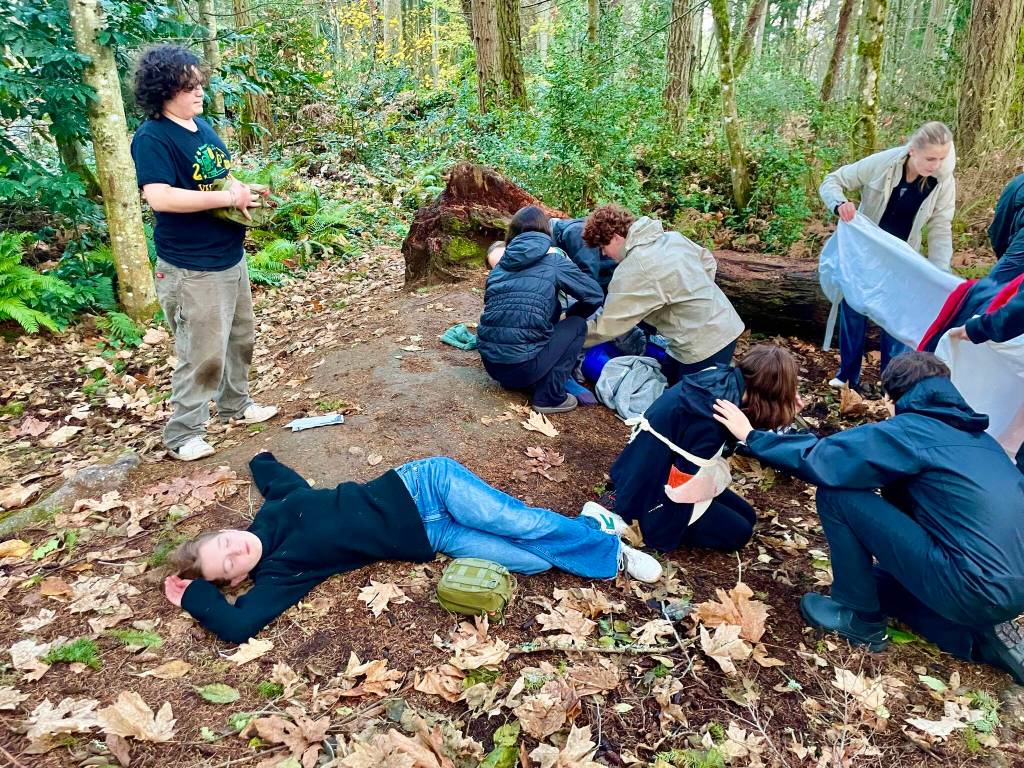
Students spent the afternoons in the McMurray Middle School woods working with simulated medical emergencies that they might encounter in real life.
“My favorite parts of the class were the scenarios … it’s a lot of thinking on your feet, which is better than a typical class setting,” club executive-board member Eli Berman, said.
In real life
They began by learning about situational awareness and judgment skills when evaluating conditions in the wild, club member Maggie Thornton said. “If you’re about to help someone else, you need to make sure that the scene is safe, so that you don’t compound the problem by getting hurt as well,” she said.
Early on, students performed emergency stabilization of joints to injured limbs, creating splints on the fly without medical kits or supplies, using materials they might find on hand in the wilderness.
Taking turns, they posed as injured persons and rescuers. Teams of rescuers located the wounded, identified the injuries and determined the best ways to assist.
The students didn’t know beforehand which simulated accident they’d have to respond to —they might be presented with a broken arm, someone having a stroke, or someone bleeding out.
Props and makeup provided clues and lent a sense of reality to the scenarios. They used fake blood for bleeding injuries, and makeup indicated bruising. Students practiced using tourniquets to control severe bleeding and CPR skills with both adult and pediatric manikins.
“Bond and Stacy did a great job of approaching and elucidating serious topics. They’d let the kids have fun and then circled back to the serious issues of medical support,” Vanselow said.
Practice included assessment, triage and the management of common backcountry injuries. The instruction stressed the importance of procedural order to allow responders to stay grounded in high-stakes situations.
“When you’ve had exposure to these experiences, you’re more prepared when something actually happens. You can take control, establish some leadership — and you can actually help the person,” Berman said.
As the course progressed, the injuries increased in complexity. Students worked through scenarios where hikers might come upon an unresponsive person but find no clues, demonstrating that sometimes responders can’t puzzle out the cause of a medical emergency.
Certification
In addition to field practice, the Wilderness First Aid certification requires six hours of online pre-course instruction followed by tests. The online component provides foundational knowledge to prepare students for the in-person, experiential training.
The BMG Wilderness First Aid certification verifies a person has completed training in cardiopulmonary resuscitation (CPR), the use of an automated external defibrillator (AED) and includes the Washington epinephrine auto-injector certification.
Certificates must be renewed every two years.
The ripple effect and a slice of PIE
An increase in membership in the Outdoor Adventure Club in 2024 landed a crop of 10th-graders who will share their experiences for the next several years.
“Throughout high school we’ll probably have more important meetings like this one. We talked about CPR in Health class, and we’ll keep getting better at it throughout our time in high school,” Berman said.
In her grant application, Vanselow wrote, “Having more members with certification increases safety for our growing club, and benefits others in the wilderness with whom we share space.”
Vanselow said it’s valuable beyond the club, because students are now out in the world and may be able to step in and help in an emergency.
“Part of the reason we have this club is to get people outdoors, to help them learn about how you take care of the planet, and of each other, including basic things like trail etiquette, and the concept of ‘leave no trace,’” she said.
Critical thinking
The Outdoor Adventure Club, active since 1990, emphasizes environmental stewardship, leadership, self-reliance and teamwork, as well as wilderness exploration.
Wilderness First Aid certification allows the club to increase the breadth and depth of its outdoor expeditions. Club co-president Piper Frith said, “When we’re seniors we may go on a backpacking trip to Oregon — we get to see our dreams come true.”
Josephine Reiling, a club member considering a career in the medical field, said: “I think it’s given me some confidence in just going out into the world.”
“Now we’re prepared for different accidents that are really scary, and we will be able to take them on in a calm way. It’s made me more prepared for more out-there adventures,” Frith said.
Marie Koltchak is a PIE board member.