Measles, COVID and Community Updates
Published 1:30 am Tuesday, March 24, 2026
Measles is back in the news
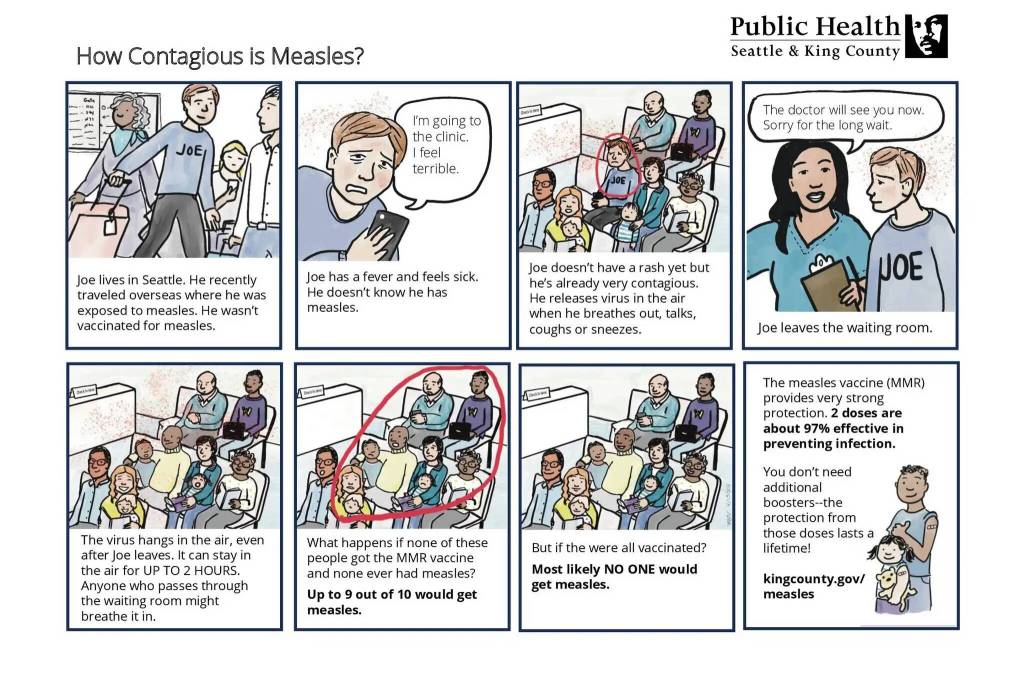
Measles has been spreading in the United States over the past year, with more cases identified in 2025 than in decades, and now an outbreak in Snohomish County has reached 14 cases. Measles is one of the most infectious viruses we know of, meaning that if someone is unvaccinated and has not previously had measles, exposure is very likely to lead to infection.
A person with measles can spread the infection to nine out of 10 unvaccinated people who are exposed. As a result, vaccination rates greater than 95% are required to prevent spread within a community — this is known as herd immunity. Because vaccination rates in the U.S. have exceeded this threshold in the past, there has not been endemic measles in the U.S. for decades.
But over the past five years, vaccination rates among U.S. kindergartners fell from 95% to 92.5% on average, and much lower in many regions, giving rise to outbreaks across the nation. The usual scenario is that an unvaccinated traveler brings measles to a community and exposes others before symptoms occur or before the disease is recognized.
As it turns out, the recent Snohomish outbreak of 14 cases has been linked to a traveler from South Carolina, where the U.S. outbreak is now centered. Unvaccinated people have accounted for 92% of the cases in our state.
King County had just seven cases last year, and none led to secondary cases. But public health officials are concerned because the county’s vaccination rate is at the herd immunity threshold, and a larger-than-usual influx of visitors is expected this summer associated with the World Cup.
Death from measles is rare but, like many viruses, it is hardest on the very young and very old. Measles can also cause lasting damage to the immune system and brain at any age. Getting two doses of the MMR vaccine during childhood or later provides approximately 97% protection against contracting measles.
The three vaccines in the MMR shot — measles, mumps and rubella — are only available in the U.S. as a single injection, delivered together for the comfort and convenience of the mostly young patients who receive them.
With an uptick in measles reported in our area, vaccination becomes increasingly important to protect individuals and the community. Those born in the pre-vaccine era, before 1950, are assumed to have had measles because it was endemic and highly infectious, so almost everyone was exposed. Because measles was widely recognized as a scourge, nearly everyone born in the U.S. after 1963 got the measles vaccine.
Those born between the mid-1950s and 1968 may have had early versions of the vaccine that were less effective. If you are uncertain about your vaccine status, you should talk to your doctor about an antibody test and whether vaccination is right for you.
What happened to COVID this winter?
The daffodils are blooming, but we have not yet seen a spike in COVID cases in the region’s emergency rooms. It was a worse-than-usual year for influenza, and RSV made its usual appearance on cue in late December.
But COVID has smoldered along at rates lower than we’ve seen for several years. Does that mean COVID is dying out or becoming less virulent? Of course, no one really knows, but epidemiologists do not believe that is the case.
Dr. Jim Bristow, coordinator of Vashon Medical Reserve Corps, tells us, “I’ve given up trying to predict what the COVID-19 virus is going to do, but I think it is wise to continue to protect ourselves. I’ll be getting a COVID shot in the late spring, so I’m protected before I travel this summer.”
As ever, the best protection is being vigilant when COVID cases are rising, getting vaccinated, wearing a mask and avoiding large crowds if you are at increased risk. The Washington Department of Health recommends an annual dose of the latest COVID vaccine for children once they have received the original series, and for adults until they reach age 65. DOH recommends two annual doses for those 65 and older, and for those at increased risk from the virus.
The food bank has moved
On Friday, March 13, Vashon Maury Island Food Bank celebrated the grand opening of its new location behind Vashon United Methodist Church at 17928 Vashon Highway SW.
The complex includes a new building that is state of the art, light and spacious, with lots of smart design features, as well as a newly renovated adjacent administrative building.
Despite the heavy snow, many people showed up to celebrate, including politicians and other dignitaries. Food Bank staff and volunteers were able to keep food available during the move from Sunrise Ridge. Although home deliveries missed a week, they will resume on March 26.
The food bank’s new location next to the Methodist church is a welcome development for the growing resilience hub in the center of Vashon. In the Food Bank’s administrative building, Vashon Youth & Family Services offers weekly help for all to navigate available social services, in English and Spanish.
The food bank has a big generator to keep the freezers humming even during power outages, and the main church building has solar power.
VIFR upcoming classes
VIFR Safe Sitter Essentials with CPR: This class is scheduled for April 25 from 9:30 a.m. to 4 p.m. The cost is $20, but scholarships are available. For information on scholarships, contact Lilie at lcorroon@vifr.org or 206-463-2405.
CPR class: The next free community CPR class will be April 22 from 6 to 8 p.m. The class includes instruction on using an automated external defibrillator, Narcan use and overdose prevention, and basic first aid.
Apply now for a free ramp: Meade Construction will build another ramp this year for a low-income residential applicant on Vashon. Individuals with disabilities or limited mobility are encouraged to apply at the link below. The priority deadline is March 31, but applications will be accepted until May 1: tinyurl.com/VashonRamps.