Study finds transient killer whales spending more time in Puget Sound
Published 9:30 am Tuesday, August 11, 2026
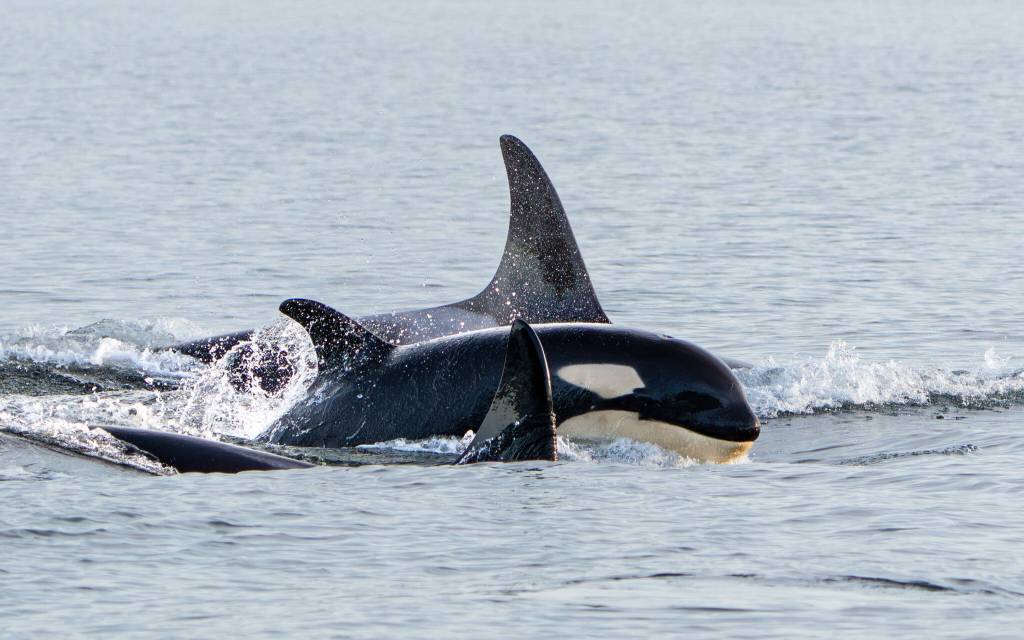
Islanders gazing out over Puget Sound from the ferry or Vashon’s shorelines may have a better chance of spotting transient killer whales than in years past, according to a new University of Washington study.
Transient killer whales are a distinct type of orca that, unlike the salmon-eating southern residents, feed on marine mammals and have unique behavior and social structure.
According to nearly 50 years of whale-sighting data, they’re increasingly calling the Puget Sound home.
Because killer whales sit at the top of the marine food web — relying on a complex network of marine plants, fish and mammals — changes to where they’re spending time can give researchers clues about what’s happening in the Puget Sound as a whole.
”They can kind of be an indicator for the overall health of the Puget Sound ecosystem in general,” said Zoe Rand, the study’s lead author. “This shows us that something is changing.”
Published in late June, the study analyzed the Whale Museum’s database of whale sightings submitted by citizen scientists, commercial whale-watching operators and dedicated observers, as well as acoustic detections from hydrophones.
Drawing on observations from 1978 to 2022, researchers modeled the migratory patterns of transient killer whales and southern residents to see how their presence in Washington’s waters has changed over time.
Researchers found that since 2002, transient killer whales have been more likely to be spotted in the Puget Sound — a notable shift from previous decades, when southern residents were the more commonly observed population.
For years, marine research and anecdotal accounts have supported the notion that transient killer whales are becoming more populous in Washington’s waters, Rand said.
On Vashon — where islanders have long spotted the smooth black-and-white bodies of orcas hunting for food — Vashon Nature Center Science Director Bianca Perla said she has noticed seeing them more than she used to.
In January, a group of transient killer whales hunting off the shores of West Seattle made headlines after their tail slapping and breaching drew a crowd of onlookers.
And according to the UW study, those observations are more than a deviation from normal behavior — they’re a part of a larger pattern, Rand said.
Based on 2022 sighting data collected off Vashon’s shores, anyone who spotted an orca between June and September was more likely to have seen a transient killer whale than a southern resident.
Between October and December of that same year — the latest year for which data were available — the chances of seeing either type of orca were about equal, Rand said.
While the study did not examine why transients are appearing more frequently in Puget Sound, researchers hypothesize the increase may be tied to a growing food supply, Rand said.
U.S. laws like the Marine Mammal Protection Act of 1972 have boosted the populations of many species, such as pinnipeds, likely providing transient killer whales with more sea lions, seals and porpoises to prey on.
While Rand said her team expected that the Whale Museum’s data would support a growing presence of transient killer whales, what was unexpected was the changing presence of the southern residents.
Southern residents are a matriarchal species that group themselves into distinct pods — K, L and J pods — centered around the eldest females in the group. Each pod has specific behaviors and vocal repertoires, and travels together as they chase prey.
While southern residents are still well represented in the Puget Sound, the data found that their presence is primarily through the J pod, with both K and L pods spending less time in these waters, Rand said.
“At least for K and L pods, the Puget Sound maybe isn’t quite as good an ecosystem for them for some reason,” Rand said.
Just as with transient killer whales, understanding why K and L pods’ presence in the Puget Sound has changed likely has to do with the availability of Chinook salmon, their favorite prey, Rand said.
Threats like overharvesting, climate change and habitat destruction have contributed to population declines for many species of Chinook salmon in recent years. And their dwindling supply is a key reason why southern residents were listed as an endangered species in 2005 under the U.S. Endangered Species Act.
It’s possible there just isn’t enough salmon for all three pods in the Puget Sound, Perla said in an email, and that K and L pods may be hunting in other waters to divide food resources among the pods.
Rand said K and L pods may also be expanding their diet to adapt to population declines in their preferred prey.
“There’s a chance there’s a difference in exactly what they’re eating,” Rand said. “They all eat salmon, but they might be differentiating and eating very specific runs of salmon.”
Perla said changes to where killer whales are spending time are directly tied to human action — and although we’ve made progress in protecting marine mammals, the data is telling us there’s still more to do.
“We have been less successful in doing the things that need to be done to recover salmon populations,” Perla said in an email. “Resident orcas, who eat salmon, are still in trouble and needing to range farther outside Puget Sound to get the food that they require.”
Since 2016, the Vashon Nature Center has relied on volunteer citizen scientists to monitor salmon populations in Vashon’s creeks, tracking species such as coho and chum salmon — important prey for southern residents.
While the Vashon Nature Center does not monitor killer whale populations directly, Perla said its work to restore healthy shorelines and marine habitats helps support the broader Puget Sound ecosystem.
For Perla, citizen scientist observations — like much of the data compiled in the Whale Museum’s archive — are a critical part of bridging the gap between scientific questions and answers.