WSF plans fix for bottleneck at dock
Published 4:44 pm Wednesday, September 24, 2025
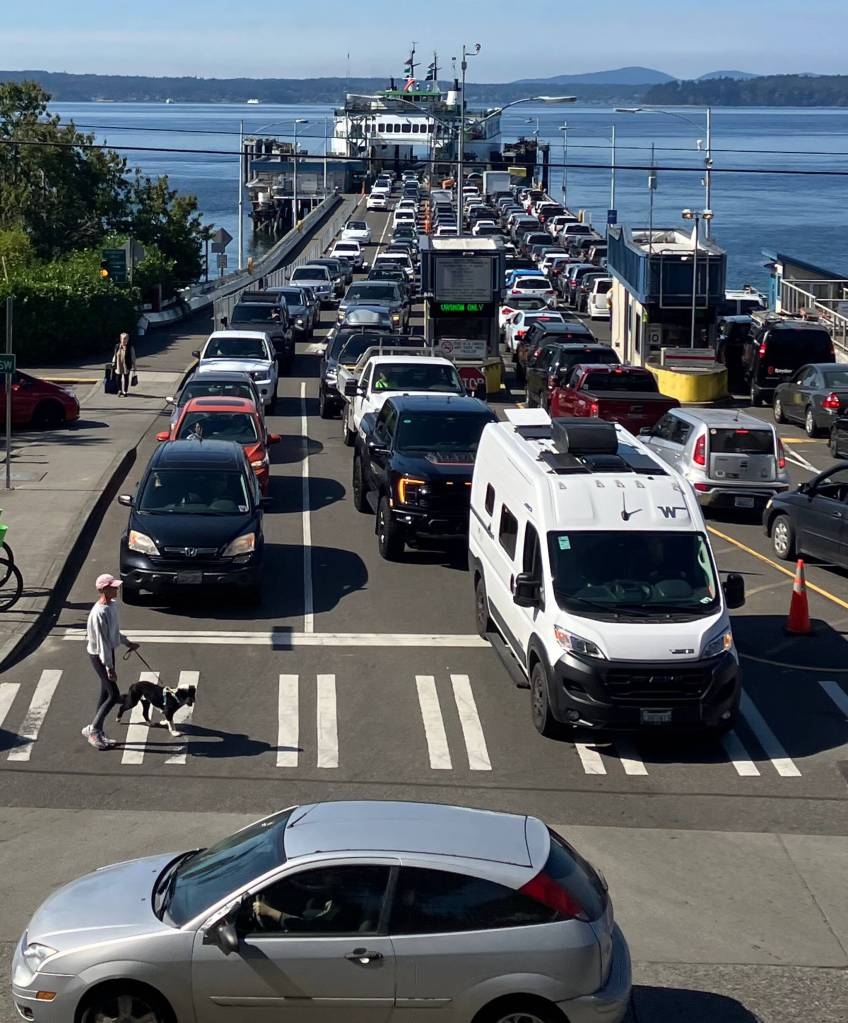
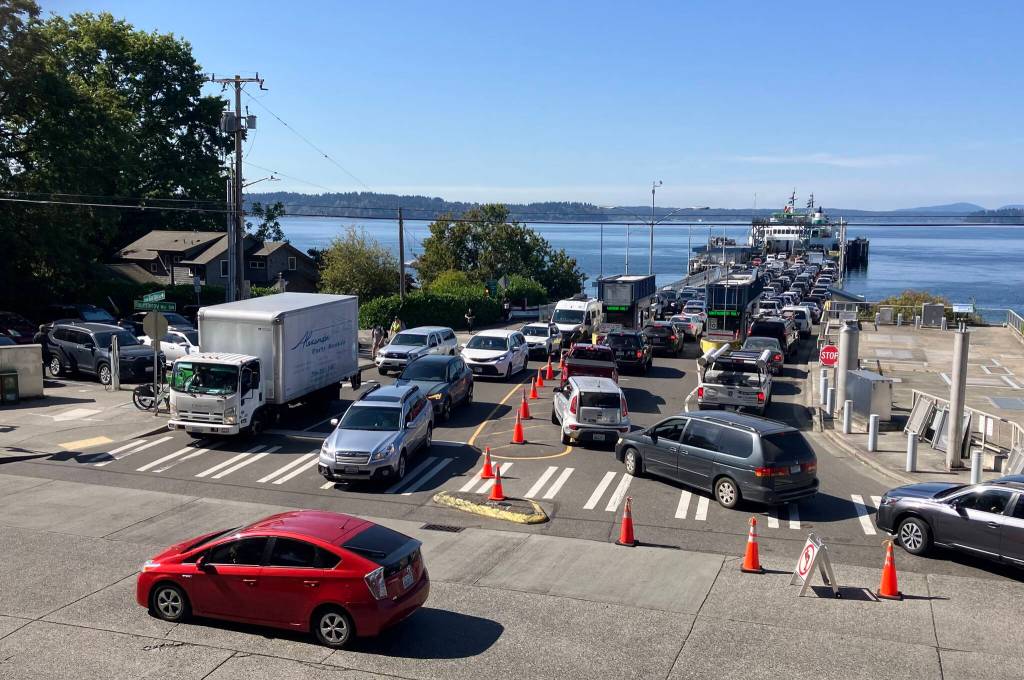


The “T” intersection where the Fauntleroy ferry dock and Fauntleroy Way Southwest meet has been a big bottleneck for decades.
A uniformed off-duty police officer directs traffic there sometimes when vehicles driving off ferries come streaming down the dock. But when that officer isn’t present, each unloading vehicle must stop at the intersection, then wait for a gap in traffic to turn left toward the West Seattle Bridge, or right toward White Center and SeaTac.
So traffic often backs up in the dock’s two exit lanes, sometimes all the way to the ferry. When that happens, vehicles waiting to board the boat to sail to Vashon and Southworth can’t load. Departures are delayed, schedules thrown off.
The troublesome intersection isn’t just an operational headache, Washington State Ferries says: It’s also downright unsafe.
Now WSF aims to fix it.
The agency plans to install a traffic signal at the intersection next spring. If all goes according to plan, by next summer unloading cars, trucks and motorcycles will cruise through the intersection under the glow of new green lights.
Some islanders can hardly wait. “We need it done as soon as possible, if not sooner,” said Justin Hirsch, who chairs WSF’s three-member Vashon Ferry Advisory Committee. “This is not a huge, complicated project. It’s long overdue.”
But Vashon ferry commuters will need to adapt to some changes in how the intersection operates that are part of WSF’s signalization plan.
For vehicles approaching the terminal from the south, left turns from northbound Fauntleroy Way onto the dock won’t be allowed at any hour. They’re already prohibited much of the time.
Left turns onto Fauntleroy from the dock’s right exit lane also will end. Once the signal is operating, WSF says, you’ll need to be in the left exit lane to turn left.
Why now?
“We’ve had issues with this intersection for as long as there’s been a ferry terminal here,” David Sowers, then WSF’s director of terminal engineering, said at a 2024 public meeting.
So why didn’t the agency install a signal years ago?
Funding was the biggest obstacle, Hadley Rodero, deputy director of external relations, said in an interview last week. There’s money available now, she said: The $1 to $2 million needed to install the signal will come from funds the Legislature already has appropriated for a larger, related, much more complex project: Replacing the aging, undersized Fauntleroy dock.
WSF began soliciting community input on that larger project in 2021. The agency decided to install the traffic signal in part because all three affected communities — Vashon, Southworth and Fauntleroy — voiced strong support for it, Rodero said.
But WSF wanted to wait until dock-replacement planning was far enough along to know the signal would fit with the rebuilt pier, said Nicole McIntosh, the agency’s current terminal-engineering director. Early on, for instance, WSF considered moving the terminal to another location.
Planning for the traffic signal began in earnest about two years ago. In early 2024, WSF consultant Jacobs Engineering recommended it be installed in advance of the larger project, which still is years away from a construction start.
Among other things, the consultant concluded, a signal would help in managing traffic when the dock rebuild does get underway.
Continuing to rely on off-duty officers for traffic control isn’t a long-term solution, Jacobs Engineering said in a December 2023 memo to WSF. It’s unsafe for the officers, especially when through traffic on Fauntleroy Way is whizzing past them in both directions.
Given ferries’ unpredictability, it’s difficult to schedule the officers for all times at which they may be needed, Jacobs Engineering said. Plus there’s no guarantee that officers always will be available to work the intersection, or that money will be available to pay them.
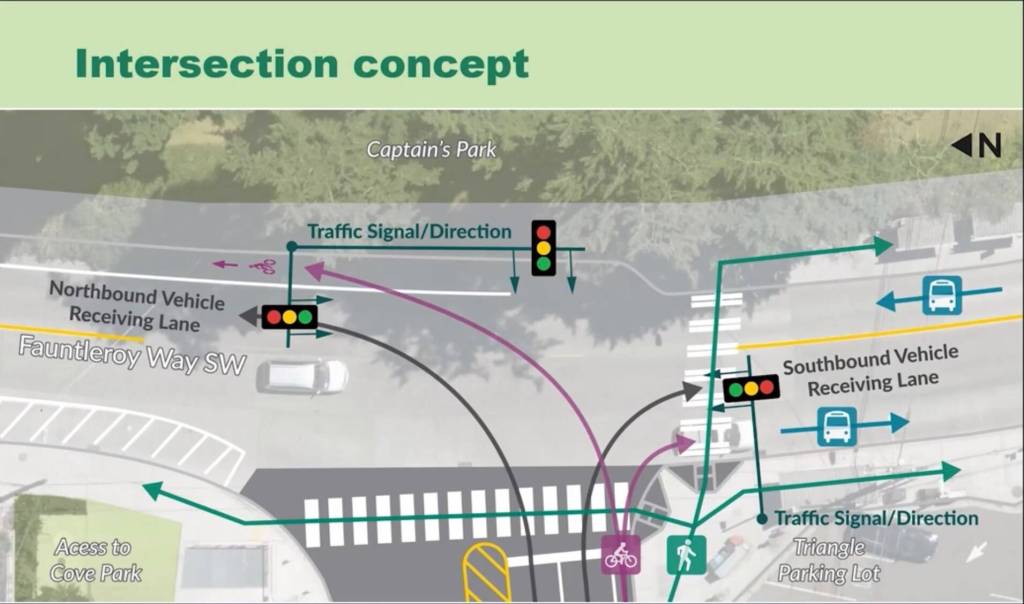
Jacobs Enginering recommended, and WSF later accepted, a signalization concept that still is being fleshed out, Rodero said. In general, here’s how it would work:
When ferries aren’t unloading, the light will be green for traffic on Fauntleroy Way, flashing red for the few vehicles coming down the dock.
When a ferry arrives, the signal will detect unloading vehicles and turn green while a red light stops traffic on Fauntleroy.
Some unloading vehicles won’t get through the intersection in that first green phase: Rodero said the Seattle Department of Transportation, the Fauntleroy community, and King County Metro, which runs buses on Fauntleroy, all told WSF that backups and delays would be unacceptable if through traffic on the street had to wait for a full boatload of cars to clear the intersection.
So the light for unloading ferry traffic will briefly turn red — “likely 20 to 30 seconds,” Jacobs Engineering wrote — to allow backups on Fauntleroy to clear before vehicles still on the dock get the green light again.
It’s similar to the way a signal for unloading traffic at their Mukilteo ferry terminal works, WSF officials say.
“The signal would be timed so that the unload traffic [on the dock] would not queue back to the ferry and delay the loading process,” Jacobs Engineering wrote.
No more left turn from right lane?
WSF estimates two-thirds of all vehicles unloading from ferries turn left at the intersection, toward the West Seattle Junction and downtown Seattle. For years, some drivers have made that turn from the right exit lane, merging in the middle of the intersection into the single northbound lane on Fauntleroy with vehicles making the turn from the left exit lane.
That creates a risk of sideswipe collisions, Jacobs Engineering said in its memo. “It’s a conflict point that is really problematic,” Mark Bandy of the consulting firm said in February 2024 at a briefing for a Community Advisory Group composed of representatives from all three affected communities.
Jacobs Engineering explored several scenarios that would have allowed left turns from the right exit lane to continue. It considered adding a second “receiving” lane on northbound Fauntleroy, taking out a chunk of the small, steep greenbelt known as Captain’s Park, but rejected that as too costly and environmentally disruptive.
It considered separate signal phases for each of the two exit lanes: Vehicles in the left lane could turn left while those in the right lane idle — then vehicles in the right lane could turn either direction while vehicles in the left lane wait. That would slow unloading and delay traffic on Fauntleroy too much, Jacobs Engineering concluded.
So the consultant recommended, and WSF accepted, a plan that limits left turns to vehicles in the left exit lane.
It not only improves safety, Rodero said, it’s what the law requires. The rules of the road, codified in statute, require that left turns be made from the left lane.
Some Vashon members of the 22-member WSF Community Advisory Group that have been briefed on the signal plan have pushed back on that.
The signal is badly needed, Scott Harvey said, but “we’re used to turning left from the right-hand lane … I don’t know how they’re going to enforce [a ban].”
He said that in 30 years on Vashon he’s never seen or heard of an accident resulting from the maneuver.
But Greg McMillan, a Kitsap County member of the advisory group, said at a meeting last year that he knows people who have been involved in road rage incidents that started at the intersection and continued all the way to the West Seattle Bridge. “I’ve driven it for 16 years,” he said. “It is a point of frustration.”
Harvey and Justin Hirsch, who also serves on the advisory group, fear that forcing all unloading vehicles that want to turn left at the intersection into the left exit lane will create backups on the dock, slow unloading, and perhaps delay ferry loading.
“It may be defeating part of the purpose of the project,” Harvey said.
Rodero and McIntosh, the terminal engineering director, say WSF’s analysis indicates that’s unlikely.
That’s partly because vehicles don’t unload from ferries in a steady stream, McIntosh said: There are gaps, which allow time and space for merging.
Hirsch said the planned prohibition on left turns from the right exit lane is unfortunate, but he understands WSF’s desire to comply with the law.
And he said he’s found that, at busy times, he can sometimes get to the West Seattle Bridge faster by turning right instead of left at the intersection and following Southwest Barton Street and 35th Avenue Southwest.
Susan Frith, another Vashon member of the advisory group, said limiting left turns at the intersection to vehicles in the left exit lane will probably be safer. “I don’t think it’s that difficult to get into the left lane,” she said. “The dock is pretty long.”
But she’s concerned WSF’s signalization plan does nothing for vehicles approaching the terminal from the south, on northbound Fauntleroy.
Sometimes they can turn left onto the dock. At busier times, however, terminal staff block the maneuver with traffic cones and signs on sandwich boards.
As part of the signal project, a “no left turn” sign will be displayed permanently at the intersection, Rodero said. That will eliminate backups on Fauntleroy behind vehicles that otherwise would turn left, she said, and prevent line-cutting.
Frith said she appreciates those concerns. But the other way to get to the dock from the south — going north past the terminal, then doing a U-turn to get into the holding lane on southbound Fauntleroy — is unsafe, she said, and banning left turns at all times will only make it worse.
Harvey agrees. “It can’t be all the time,” he said of the left-turn ban. “Maybe they can have the sign allow it at certain times.”
Next steps
The signal project’s design is now is 90 percent complete, Rodero said: WSF plans to share more details with the Community Advisory Group soon, hopefully at a meeting next month.
WSF also continues to consult with Seattle’s Department of Transportation, which will own the signal. So far the city and other government stakeholders have accepted the ferry agency’s plans, Rodero said.
Construction should take a couple months. Rodero said WSF plans to install the signal next year after wet weather ends, but before the peak summer season, to minimize disruption. Installation will affect traffic, she said, but WSF is committed to keeping at least one lane open at all times.
The agency’s job won’t end when the signal is activated, McIntosh said. WSF will monitor performance, then adjust the signal as needed to make the intersection and the dock operate as efficiently and safely as possible.
While planning proceeds, anticipation builds. “All will be right in the universe when there is a stoplight there,” a commenter on the West Seattle Blog wrote this summer.
Eric Pryne is a retired Seattle Times journalist whose many beats at the newspaper included transportation. To see a WSF graphic of the proposed traffic lights at the intersection of the Fauntleroy ferry dock and Fauntleroy Way SW, and how unloading ferry traffic would move through the intersection, read this story online at vashonbeachcomber.com.