VHS students work with island’s gray whale bones
Published 9:30 am Wednesday, May 21, 2025

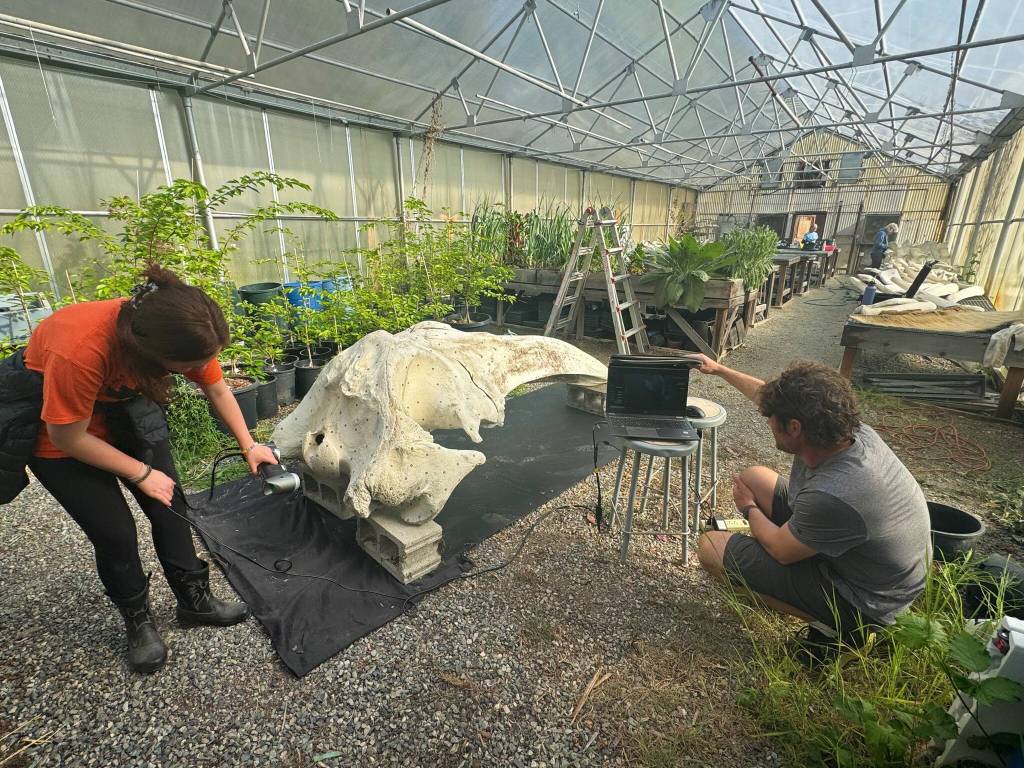
The greenhouse hums with excited chatter as each ninth grader picks up their assigned bone — some the size of a notebook, others too big to carry alone.
One by one, the students study, sketch and measure their individual bones. The 164 pieces once belonged to a gray whale that swam through Puget Sound. Now, they’re part of a scientific and educational project unfolding in the hands of teenagers.
In April 2024, a 39.5-foot male gray whale washed up near the high-tide line north of KVI Beach. With guidance from the Vashon Nature Center, including the Nature Center’s Education Director Maria Metler, who started the project, students at Vashon Island High School and community members are working to study and reconstruct its skeleton.
The project is designed to teach students about biology and anatomy up close. Their sketches and measurements will also contribute to a comprehensive scientific record being developed by the nature center, helping expand scientific knowledge about gray whale anatomy — an area where detailed studies remain rare.
By 2026, the bones the students are now illustrating and studying will be suspended in the atrium of Vashon Center for the Arts, alongside their biological illustrations.
When the gray whale washed up, he wasn’t close to homes, and the smell wasn’t bothersome, so the Vashon Nature Center saw a rare opportunity to leave the whale in place and study its natural decomposition.
Cameras were installed. Coyotes chewed the tail. Phosphorescent marine creatures darted in and out, feeding on the remains. And over time, the tide did most of the work, washing away much of the flesh and naturally cleaning the bones before the nature center removed the rest.
“That’s an opportunity that isn’t presented a lot,” said Bianca Perla, founder and science director of the nature center. “We were curious — how long does it take to degrade? Who eats it?”
By September, they had transported the skull — about 500 pounds — and the rest of the skeleton by boat to The Coop, a local music venue where the bones were stored and monitored by nature center staff in the fall and early winter.
The whale was affectionately named Singer, both for his species’ ability to vocalize and because he spent the summer at The Coop, where he was stored simply because there was room. Singer spent the summer outdoors, surrounded by the sounds of live music and dancing.
“We wanted to know how complete the skeleton was,” Perla said. “So we brought students to The Coop, gave them a whale skeleton printout, and said: ‘Put him together.’ They laid out the ribs, the vertebrae, even the vestigial pelvis bones — and realized just how close to complete Singer really is.”
One pelvis bone is missing. So are a handful of finger bones. Still, Singer is remarkably intact for a whale found in the wild.
Singer at school
By February, Singer entered the classroom.
All Vashon Island High School ninth graders — and a section of the marine science class — began sketching, weighing and cataloging the bones.
In March, they spent Thursdays with the skeleton, observing and drawing, learning the structure of a whale one bone at a time. The project will continue through June.
The Vashon Nature Center collaborates with the high school every year on science-based field learning projects, and when staff at the center proposed the whale project, teachers were immediately enthused. It was a perfect fit for their existing marine biology unit, which explores whale migration, ecosystems and the impact of climate change.
Each student is assigned their own bone. Annie Brulé, a scientific nature illustrator, leads the classroom in making some first-draft thumbnail drawings. She teaches the fundamentals of taking field notes, also known as nature journaling.
“Part of the measure for success today is whether you’re looking and spending time with your bone and, like, just taking the time to take it in,” Brulé said to the class on a recent Thursday. “Drawing is a great excuse to just slow down and take the time to look.”
The room buzzed with conversation — some students were eager to trade bones, others were visibly frustrated to still be in school, and many, by their own admission, weren’t exactly ocean enthusiasts. A few were even grossed out by the idea of touching a bone.
But a sentiment shared among students was how nice it felt to get outside of the classroom and learn in a way that felt more hands-on.
“I think it’s really cool what we’re doing,” said student Kiran Rajaratnam. “I feel like this actually prepares me for the real world. Biology should be setting up experiments — not just giving us information you already know.”
Others echoed the sentiment.
“I think it’s interesting to learn about the whales in our environment where we live,” said Landon Wettig. “I also like to see the size comparisons of everybody’s bones. It really gives you perspective of how big the whales are. … We’re doing more experimental stuff. It makes school worth going to.”
Student Bridget Simmons cradled a whale palm bone that she thought looked a little more like coral. “We’re contributing to science!” Simmons exclaimed.
And many were consumed with their small pencil sketches, excited to work so closely with the gigantic marine mammal.
“I’m not teaching them how to draw, I’m teaching them how to pay attention,” Brulé said. “Attention is such a precious resource, and drawing is an excuse to spend some time looking and observing and paying attention to the natural world and what’s right in front of you.”
The work is supported by Vashon Schools Foundation, Partners in Education, The Russell Family Foundation, and a NOAA BWET grant.
A whale of a mystery
The last comprehensive scientific paper on gray whale skeletal structure was published in 1914 by R.C. Andrews, titled “The California Gray Whale: Its History, Habits, External Anatomy, Osteology and Relationship,” said Perla, who added that little has been documented since then.
“There’s a big blank gap in science,” Brulé said. The students are “doing science actively. They’re contributing data to the scientific record.”
Despite being among the most visible whale species along the Pacific Coast, gray whales remain surprisingly understudied. Their nearshore migration route makes them one of the few large whales observable from land. Yet scientists still don’t know exactly how many bones a gray whale has, or how skeletal structures vary with age or gender, Perla said.
Gray whales migrate up to 12,000 miles annually, from breeding grounds in Baja California to feeding areas in the Bering and Chukchi seas. In recent years, between 2018 and 2023, scientists have documented unusual mortality events, with many whales washing up emaciated along the West Coast. Singer, too, showed signs of starvation.
These mortality events are raising alarms about changing ocean conditions, shrinking prey availability and potentially broader impacts of climate change. That makes projects like the one on Vashon Island especially valuable, Perla said.
Rebuilding Singer
This summer, the bones will be moved outside to cure in the sun. In the fall, work will begin on rebuilding the skeleton, with help from metal workers and possibly a few excited students. The full mount will involve drilling, bracketing and careful engineering, and island metal artist Ela Lamblin will direct the design and fabrication.
Engineers from island model bone manufacturer Sawbones are helping with 3D scanning and other engineering questions. They coached eighth grade student Sophie (Quinn) Williams in performing 3D scans, according to Perla, who said Sophie scanned all 164 bones for an independent student project — which took more than 75 hours.
An installation celebration is planned for Earth Day, April 22, 2026, when Singer will be suspended overhead at Vashon Center for the Arts, with students’ drawings alongside him.
Brulé hopes what stays with students isn’t just the anatomy lesson, but the way drawing deepens their connection to the natural world.
“It’s rare that it does not lead to feelings of curiosity, wonder or sometimes awe,” Brulé said. “It’s about forming connections between human beings and the natural world, using drawing as a bridge.”
Aspen Anderson is a contributing journalist to The Beachcomber. This article was first published in The Seattle Times.