As housing pressures grow, Vashon looks to ADUs
Published 1:30 am Tuesday, March 24, 2026
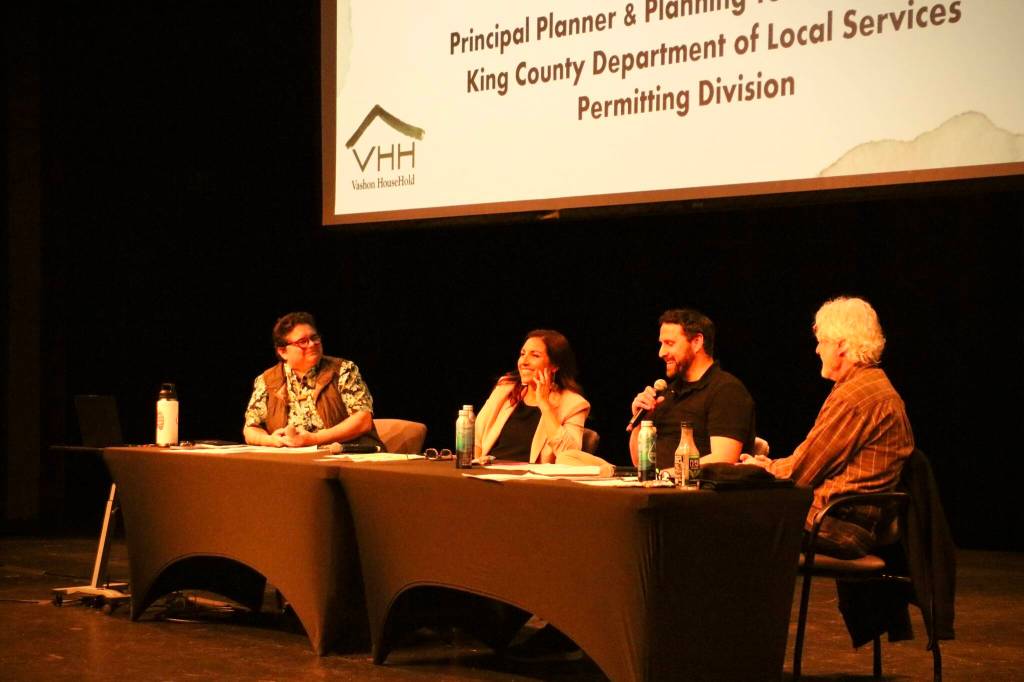
“How many of you know someone on Vashon who has had to leave because of our housing crisis?” Amy Drayer, executive director of Vashon HouseHold asked the crowd.
Nearly everyone raised a hand.
“The people who make the island work are being pushed out,” Drayer said.
That was the frame for Vashon HouseHold’s recent housing forum, where islanders, county officials and housing advocates gathered to talk through one of Vashon’s most pressing questions: who still gets to live here — and what can actually be done about it.
At the center of the conversation were accessory dwelling units, or ADUs — smaller secondary homes built on the same property as the main house. ADUs can either be attached to the home or a free-standing structure — known as a detached accessory dwelling unit (DADU).
They can take the form of backyard cottages, converted garages, or apartments over a main house, and are increasingly being seen on Vashon and across the country as a realistic way to add housing without dramatically changing the feel of a neighborhood.
“How many folks out there have considered putting an ADU or a DADU on your property?” Drayer asked.
Around the room, hands rose — about half the audience signaling that, on Vashon, the prospect of building small has become a very big conversation.
For islanders interested in building ADUs, some help may be on the way: King County Councilmember Teresa Mosqueda said at the March 18 forum that changes to the county’s comprehensive plan could make the process easier.
The comprehensive plan is the county’s long-range blueprint for growth and development over the next 20 years, and Mosqueda said amendments finalized at the end of 2024 could help address what she called the “paramount issue we need to tackle for Vashon” — the island’s housing crisis.
While Washington is already one of 10 states with strong laws supporting ADUs, Mosqueda says local changes could further reduce some of the cost and delay that still keep many homeowners from moving forward.
“We should be expediting the process so that those property owners can move quickly and save costs,” Mosqueda said.
Mosqueda said King County is working on a set of pre-approved ADU designs, which could save homeowners the cost and hassle of starting from scratch. The idea came in response to a request from the Vashon-Maury Community Council Affordable Housing Committee.
Mosqueda compared the idea to flipping through a Sears catalog.
“You can kind of thumb through and say, ‘Okay, yeah, this one would fit great on my property,’” she said. “And then you hopefully can expedite the process of getting it pre-approved.”
She also said the Department of Natural Resources will work on policy to allow greywater systems — which reuse water from sinks, showers and laundry — as well as low-water composting toilets in ADUs.
That matters on Vashon, which relies on a sole-source aquifer system, meaning the island depends almost entirely on groundwater replenished by rain for drinking water.
By cutting down on the amount of fresh water used in ADUs, Mosqueda said, the county is trying to strike a balance between protecting the island’s limited water supply and creating more housing.
Mosqueda said the policy changes were moving forward because islanders pushed for them. “Tonight was our opportunity to say it’s happening — you asked for it, and they are moving it forward,” Mosqueda said.
Still, ADUs are not an emergency fix.
Drayer reminded the audience that building an ADU still takes time, something that those in desperate need of housing don’t have. According to King County Public Health panelist Derek Pell, the permitting process alone usually takes around three to six months.
That makes ADUs more of a long-term housing strategy than an immediate answer for people already struggling to stay on the island.
So Vashon HouseHold is also looking at shorter-term solutions.
Drayer said the organization is developing a proposal for King County that could allow limited, regulated occupancy of temporary dwellings — including RVs, tiny houses on wheels, park model trailer homes and other movable units — on private property through a three-year pilot program.
Under current King County code, those units generally cannot legally be occupied on private property, and strict water and wastewater rules make even temporary living arrangements noncompliant.
That leaves people already living in RVs in a precarious position — sheltered, but unofficially, and vulnerable to eviction.
In an email after the forum, Drayer said the proposal is intended to create a lawful pathway for property owners and nonprofits who are ready to host people safely but currently lack a legal way to do so. The draft framework would require sanitation plans for water, wastewater and solid waste, along with fire safety measures and spacing standards.
It would rely on annual self-certification, optional third-party inspections and complaint-based enforcement with time for remediation — an effort, Drayer said, to create oversight while minimizing burden.
The proposal would also prioritize nonprofit, land trust and mission-driven property owners, with rent caps tied to area median income. It calls for approved greywater, pumping and composting systems, while prohibiting uncontained waste disposal or generator use.
If adopted, the pilot would run for three years, with the county able to decide later whether to expand it based on the results.
Drayer said Vashon HouseHold staff and board developed the proposal and hope to send a policy packet to Mosqueda’s office for consideration. They hope the plan could come online within the next year if it gains enough county support.
The proposal is part of Vashon HouseHold’s broader push for both permanent and transitional housing, as the group tries to respond to what it sees as both a social and economic crisis.
Drayer called it the “vanishing island effect” — the quiet way rising costs, increased demand and limited housing options are reshaping who gets to call Vashon home.
Hosted at the Vashon Center for the Arts, the forum brought together county representatives from public policy, public health and permitting, with panelists stressing that no one office can solve the housing crisis alone.
Throughout the evening, Mosqueda repeatedly pointed to islanders as the force behind much of the county’s movement on ADUs, praising Vashon for pushing officials to think more creatively about housing.
“You created the vision of what it could look like to do density done right for a very unique island,” Mosqueda said. “We cannot restrain ourselves when it comes to policy solutions.”
On Vashon, the housing crisis is no longer an abstract policy problem. For many in the room, it already has a face — a friend, a coworker, a family member, someone who had to leave.