Vashon turns out in force for Jayapal town hall
Published 1:30 am Thursday, April 16, 2026
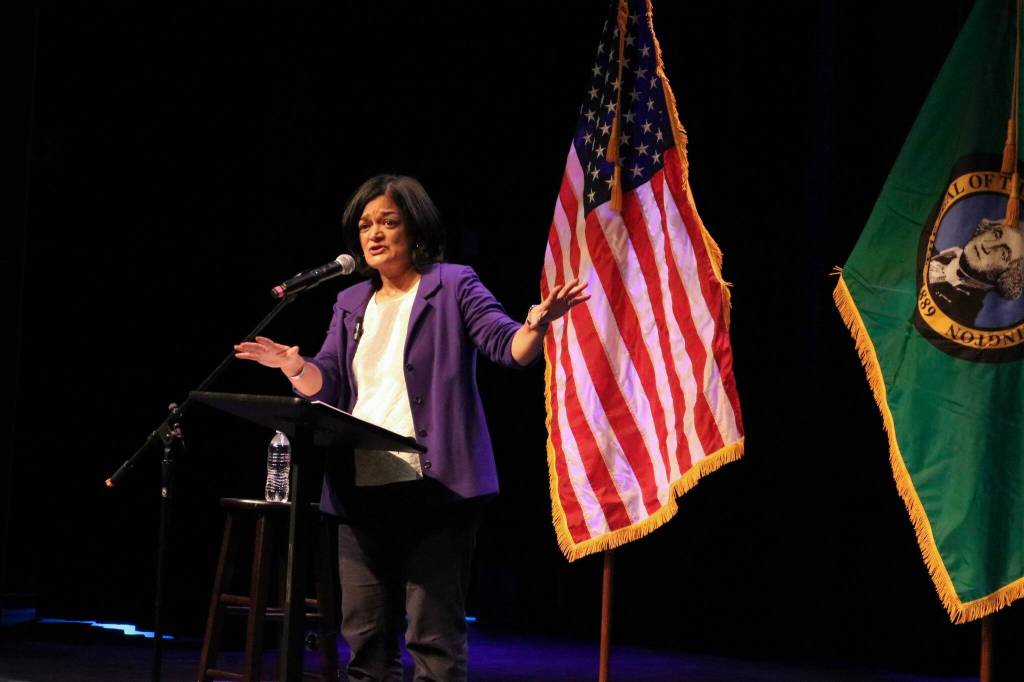
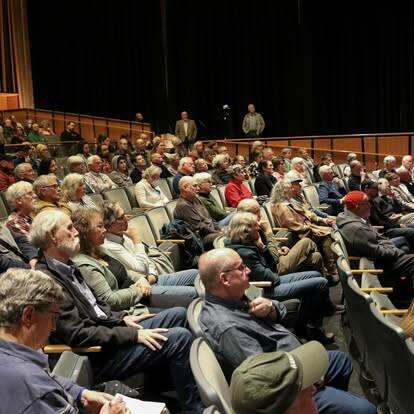



Washington’s 7th District Congresswoman Pramila Jayapal, whose district includes Vashon Island, arrived at Vashon Center for the Arts on Thursday evening to a standing ovation, greeted by a packed house of islanders eager to hear from their representative at her 130th town hall.
Jayapal had spent the full day on Vashon before the evening event — visiting the Vashon Food Bank, meeting with local business owners through the chamber of commerce, touring a shoreline restoration project and celebrating federal funding she helped secure for the Thunderbird Treatment Center and the Mukai cold processing fruit barrel facility. All told, she said she has brought nearly $7 million in federal funding to the island.
But the mood of the evening quickly turned to weightier matters.
“I’ll start with Iran, because I know that’s on everybody’s mind,” Jayapal said, and the room went quiet.
She called the ongoing military conflict an unauthorized war of choice — one she believes was launched in part to distract from domestic turmoil, including rising consumer prices, the Epstein files, and what she described as the lawless conduct of immigration enforcement agencies.
“We never held him accountable for January 6,” she said, drawing murmurs of agreement from the audience.
Jayapal argued that because the Senate failed to convict President Donald Trump after the House impeached him for inciting the January 6, 2021 attack on the U.S. Capitol — in which a mob of his supporters stormed the building in an attempt to stop the certification of the 2020 election — there has been a sense ever since that he can do anything without consequence.
“He is the king and nobody’s going to hold him accountable,” she said.
That failure to convict, she argued, has had a cascading effect, emboldening the administration to wage unauthorized wars, deploy immigration enforcement she described as lawless and ignore the constitutional boundaries that are supposed to constrain executive power.
She said the war has already killed at least 13 U.S. service members and thousands of Lebanese and Iranian civilians, and has displaced millions across the Middle East — all without a formal congressional authorization. “There has been no hearing on any of this in Congress,” she said. “Whatever you read in the paper is what I get.”
Jayapal estimated the war is costing between $1 and $2 billion per day, with the administration requesting an additional $200 billion for the conflict and $1.5 trillion overall for the Department of Defense — while simultaneously cutting food assistance, healthcare subsidies and low-income energy programs, she said.
She said she has already voted for impeachment articles twice and filed a lawsuit against the president related to January 6, which recently cleared a significant legal hurdle when a federal judge rejected the administration’s argument that Trump had immunity for his actions that day.
In one of the evening’s most resonant moments, Jayapal raised her hand and asked how many people in the room used to believe the United States had a reliable system of checks and balances. Nearly every hand went up.
“Our founders were smart, but they weren’t all knowing,” she said. She walked through what she sees as the failure of each branch to serve as a meaningful check: Republicans in Congress unwilling to break with the president, a Supreme Court she described as increasingly corrupt and relying on shadow docket rulings to avoid full hearings and the executive branch concentrating power without consequence.
“It is the people,” she said, “that is actually the only way authoritarians have been taken down.”
She promoted her Resistance Lab program — a training initiative she said has now reached 32,000 people across all 50 states and eight countries — as one of her most significant accomplishments. “It is about returning the power to the people.”
Jayapal described a five-day trip she took to Cuba the week before the town hall — her second visit to the island and the first congressional visit in two years.
She called the U.S. embargo the longest trade embargo in modern history, and said Trump’s recent fuel blockade — cutting off oil imports to Cuba for months — had compounded an already dire situation. She asked the audience to imagine life without any oil: no refrigeration, no cars, no ability to get children to school, no functioning medical equipment.
The most affecting moment of her trip, she said, came during a visit to a neonatal intensive care unit. She described seeing premature babies in incubators, many of which had stopped working because power surges from emergency generators had blown out their internal boards — and replacement parts were unavailable due to sanctions.
Her own daughter was born at 26 and a half weeks, she said. “I know the medications that are required.”
She introduced legislation with the ranking member of the Foreign Affairs Committee to prohibit the use of federal funds for any military action against Cuba. “We are not going to take Cuba,” she said flatly.
The loudest applause of the night came when Jayapal declared that Democrats had refused to give another dollar to ICE and CBP without meaningful reform attached. She said she had witnessed children as young as five sitting alone in immigration court, clutching stuffed animals, being told by judges they had the right to question attorneys and present witnesses.
“This is what we call due process,” she said.
She said Democrats had successfully passed a bill in the Senate — unanimously, by voice vote — to fund other components of the Department of Homeland Security while withholding funds from ICE and CBP, only to have Speaker Mike Johnson refuse to bring it to the House floor.
As ranking member on the immigration subcommittee, she said she hopes to chair the committee when Democrats retake the House.
Jayapal closed her opening remarks by invoking Benjamin Franklin’s famous response when asked what kind of government the constitutional convention had produced: “A republic, if you can keep it.”
The Q&A that followed ranged broadly. One islander, Seth Zuckerman, asked whether any Republican colleagues were close to breaking with the president on foreign policy or immigration.
Jayapal was candid: not in any significant way, though she noted some bipartisan work on a bill to ban stock trading by members of Congress, and said the upcoming Iran War Powers vote could produce an unexpected break.
On Gaza and Palestine, she said she is a co-lead on the Block the Bombs bill, has called the situation in Gaza a genocide and was unable to secure an independent investigation into the killing of a constituent by Israeli forces in the West Bank — even under the Biden administration.
When asked about the possibility of a general strike, Jayapal was supportive but measured, noting that the U.S. has a far lower union participation rate than countries where general strikes have succeeded. She pointed to the Tesla boycotts as a promising model and said May 1 could serve as a test case for broader economic resistance.
On artificial intelligence, she called for a moratorium on new data centers until proper regulation is in place, warned that AI companies are pouring money into congressional races to prevent oversight, and said she is working on legislation targeting algorithmic discrimination and the broader harms caused by unregulated AI models.
The room responded with sustained applause.
And for at least one evening on Vashon, the town hall felt less like a political event than a community reckoning — with one of Congress’s most outspoken progressives, and with the state of the country itself.