Desert island bookworm: The massage maven
Published 3:00 pm Tuesday, June 16, 2026
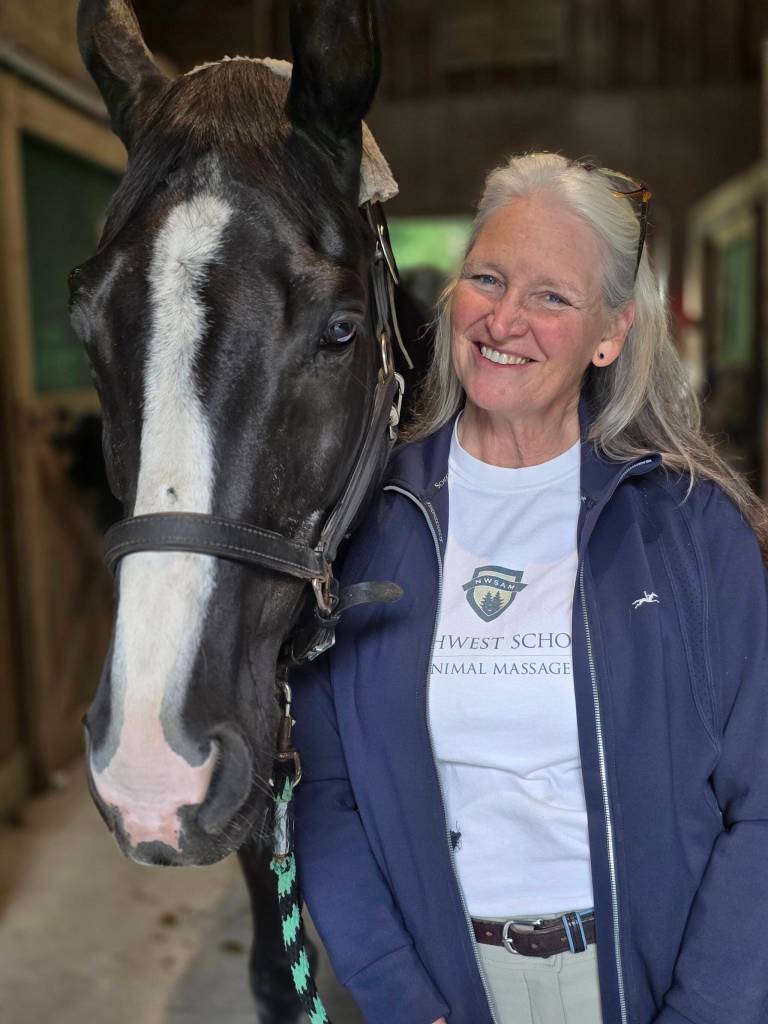
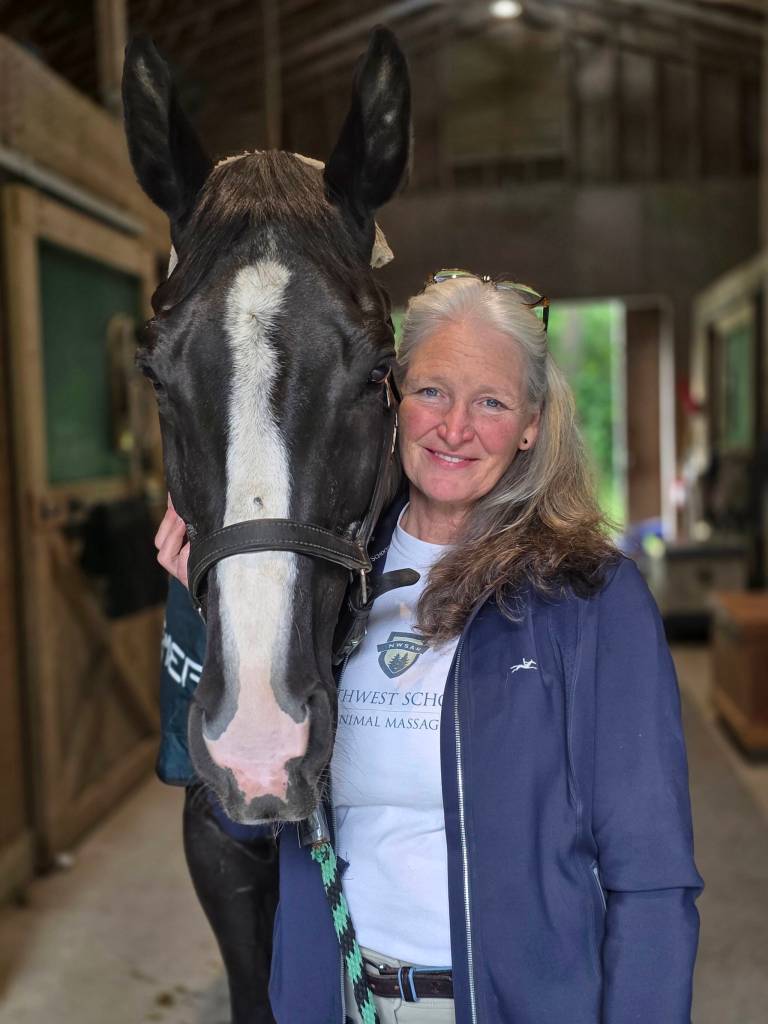


Head north on Vashon Highway, then hang a right on 156th, and you’ll find yourself passing by Paxhia Farm, home of the Northwest School of Animal Massage. Founded a quarter-century ago by Lola Michelin, the school teaches equine and canine massage at all levels, from beginner to licensed professional.
The school’s courses involve sophisticated techniques, and the instructors teach detailed knowledge of the anatomy, behavior and pathology of the animals. As Michelin explains it, “It’s the difference between a professional massage and your partner giving you a back rub. They’re both great, but one’s worth paying for.”
Born in Detroit — one of five sisters — Michelin originally planned to enter veterinary school. Indeed, she was working as a vet tech when she first discovered animal massage, with horses. She learned her craft working at racetracks in Detroit and Florida. At that time, there were no massage schools offering formal training. She opened hers in Redmond in 2001, one of the first in the country.
Michelin’s experience is extensive: She’s taught in many parts of the U.S., including in correctional facilities, as well as in countries ranging from Mexico and Canada to New Zealand and Japan. She’s also worked at zoos, where she’s applied massage techniques to a wide variety of exotic species — or, as she puts it, “animals from A to Z, from aardvarks to zebras.” For the record, her favorite is giraffes — “they’re anatomically unique.”
Although her work began with horses, she soon branched out to include dogs. “People who have horses have dogs,” she explains. “It was a natural progression.”
The school’s most basic canine offering is an introductory course that allows dog owners to acquire skills that can be used on their pets immediately. Michelin notes that when people see the relief that their pets obtain from massage, they’re convinced.
This is particularly the case with older dogs who have joint problems or other health issues. As those of us of a certain age can appreciate — beset as we are with arthritis or sore muscles — massage can really help alleviate pain, stiffness and circulation. It’s no different for animals.
In 2011, she and her husband, David, bought the 12-acre Paxhia Farm and moved themselves and the school to Vashon, where they’ve thrived.
“I love Vashon because of its community,” she says. “And also because it’s one of the county’s few designated equestrian communities that protects our trails and parks for those who live in service to the horse.” She adds that this benefit extends to others because “we ‘horsefolk’ fiercely steward the land and the unique nature we all enjoy here.”
So, if Lola Michelin found herself stranded on a desert island, which books would she want with her?
First, C.S. Lewis’ “The Chronicles of Narnia,” which her sister gave to her when she was 11 or 12. “Who wouldn’t want to walk through a door and enter a magical realm?” Michelin notes. She also likes the minor aspect that the horses are named, adding, “I’ve always wanted a horse named Philip.”
Next, and also a gift from her family when she was young, the James Herriot books — “for obvious reasons,” she says. “They contain endless animal stories, each with their own moral or other lesson that you don’t always realize until after you’ve read them. The books made me want to work with animals.”
Her third book is “The Power of One,” by Bryce Courtenay, an inspiring novel about a young white boy named Peekay in apartheid-era South Africa, who overcomes humiliation and prejudice through friendships with a Black nanny and a German boxer.
Returning to a horse theme, Michelin’s next choice is “Traveler,” by Richard Adams, who also wrote “Watership Down.” It’s a unique recounting of the American Civil War by Robert E. Lee’s horse, who tells the story to a barn cat at the University of Virginia, where Lee became president after the war and where Traveler was retired.
“It’s a wonderful story,” Michelin says. “If you know horses, it feels like you’re really talking to a horse.”
One quotation from the book she particularly loves concerns the fact that these animals are frequently taken from one home to another. “That’s the life of a horse,” says Traveler, “forever saying goodbye.”
The words resonate because, since buying Paxhia Farm, Michelin has taken on a number of retired horses and donkeys. One is blind, and some have other health issues. “In other words,” she comments, “now I have a farm where they never have to say goodbye.”
Other choices: the poetry of Pablo Neruda and anything by Paul Theroux. “If you don’t get to travel,” Michelin says, “you can at least travel by proxy.”
Finally, she’d take sheet music for her guitar: “Probably the greatest hits of the 1950s, ’60s and ’70s.”
“I love books,” she says. “If a book resonates with you, it’s probably going to provide you with advice or a roadmap — or a warning.”
She’s writing her own book now, to be called “The White Witch Chronicles.” This is not merely a nod to the Narnia series, but a name that is personal to her. “Horse trainers long ago started calling me The White Witch, because I can often see things in horses before others do.”
As is the case with James Herriot, Michelin’s book “will chronicle the stories of the animals I’ve worked with that have taught me my craft.” She adds that “these are their stories, not mine — I’m just the common thread, the witness.”
The book is developing slowly, a reflection of a busy life that does not offer much free time. “So,” she says with a laugh, “maybe I need to go to a desert island to finish it.”
More information about the Northwest School of Animal Massage and its courses can be found at the school’s website, nwsam.com.
Phil Clapham is a retired whale biologist and writer who lives on Maury Island. His novel, “Jack,” a romantic comedy narrated by a dog who lives with a dominatrix, is available on Amazon, under his nom-de-plume, Phillip Boleyn.