A mother and daughter bring “Earthing” to life
Published 1:30 am Tuesday, June 9, 2026
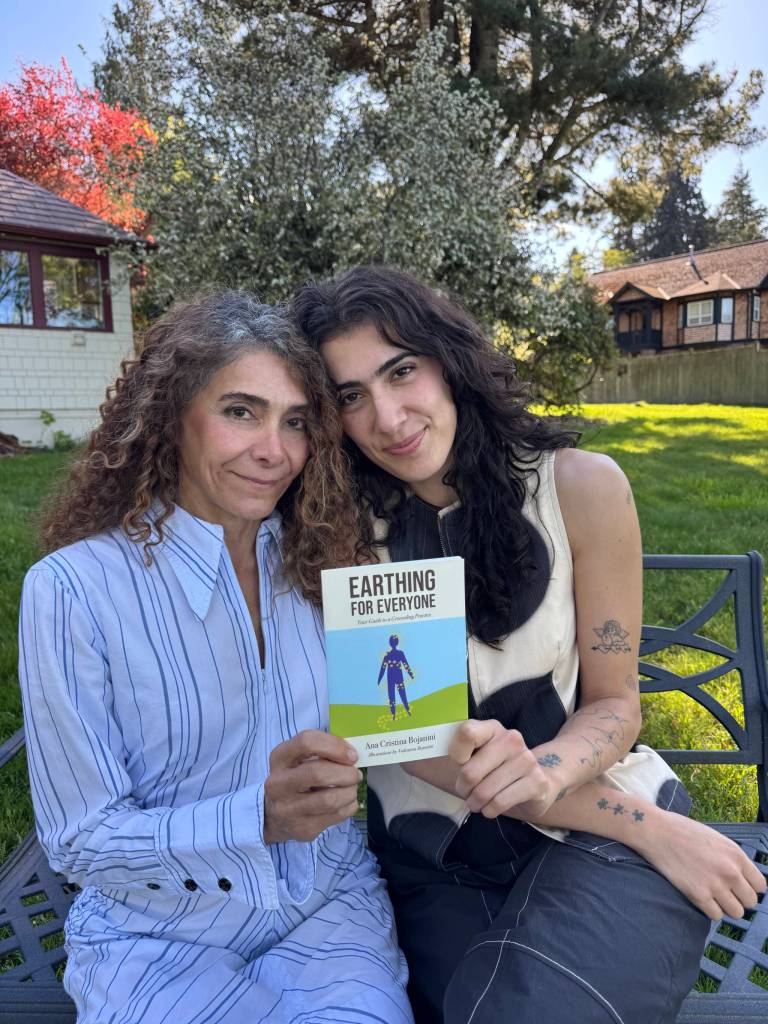
On the cover of “Earthing for Everyone,” a simple human figure stands on a patch of green earth. The body is filled with small yellow stars. They move upward — from the feet, through the torso, into the head — like something is rising, or being switched on.
For Ana Cristina Bojanini, the practice behind the book has been part of her life for decades. For her daughter, Valentina Bojanini, the challenge was turning something deeply personal — something her mother felt more than explained — into images a stranger could understand.
That made “Earthing for Everyone” more than a guide to grounding. It became a daughter’s translation of the way her mother sees the world.
Ana Cristina, who is from Colombia and lived in places like Los Angeles and Houston before making Vashon home in 2002, has practiced what’s commonly called “earthing,” or “grounding,” for years — standing barefoot on the earth as a way, she says, to reconnect with the body and release stress.
At its simplest, the practice is physical. Standing barefoot. Sitting. Lying down.
But the version she developed over time is more structured — a kind of guided progression through the body.
It begins at the feet and moves upward. The reader is asked to imagine energy traveling through the body, to thank each part for what it does, and to release emotions — fear, stress, grief — tied to different systems so the Earth can “recycle” them.
By the end, the practice moves beyond simply standing on the ground. It invites the reader to imagine the body as “a beam of light,” connected to both the Earth and the Universe.
Which is why, when Ana Cristina decided to write it down, she knew it couldn’t just be text.
“She’s the expert,” Valentina said. “And I could be the audience.”
Valentina, who graduated from Vashon Island High School in 2013 and now lives in Oakland, had grown up around her mother’s interest in meditation and holistic practices — but translating that experience into something others could follow was different.
Ana Cristina understood the practice from the inside. Valentina could step back and ask the kinds of questions a new reader might ask — what makes sense, what doesn’t, and what needs to be simplified.
The two began developing the book together in early 2025. The first versions didn’t work.
“It was too much,” she said. “It didn’t translate.”
Valentina initially tried illustrating the practice literally — organs, systems, specific parts of the body.
So they stepped back and asked a different question: What does this feel like? The answer became the visual language of the book.
A simplified human figure — no gender, no defining traits — so anyone can see themselves in it.
And the stars. Small, bright points that move through the body, representing energy being received, released and returned.
Early in the book, they appear scattered across the figure’s legs and torso. By the end, the entire body is filled with them.
The images don’t explain the practice as much as they accompany it.
They give readers something to hold onto while the words ask them to imagine something harder to define.
“We wanted it to feel accessible,” Valentina said.
The book reads less like instruction and serves more as a quiet companion.
It moves step by step through the body — feet, legs, abdomen, chest, arms — following a steady rhythm of noticing, releasing and moving forward. It’s repetitive, intentionally so, building toward something broader — not just letting things go, but choosing what to take in.
The collaboration changed how they saw each other, too. “It’s really special to see your parent as a full person,” Valentina said.
For Ana Cristina, it meant opening that world up — and trusting someone else to shape how it would be understood.
“Valentina always pushes me to be more brave,” she said.
Working through the book together helped quiet moments of doubt. Valentina asked the kinds of questions a reader might ask, and that tension — between experience and translation — is what ultimately shaped the book, which is now available at Vashon Bookshop, through BookShop.org and on Amazon.
Ana Cristina made “Earthing for Everyone” pocket-sized for a purpose. It’s designed to be carried — into a yard, onto the beach, somewhere quiet — and followed along. And maybe that’s where the collaboration lands most clearly. A mother who spent decades developing something internal. A daughter who found a way to make it visible.
Together, they didn’t just write a book.
They translated a way of seeing — one lived, one interpreted — and made it something others can step into, if they choose.
Eddie Macsalka is a contributing reporter to The Beachcomber.