Amid signs of hope, clear danger from COVID still exists
Published 1:30 am Wednesday, February 2, 2022


Editor’s note: Read COVID updates by VashonBePrepared in Spanish and English at tinyurl.com/yan39zeh.
Experts have been telling us that we might be seeing the beginning of the end of the current spike of COVID.
New case numbers have dropped somewhat according to many sources, including the public health agencies for King and Pierce counties. That’s hopeful and potentially even wonderful news, but we all need to recognize that danger signals are still flashing.
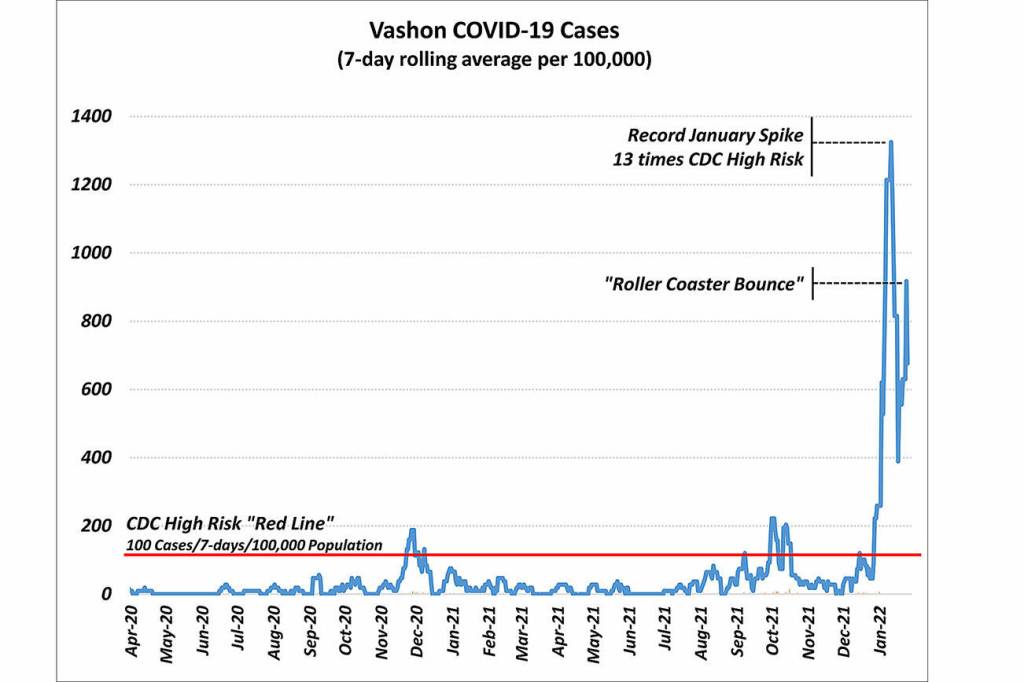
• After a historic spike in cases following the December holidays, there was a sharp drop in cases over the last several weeks on Vashon. However, it’s a volatile situation and the latest numbers have again increased. The trajectory of the pandemic continues to defy prediction. It’s not over.
• A new COVID-related death has been recorded for Vashon Island, bringing the total to five deaths tabulated since the pandemic began according to the online data dashboard operated by Public Health — Seattle & King County (PHSKC). There have been three new hospitalizations since the first of the year, bringing the total to 11 hospitalizations since the pandemic began. Names and other details on patients are private and not released by Public Health.
• Even with the sharp fall in cases, the lowest recent case rate was still significantly above the previous record spike. Vashon remains solidly above the highest CDC risk category by a big margin — well over the red line of 100 cases per 100,000 people per week.
• Scientists have started tracking a new subvariant of Omicron. It’s BA.2, the third variant of Omicron. Just a few cases have shown up in Washington state, and the effects of the new Omicron variant are not yet clear. The new variant reminds us yet again that viruses mutate, and that we continue to ride the pandemic roller coaster.
• Serious illness has soared, even while case numbers are dropping. Hospitalization rates are so high that the Washington State Hospital Association took out a full-page ad in the Seattle Times headlined: “We Need Your Help.” The ad pointed out that hospitalizations increased 700% in the last month. Hospitals report that most surgeries have been canceled, endangering the health and even the lives of non-COVID patients.
“The hospital association gave good advice about how everyone can help,” said Rick Wallace, manager of the Vashon Emergency Operations Center. “Get vaccinated and get a booster shot for the best protection against Omicron. Upgrade your mask to an N95. Save the emergency room for true emergencies. Go to your routine healthcare visits to avoid needing advanced care during this pandemic. And, of course, follow all the standard routines of masking, hand washing, and social distancing.”
Get Smart About These COVID Myths
False: I can’t have COVID. I don’t have symptoms and I don’t feel sick.
The virus that causes COVID-19 can be spread to others before symptoms appear and even by infected people who never show symptoms. People without symptoms may let their guard down, and that’s one major way the virus spreads so quickly and easily, even causing super-spreader events. It’s a fact: you are infectious two days before symptoms show or two days before a positive test.
False: It’s okay for us to get together because I’ve been tested.
You can spread the virus both before and after getting tested. You could have been exposed the day after your test, for example. That’s why some people have been having testing parties for guests using rapid test kits immediately before a gathering with people outside your household. If your rapid test is positive or you have symptoms, stay home and isolate yourself from others in your household until you can get a PCR test. Find updated CDC guidance at tinyurl.com/yckbhz
False: I’m vaccinated so COVID can’t get me.
Vaccination protects against severe illness and death, but even fully vaccinated people can get COVID. When they get infected, vaccinated people spread COVID just as well as the unvaccinated. Even before all the variants, the vaccines didn’t prevent all COVID cases. Fortunately, vaccines have been very effective at reducing hospitalizations and deaths. A recent CDC study shows that the third dose booster does a good job — as much as 90% effective at keeping you out of the hospital if you get the Omicron variant. If you stop at two shots, protection against serious illness falls to 38% after six months.
False: Omicron is no worse than a cold or flu.
Although Omicron can be less severe than earlier variants of COVID, it’s still dangerous and can be much worse than a cold or flu. There’s nothing mild about going to the hospital or dying. Computer modeling suggests there will be 50,000 to 300,000 more deaths in the United States by mid-March due to Omicron — far more than deaths from seasonal flu.
False: We should just get COVID now to achieve herd immunity.
Getting COVID on purpose could endanger not only you but your family and others you care about. What if you don’t get a mild case? What if you pass the virus to a senior, a child too young to be vaccinated, or someone whose immunity has been compromised? What if infection with one variant doesn’t protect you from another? Hospitals are jammed and health care workers are exhausted and need your support, so stay safe. Don’t take the risk.
False: We’re tested and vaccinated so we’re safe to travel.
There’s more to safe travel during a pandemic than getting tested and vaccinated. And some types of travel are safer than others. A camping getaway to a nearby state or national park may pose little risk, while a plane trip with airport layovers or a party at the destination could be quite risky. While planes themselves are considered to be fairly safe, what you do on the ground during the trip may expose you to illness, and Omicron is much more infectious than Delta. If you travel, be vaccinated and boosted; wear a high-quality mask, such as an N95; wash hands often; socially distance, and get rapid tests to help prevent exposing others to illness.
False: Young kids are not at risk from COVID.
Babies and children under 5 are not eligible for vaccination yet. Although most children at that age develop only mild symptoms, there have been many cases of serious illness in the 5-and-under age group, especially kids with health problems such as asthma or who are receiving certain types of medical treatment. There’s also a risk of multisystem inflammatory syndrome (MIS) in children.
Reminder: Get Your Online Proof of Vaccination
WAverify provides Washington state residents easy online proof of their COVID vaccine records, including vaccine doses and dates. By going to waverify.doh.wa.gov on your phone or computer and entering basic information, you will receive a digital record of your COVID-19 vaccinations, including a QR code that you can save to your phone to have access on the go. To keep a complete digital record of all of your vaccinations (including, but not just COVID), register with Washington State’s Immunization Information system at wa.myir.net.
Opioid Overdose Antidote Now Available for Home
Accidental deaths from opioids, including fentanyl, have increased dramatically during the pandemic.
For King County, the number of deaths has gone from 282 in 2019, to 357 in 2020, to 496 in 2021. Opioid overdose deaths do happen on Vashon once or twice per year on average. A new lifesaving program is making an overdose antidote available at home, ready for emergency use whenever it’s needed. Washington state, King County, and the Polyclinic in Seattle are making naloxone (Narcan) available to all residents. King County residents can get the easy-to-use nasal spray antidote sent to their homes free of charge by signing up with the Polyclinic pharmacy at kelley-ross/polyclinic/naloxone. For more information about fentanyl and its presence in King County, see lacedandlethal.com.
Latest Vashon COVID Statistics
Source: Public Health — Seattle & King County (PHSKC) and Vashon EOC. These statistics are considered to be understated as they do not include all recent Vashon cases, due to the lag in posting of data to the PHSKC COVID-19 dashboard, especially given the current Omicron variant spike. They are also missing some of the home testing data because there is no comprehensive system to collect it.
684 = Total COVID cases for Vashon residents since the pandemic began.
74 = New cases reported since the last weekly report (133 new cases in 14 days).
11 = Patients hospitalized since the pandemic began.
5 = Deaths since the pandemic began.
>95% = percentage of Vashon residents age 12+ who have been fully vaccinated, compared to 87.0% of the total King County 12+ population.
69.5% = percentage of Vashon residents age 12+ who have their booster doses.
63.2% = percentage of Vashon residents age 5 to 11 with first doses of vaccine (57.6% have completed the series).
For King County, the PHSKC dashboard for the last 30 days says unvaccinated people are three times more likely to get COVID, 12 times more likely to be hospitalized for COVID and 17 times more likely to die of COVID.
For more resources, visit VashonBePrepared.org. Sign up at tinyurl.com/4smk364m to receive updates from the group, and/or visit VashonBePrepared on Facebook.