Fire district levy lift will be on August ballot
Published 1:30 am Wednesday, April 26, 2023


Vashon Island Fire & Rescue (VIFR) commissioners voted earlier this month to place a measure on the August 1 ballot that would increase property taxes paid to the district next year by about one-third.
The levy “lid lift,” if approved by voters, would authorize VIFR to increase its levy rate from about $1.13 per $1,000 of assessed value this year to $1.50 — the maximum allowed by state law — in 2024.
For the following five years, through 2030, the district could increase its property tax collections by another 6 percent each year.
Vashon voters approved a similar six-year measure in 2017. It expires after this year; if voters don’t give their blessing to another lift this year, by state law VIFR’s property-tax revenue increases would be limited to 1 percent in 2024 and each succeeding year.
The lift needs “yes” votes from a simple majority of those voting to pass.
Here’s what it would mean in dollars and cents:
This year the owner of a $922,000 home — now the median on Vashon, according to the King County Assessor’s Office — is paying $1,040 in property taxes to the fire district.
If the lid lift passes, that would increase to $1,383 in 2024, a 33 percent increase.
The increase could be more or less if assessed values rise or fall.
The district’s property tax revenues in 2023 are about $5.67 million, according to the assessor’s office. If the lift passes, district revenues also would increase about one-third, to more than $7.5 million — again assuming property values stay the same.
VIFR’s property-tax revenues have risen significantly since the passage of the first lid lift in 2017. It increased the rate per $1,000 of assessed value from less than 94 cents to $1.50.
That, coupled with a big increase in property values, bumped the district’s tax revenues up by more than 80 percent, from less than $2.4 million in 2017 to about $4.4 million in 2018.
The 6-percent increases authorized for each of the following five years have pushed VIFR tax collections up to the current $5.67 million.
But the levy rate per $1,000 has dropped because, as a rule, rates fall when property values go up. And, for most years, percentage increases in assessed values on Vashon have outpaced the 6 percent limit on annual revenue increases.
District lays out case for voting yes
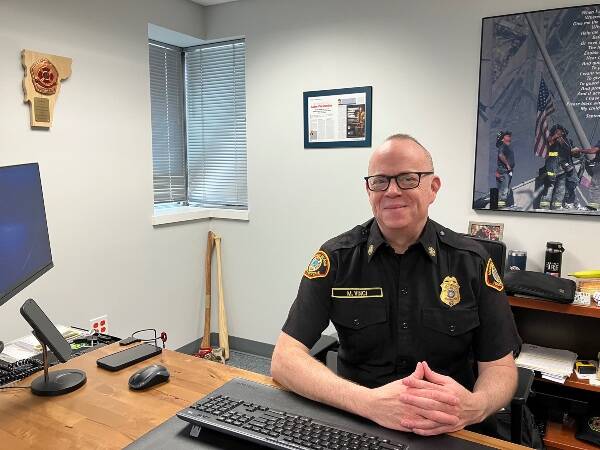
Funding the levy, according to Fire Chief Matt Vinci, is critical to adequately meet the current and future needs of the island for timely and effective emergency response.
In an interview on Monday, Vinci acknowledged the price tag of the levy lift but said it would be worth the cost to islanders in terms of the district’s ability to better protect life and property.
“I don’t want to minimize the tax burden,” Vinci said. “But it’s reinvesting in the safety of our island and putting an effective deployment model in place.”
Passage of the levy, he said, would enable VIFR to enact the district’s arching new strategic plan, also passed earlier this year after a months-long process that included meetings with community members and stakeholders, as well as community survey that drew responses from more than 300 islanders.
The strategic plan, viewable here, calls for the district to address shortcomings including its rapidly aging fleet, unstaffed fire stations with poor proximity to some parts of the island, and currently insufficient staffing levels which regularly threaten its capability to respond to simultaneous calls.
District staffing, which has fluctuated since the last levy to add and eventually eliminate a part-time paid firefighter program, now stands as 13 full-time paid firefighter/EMTs — not nearly enough to adequately address Vashon’s needs, Vinci said.
“Since January 1, we’ve had over 80 instances where we’ve had simultaneous calls – we’ve had an aid car at an incident or transporting, and a second call comes in,” Vinci said. “In one 48-hour period, last month, we had 21 calls — and our primary aid car was off island for 16 and a half hours.”
Mutual aid from other fire departments and districts, Vinci has regularly pointed out, is not possible for Vashon.
“We have to build resources to be self-sufficient — the ability to bring additional resources to the island is an hour away,” he said.
Seven more recently hired firefighter/EMTs are set to join the district when they complete academy training in June. Due to two upcoming vacancies, the staff, after June 1, will be at 18 career firefighter/EMTs.
Passage of the levy, Vinci said, would enable the district to further increase staffing to a minimum of six full-time firefighter/EMTs per shift.
This, he said, would guarantee two firefighter/EMTs, on an engine, and two firefighter/EMTs, on an aid car, at the district’s Bank Road station — plus additionally have two firefighter/EMTs at the currently unstaffed Burton Station.
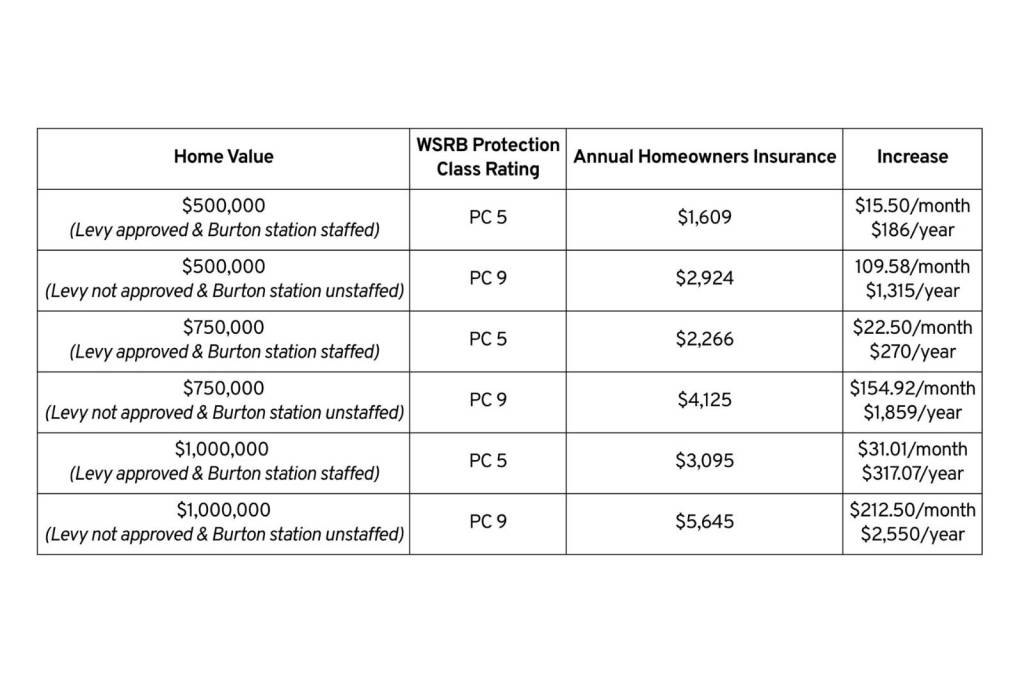
Staffing the Burton Station would halve the response times to the south end of the island, Vinci said, saving lives and property. In addition, having full-time firefighters/EMTs at the Burton Station, he said, would ensure that the district’s Washington Surveying and Rating Bureau (WSRB) Fire Protection rating remains at its current property class protection.
Insurance companies use WSRB ratings — set to be re-evaluated on Vashon in August — to calculate homeowners’ insurance rates. If Burton’s fire station remains unstaffed, Vinci said, it could result in a worst-case scenario of doubling insurance premiums for residential and commercial properties in the surrounding Burton area and south to Tahlequah, and west to Wax Orchard.
“The big takeaway here is the staff station in Burton is going to benefit all of Vashon Island,” said Vinci. “It’s not just about providing fire protection, it’s also about providing timely emergency medical services. We’re not only going to staff an engine and aid car there — we’re going to have an aid unit with EMTs there as well, which we don’t have at that location currently. It’s a win-win there all around.”
While Vinci offered high praise for VIFR’s volunteer staff, he said that it would not be possible to staff the Burton station with volunteers on a 24/7 basis — pointing out that many district volunteers work off-island and are not available, 24/7, to meet VIFR’s service needs.
Another critical issue for the district, Vinci said, is the condition of key vehicles in its fleet.
Vinci described the issue in stark terms, saying that VIFR’s fire engines are now, on average, 19. 5 years old — the oldest in King County. Moreover, he said, the district’s water tender is 23 years old, and also needs to be replaced, as do two aid cars, which are now 11 and 14 years old.
Vinci also said that passage of the levy would help the district make much-needed improvements in its facilities, benefiting the health and safety of its firefighting force.
Voters’ approval in August, he said, would give the district “a road map for the next six years to reinvest the levy into public safety across the island.”
And what will happen if voters say no?
“If the levy does not pass we will not have the resources to staff the Burton fire station,” said Vinci. “That will result in an impact on fire property insurance in a large portion of the island, and we will continue to struggle to deal with our simultaneous calls. We have an aging fleet, not enough staff, and facilities that are in very poor shape, and that is not a safe model for our citizens or our staff.”
Find out more about the levy online.