Islanders complete dock-to-dock swim
Published 1:30 am Wednesday, July 9, 2025
Mention “dock-to-dock” to one of the teens on the high school cross country team, and that means a tough training run from Tahlequah to the north end ferry dock, or the reverse. At roughly the distance of a half marathon, it’s a good workout.
Mention the same thing to one of the mostly over-fifty-year-old cadre of open water swimmers on Vashon, and it brings up an entirely different challenge. A talented runner can make the distance in a little over an hour and a half; by contrast, swimming from one dock to the other takes about four times longer, and is about a mile further.
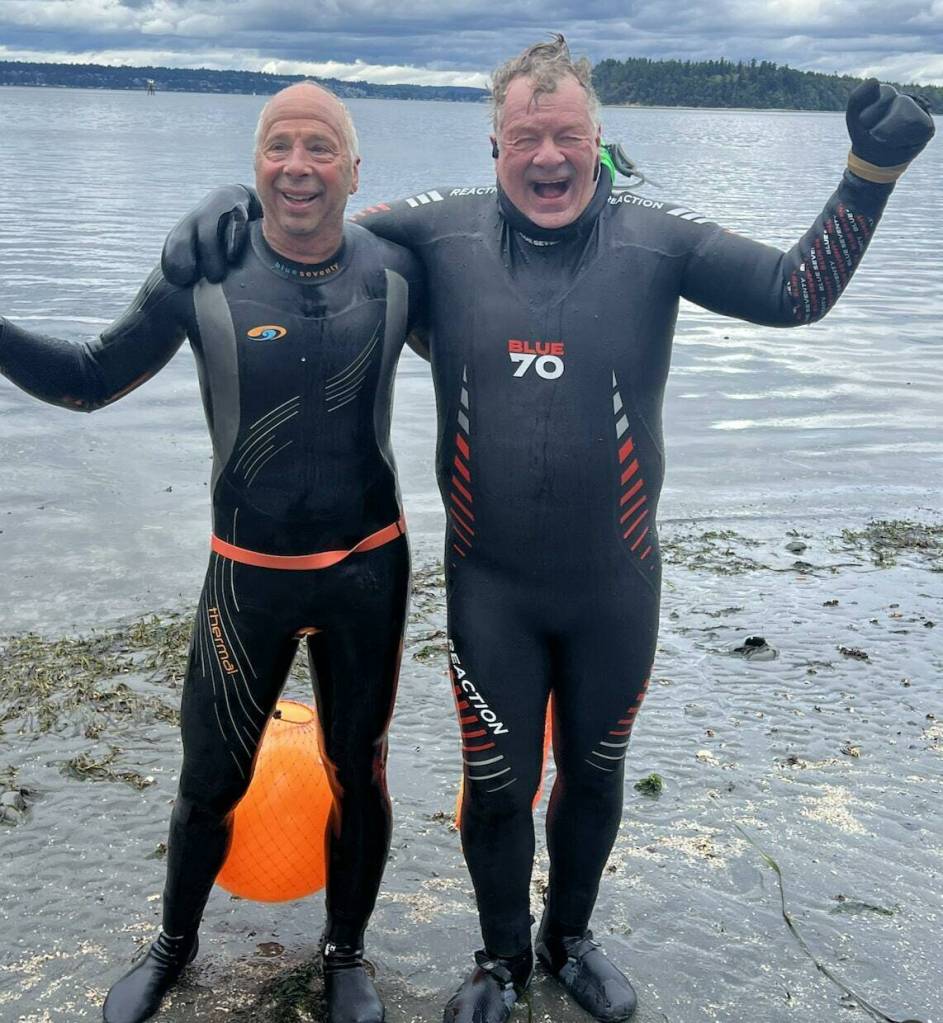
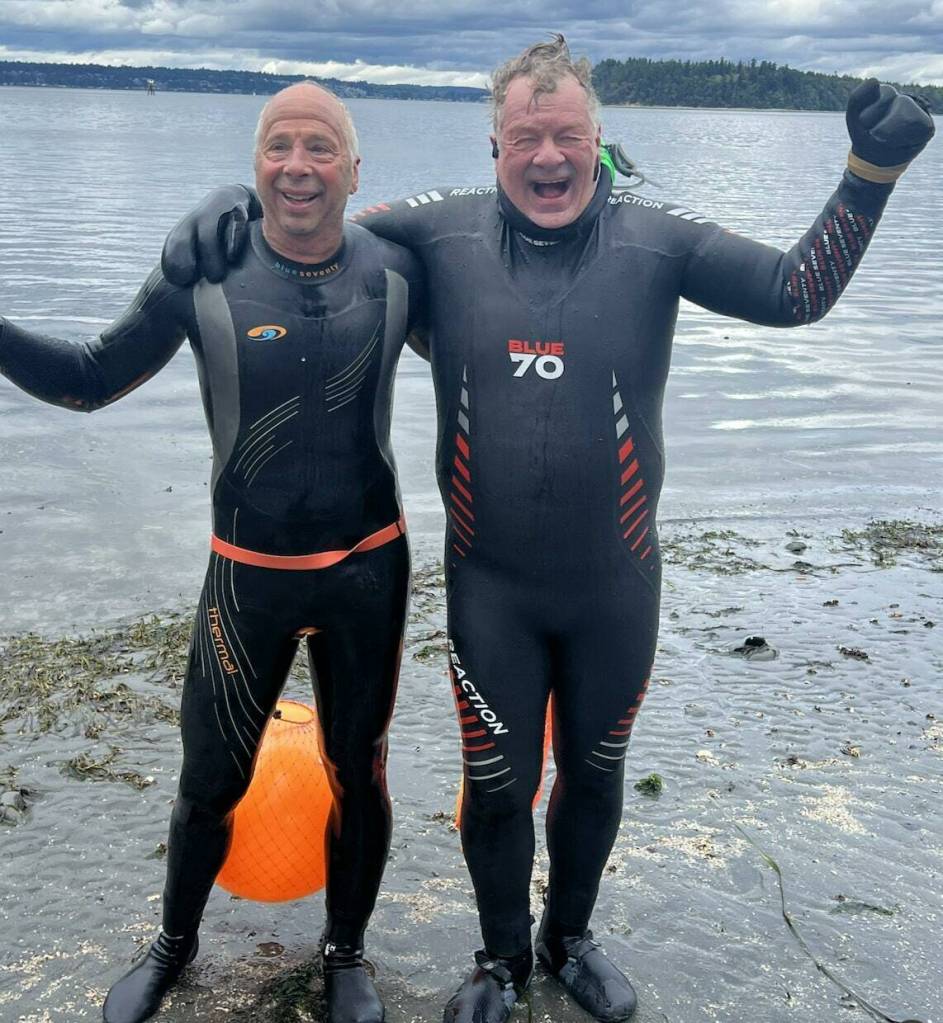
It’s also exactly what two islanders accomplished Friday, June 27. At 7 a.m. that morning, Theo Eicher and Joe Yarkin waded into the water at Tahlequah, touched one of ferry terminal pilings and began swimming west towards Colvos Passage.
This swim was the first try for Eicher and the third for Yarkin. Much to their surprise and horror, they were swimming against a strong current. But as they rounded Point Dalco and headed north, the following current that they expected swept around them and they zoomed down the passage. Five hours and thirteen minutes later, they came ashore in front of the north end dock — the extremely low tide preventing them from actually touching the dock itself.
Both the date and the start time were deliberate. Friday was the second lowest tide of the year, and starting at 7 a.m. meant there would be an outgoing tide heading north in Colvos Passage. Due to a geophysical oddity, the current in the narrow passage mostly flows north.
In simple terms, this happens because the passage between the north tip of Vashon and Blake Island is shallow. When the tide is out, this stretch gets very shallow. With the incoming tide flowing mostly to the east of Bainbridge and Blake Islands, the inflow into the north end of Colvos Passage is blocked by the shallow area. The water takes a path of lesser resistance around the east side of Vashon, continuing west past Tahlequah and then finally north into Colvos.
Conversely, when the tide is high and the water is flowing out of Puget Sound, there is plenty of depth at the north end of Vashon for the water to again flow north through Colvos Passage. The 7 a.m. start was designed to allow five hours of outgoing flow to be behind the swimmers.
The swimmers were highly motivated by a campaign to protect seals. House Joint Memorial Bill (HJM) 4004, introduced in the state legislature this year, would have asked the U.S. Congress to change the Marine Mammal Protection Act to start killing seals at a grand scale in Puget Sound to improve salmon runs.
Eicher and Yarkin, who said they would like to continue swimming with the seals, were strongly against that bill. It expired in this year’s legislative session, though lawmakers may raise efforts like it again in the future.
“Seals are our good-natured companions on many, many swims; curious, kind, inquisitive, and a wonderful indicator of the quality of the ecosystem around Vashon Island,” Eicher said.
Open water swimmers on long swims such as this one are supported by a small craft that serves several roles: safety, course setting, hydration and calories. Most swimmers also wear wetsuits to reduce the amount of heat loss during the swim.
Nevertheless, with water temperatures in the low fifties in Puget Sound, a swimmer might burn as many as 800 calories per hour, so they must be able to refuel in the water. Swimmer Mary Singer paddled a sea kayak in support of Eicher, pulling an inflated rubber ducky with five liters of electrolytes. Joe’s daughter Madeline, and wife, Celina, took turns rowing a sliding seat sculling rowboat in his support. Family dog Penny came along for company and to see the sights.
Singer, an accomplished open water swimmer who is training for an English Channel crossing later this summer, reported one amusing story in supporting Eicher. He injured his right shoulder last year, so his left arm stroke is more powerful. The swimmer is alongside the support craft, and in Eicher’s case, he was swimming on the west side of the kayak.
Had he been on the other side, his asymmetric stroke would have taken him increasingly away from support. But being on the west side he repeatedly swam into the side of the kayak, causing Singer to have to pull her paddle to avoid conking him with it. Eventually they adjusted, and a mostly smooth swim ensued.
At Point Vashon, where the route turns to the east, there were large and strange currents that took the swimmers toward Blake Island and the ferry lanes. Eicher and Yarkin were eventually able to make the turn, and arrived at the north end dock cold, happy and in good condition.
Through chattering teeth at the finish, Eicher said: “Those currents around the north end were pretty disorienting and concerning. Thank goodness Mary was able to guide us through it.”
It takes a few years of training to build up to this kind of endurance event. In spite of the challenge of cold water swimming, the rewards of seeing the underwater beauty and encounters with curious creatures like seals provide ample rewards.
If this sport sounds intriguing, contact “Vashon Open Water Swimmers” at heylo.com to learn more.
Pat Call is a freelance contributor to The Beachcomber.