Native plants: A Q&A for Vashon gardeners
Published 1:30 am Tuesday, March 24, 2026
What is a native plant?
The Washington Native Plant Society defines a Washington native plant as a species that occurs — or historically occurred — within our state’s boundaries before European contact, based on the best available scientific and historical evidence.
You can think of native plants as the ones that were already here. They evolved over thousands of years with our rainfall patterns, glacial soils, salmon-bearing streams, birds, insects and the stewardship of Indigenous peoples.
What are some common examples?
Common examples are vine maple, sword fern, red-flowering currant, evergreen huckleberry, Oregon grape, salal and kinnikinnick.
What’s the best native plant for a beginner to start with?
You can’t go wrong with a sword fern. It can handle full shade to full sun, with some extra moisture, is surprisingly drought-tolerant for a fern, and can live 75 years or more.
Why are native plants important?
They provide the food and shelter that native creatures need: leaves, pollen, nectar, berries, nuts and nesting holes. Even when dead, they support countless other creatures in our ecosystem.
Native plants that allow butterflies and moths to lay their eggs on them are especially important to songbirds. Why? It takes about 9,000 caterpillars to raise one nestful of baby songbirds. Fully 90% of butterflies and moths lay their eggs only on the specific native plants they co-evolved with. Native plants equal caterpillars equal songbirds.
I would like to have less lawn and more native plants. How do I begin?
First, get rid of the lawn. There is no need for chemicals. If you are in a hurry, you can rent a sod cutter. A better way is to collect cardboard, remove the tape and lay it over the grass where you want to grow native plants. Cover the cardboard with at least 4 inches of wood chips and wait six months.
During that time, the grass will die from lack of light, the cardboard will decompose, and both will help improve the soil. Then move aside the wood chips, dig your holes through the rotting cardboard, plant your native plants and bring the wood chips back close to the plants to discourage weeds and hold moisture. This method does not work for seeds, only for native plants with roots already on them
Where can I buy native plants and native plant seed?
On Vashon, you can buy some native plants from all our local nurseries. Little Bird Gardens has a good selection and will order from off-island suppliers. I run the native plant half of Dragonfly Nursery. We have the best selection of native perennials, especially for part shade. The Vashon-Maury Land Trust is the most cost-effective source for bare-root native trees and shrubs. They have one sale a year, in February.
If you can’t plant your bare-root plants right away, it works well to pot them up individually, water them over the dry summer and plant them in the fall when the rains return.
Off-island, year-round, you can find a great selection of potted native plants at Woodbrook Nursery in Gig Harbor. King Conservation District and Pierce Conservation District have spring and fall sales of bare-root plants, as do different chapters of the Washington Native Plant Society. Some sales include potted plants, not just bare-root plants. You can buy Washington native plant seed online at Northwest Meadowscapes and Inside Passage Seeds.
Where can I learn more about native plants?
The Washington Native Plant Society is the best place to start. I also recommend the Homegrown National Park site, where you can learn about keystone plants for our Marine West Coast Forest. You can also learn about local native plants at the Burke Herbarium website, King County Native Plants and in numerous books.
One I like is “Real Gardens Grow Natives” by Eileen M. Stark. The best book for understanding the connection between native plants and songbirds is “Nature’s Best Hope” by Professor Douglas Tallamy.
Which native flowers bloom the longest?
I find that native goldenrod blooms for a very long time, well into fall. In sun, it provides lots of tall color in the garden and a great deal of interest if you look at all the different pollinators that visit it.
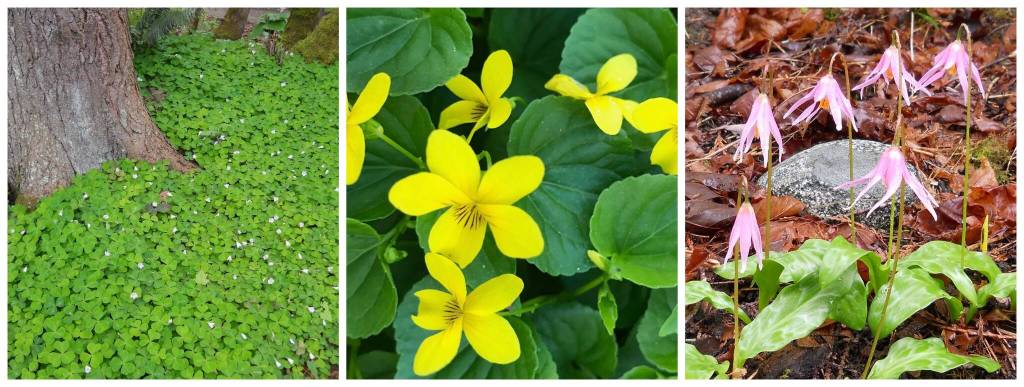
On a smaller scale, Pacific bleeding heart blooms from spring through summer if grown in partial shade with extra moisture. Wood sorrel, Oxalis oregana, also blooms all summer long and has edible leaves and flowers. Miniature western iris, also known as yellow-eyed grass (Sisyrinchium californicum), has cheerful yellow flowers all summer. Nodding onion blooms from June through September, as does sea thrift. I have seen sea thrift bloom through the winter on Vashon, where it loved a sunny, well-drained location. The showy red-and-yellow western columbine also blooms a long time and will grow in sun or shade.
What kind of soil do our native plants like? Do I need to add compost and fertilizer?
So much depends on which native plant you wish to grow. Native plants that grow in shade typically like soil with lots of organic matter, like the forest duff you see along the trails. Sun-lovers typically like well-drained soil.
Exceptions are willows and red-twig dogwood, which love sun and plenty of moisture and can grow in poorly drained, heavy soil. Our native plants are adapted to acid soil and low fertility, so compost and fertilizer are not necessary. Most would appreciate a covering of fall leaves or 2 to 4 inches of wood chip mulch. Mulch deters weeds, holds moisture and provides nutrients as it breaks down. To be safe, research the needs of the native plants you purchase. Right plant, right place.
What are some native plants I can use as an evergreen privacy hedge?
For a 6 to 8-foot hedge, consider tall Oregon grape or evergreen huckleberry.
For a 15 to 20-foot hedge, Pacific wax myrtle works well and grows fast.
For much larger spaces, western red cedar works well because it keeps its lower branches.
Flowers:
Flowers: Which native plants provide the most showy flowers?
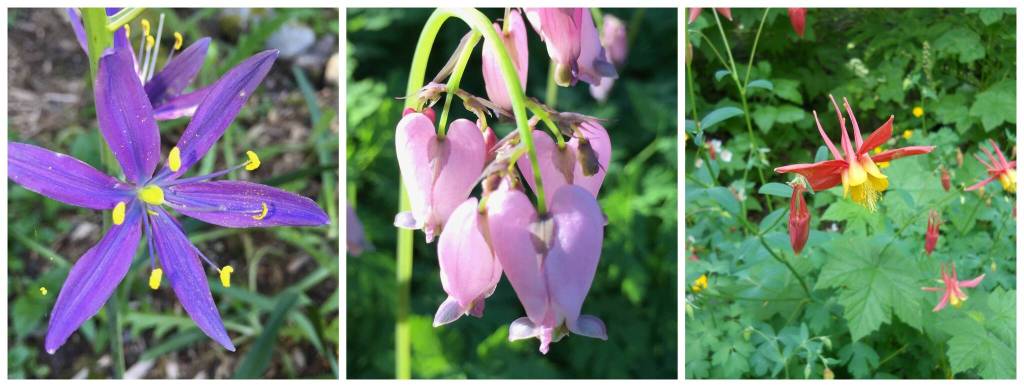
For me, it would be camas, Henderson’s checkermallow, any of our native lupines, Oregon iris, western columbine, western trillium, yellow glacier lily, and yellow stream violet. For shrubs, red-flowering currant is wonderfully showy in spring.
I would like to have a native plant meadow with lots of flowers. How can I do that?
Native meadows are great for pollinators and can be very colorful. You need a spot that gets at least six hours of direct sunlight a day. Then get rid of the existing non-native plants. You can do this by cutting everything as close to the ground as possible, then covering it for a year with reusable black silage tarp. Or you could cover it with very thick cardboard weighted down for a year.
Do not cover the tarp or cardboard with wood chips or other mulch, as meadow seed needs to be spread on bare soil.
If you have lawn grass or a field you want to convert and don’t like the idea of covering it, Northwest Meadowscapes has a native flower seed mix you can overseed into existing grass or fields. It will take several years to do it this way. They explain how on their website.
What are some native plants I can grow in the shade of other trees?
With so much of our island covered in trees, shade is what we have the most of. Fortunately, there are beautiful native plants well adapted to growing in the shade of other trees.
Trees: Vine maple and beaked hazelnut are both understory trees, used to growing in the shade of taller trees.
Shrubs: Pacific rhododendron loves to grow in the shade of mature Douglas firs. Osoberry and snowberry both do well in shade, as do evergreen huckleberry, cascade Oregon grape (Mahonia nervosa), salal, Oregon boxwood and red huckleberry.
Taller perennials: Sword fern, lady fern, goatsbeard, great false Solomon’s seal, coltsfoot and giant chain fern for a moist site.
Shorter perennials and groundcovers: Vanilla leaf, maidenhair fern, wild ginger, deer fern, Pacific bleeding heart, oak fern, spreading wood fern, wood sorrel, Smith’s fairy lantern, piggyback plant, western trillium, inside-out flower, Brewer’s mitrewort, false lily-of-the-valley, fringecup, star-flowered Solomon’s seal, Siberian miner’s lettuce, pink or white fawn lily, starflower, western columbine, woodland strawberry and our native violets — not the invasive dog violet. Two of our native violets for shade are Viola palustris and Viola glabella.
Sun and dry:
Sun and dry: Which native plants are drought-tolerant and can handle full sun?
If you have a full-sun site and only want to water for a year or two to get your native plants established, here are some good choices:
Trees: Grand fir, Douglas fir, Pacific madrone, incense cedar, Garry oak, shore pine, black hawthorn, Oregon ash and beaked hazelnut.
Shrubs and a vine: Red-flowering currant, tall Oregon grape, hairy manzanita, snowbrush, oceanspray, golden currant, mock orange, Nootka rose, serviceberry, snowberry, salal, evergreen huckleberry, California wax myrtle, osoberry, Pacific rhododendron, creeping Oregon grape, Pacific ninebark and hairy honeysuckle vine.
Perennial flowers and grasses: Yarrow, sea thrift, kinnikinnick, beach strawberry, western columbine, Oregon iris, harebell, shooting star, native stonecrops — spreading, Oregon and broad-leaved — nodding onion, woolly sunflower, Viola adunca, coastal mugwort, Henderson’s checkermallow, showy fleabane, gumweed, Roemer’s fescue, American dunegrass and native penstemons including Cardwell’s, Davidson’s and lowbush.
Which native plants can do well in the dry shade under other trees?
Dry shade is the most difficult condition for plants. Fortunately, we do have some excellent native plants that can handle it.
Understory trees: Beaked hazelnut, vine maple
Shrubs: Salal, tall Oregon grape, low Oregon grape, osoberry, red huckleberry, evergreen huckleberry, Pacific rhododendron, mock orange, oceanspray, red-flowering currant, snowberry and baldhip rose
Perennials: Sword fern, wood sorrel, wild ginger, inside-out flower and deer fern
Vines: Orange honeysuckle and hairy honeysuckle
What are the best native plants to help hold my steep slope?
To hold steep slopes, you want roots at all levels: deep-rooted trees, medium-rooted shrubs, and shallow-rooted native perennials and grasses. The plants listed here require different light and moisture conditions, but they are all great for holding slopes because of their spreading roots.
Trees: Shore pine, cascara, Douglas fir, grand fir, Sitka spruce, Garry oak, bigleaf maple, bitter cherry, Pacific crabapple, black hawthorn, Douglas maple, vine maple, western red cedar, western hemlock, western white pine, beaked hazelnut, red alder, quaking aspen and northern black cottonwood for streambanks
Shrubs: Serviceberry, native willows, Pacific wax myrtle, black twinberry, evergreen huckleberry, mock orange, Nootka rose, cluster rose, baldhip rose, oceanspray, Pacific ninebark, Pacific rhododendron, red-flowering currant, red-twig dogwood, salal, snowberry, snowbrush, tall Oregon grape, low Oregon grape, red elderberry, hairy manzanita, salmonberry, Douglas spiraea, osoberry, native highbush cranberry, chokecherry and thimbleberry
Flowering perennials and grasses: Sword fern, kinnikinnick, beach strawberry, fireweed, Canada goldenrod, bigleaf lupine, Douglas aster, pearly everlasting, yarrow, sea thrift, goatsbeard, Pacific bleeding heart, silverweed, wood strawberry, lady fern, Cooley’s hedge nettle, piggyback plant, inside-out flower, oak fern, wood sorrel, false lily-of-the-valley, wild ginger, dunegrass, tufted hairgrass, coastal mugwort and Roemer’s fescue
Which native plants are the best for native pollinators, and why?
Good plants for pollinators provide food for the babies, not just nectar for the adults. Ninety percent of butterflies and moths require a specific native plant to survive. That is because they co-evolved, and the insects developed ways to overcome the host plant’s defenses. Here are the best and most common host plants for our area.
Trees: Garry oak, bitter cherry, western birch, quaking aspen, bigleaf maple, vine maple, Douglas maple, Pacific crabapple, shore pine, red alder, beaked hazelnut and Douglas fir
Shrubs: All the native willows, all the huckleberries, chokecherry, serviceberry, thimbleberry, salmonberry, our native blackberries, all the roses, red-twig dogwood and Douglas spiraea
Perennials: Canada goldenrod, Douglas aster, showy fleabane, beach and wood strawberries, any native lupine, gumweed, kinnikinnick and yarrow
Wet areas: What native plants can I plant in the wet area on my property — along a stream or pond, or a seasonally soggy area?
Plants do love water, but few like having their roots wet for long. The plants listed below can handle wetter, more poorly drained soil, but have varying sun requirements.
Trees: Vine maple, cascara, Pacific crabapple, western hemlock, western red cedar and red alder
Shrubs: Any of the native willows, mock orange, Nootka rose, oceanspray, Pacific ninebark, red-twig dogwood, serviceberry, salmonberry, sweet gale and snowberry
Perennials: Western maidenhair fern, lady fern, oak fern, deer fern, spreading wood fern, giant chain fern, salal, Douglas aster, fringecup, nodding onion, pearly everlasting, camas, blue-eyed grass, dagger-leaf rush, fireweed, goatsbeard, graceful cinquefoil, gumweed, small cranberry, streambank lupine, coltsfoot, hedge nettle, great false Solomon’s seal, littleleaf miner’s lettuce, native mint, Pacific bleeding heart, silverweed, yellow stream violet and tufted hairgrass
Which native plants will be best able to handle climate change?
Shall I buy native plants from California?
Climate change predictions for Vashon include drier, hotter, longer summers and wetter, warmer winters. The longer, drier summers we are experiencing now are taking a toll on wild-growing salmonberry, western hemlock, bigleaf maple and western red cedar — plants that need at least some summer moisture. Salal and sword ferns are showing signs of stress, too.
But we don’t need to look to California for plants. We already have plenty of local native plants that can handle dry summer soil. Some require shade, though, to tolerate the extra-dry summers we have now.
Trees: Garry oak, shore pine, beaked hazelnut, incense cedar, Douglas hawthorn and bitter cherry
Shrubs: Serviceberry, salal, oceanspray, hairy manzanita, tall Oregon grape, low Oregon grape, Pacific wax myrtle, osoberry, mock orange, Pacific rhododendron in shade, red-flowering currant, red-twig dogwood, Scouler’s willow, snowberry, red huckleberry, evergreen huckleberry in shade and Oregon boxwood
Perennials, grasses and vines: Kinnikinnick, western columbine, beach strawberry, wood strawberry in shade, wood sorrel in shade, inside-out flower, sword fern in shade, deer fern in shade, nodding onion, camas, woolly sunflower, Oregon iris, native stonecrops, native penstemons, wild ginger in shade, early blue violet, Henderson’s shooting star, yarrow, Roemer’s fescue, Idaho fescue, and hairy and orange honeysuckle vines
Which native plants are deer resistant?
It is fascinating to observe how deer seem to like different plants on different parts of the island — and how they can change their preferences from year to year. The list below is based primarily on my personal experience. I find that our island deer will eagerly eat plants that other books and lists say are deer resistant. Lupines, for example.
Please note: Deer-resistant does not mean deer-proof. Some nibbling will occur as young deer taste-test them.
Trees: Grand fir, shore pine, Douglas fir, Garry oak, beaked hazelnut, paper birch and western hemlock
Shrubs: Salal, Oregon grapes, Pacific wax myrtle, Oregon boxwood, potentilla, Pacific rhododendron, red-flowering currant, Douglas spiraea, snowberry, evergreen huckleberry, native highbush cranberry, oceanspray, osoberry, red huckleberry, salmonberry and sweet gale
Perennials, grasses and vines: Yarrow, nodding onion, sea thrift, Douglas aster, Canada goldenrod, blue- and yellow-eyed grasses, inside-out flower, kinnikinnick, pearly everlasting, small cranberry, Brewer’s mitrewort, coltsfoot, Cooley’s hedge nettle, great false Solomon’s seal, star-flowered false Solomon’s seal, ferns, miner’s lettuce, native mint, self-heal, silverweed, yellow stream violet, wild ginger, western starflower, dagger-leaf rush, orange or hairy honeysuckle vines, plus irises, grasses, stonecrops and penstemons
The deer are eating my native shrubs and trees. What can I do?
You can spray them weekly with Deer Out Spray, an island favorite, or put a metal cage around them until they grow large enough to withstand hungry deer. That’s what my husband and I do with shrubs and trees we plant outside the fence.
Diane Emerson advises Island residents on all aspects of gardening and pruning. She was inspired to focus on native plants after reading Professor Doug Tallamy’s book “Bringing Nature Home”.