Exhibit explores history of island schools
Published 1:30 am Wednesday, April 6, 2016
It’s hard to believe that once upon a time during Vashon’s relatively short history, islanders called Cemetery Road the Mason-Dixon Line. Division ran deep between north and south, due in part to a bitter rivalry between the two high schools, one in Burton and one near Vashon. By 1927, the animosity peaked with fisticuffs, an incident that according to early island historian Roland Carey, “convinced thoughtful people that the rivalry must end.”
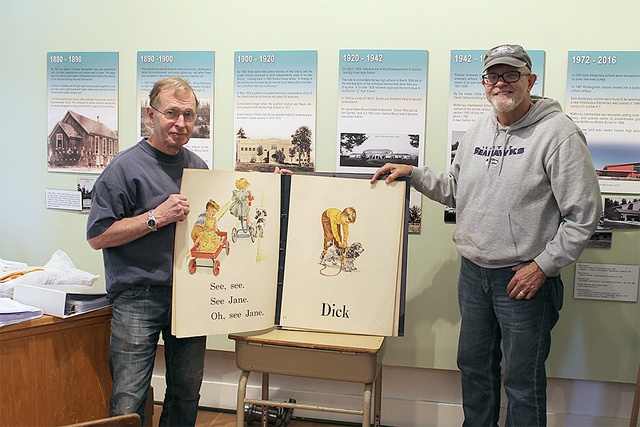
A year later, détente through school unification eased tensions and played a crucial role in the development of the island. A new exhibit at the Heritage Museum called Schools Through the Window of History: How Schools Unified the Island, takes a three-dimensional look backward at the evolution of Vashon through the social and geographic impact of island schools.
“This is the big story of how the schools helped us become an island community,” said Bruce Haulman, an island historian who, together with the show’s curator Mike Kirk, created the exhibit. “At one time there were nine schools districts. It gives you a sense of how different things were. People didn’t talk about being from Vashon as they did from Burton or Tahlequah or Lisabeula.”
That’s because there was no central town of Vashon as we know it today. Geography dictated where the early Europeans settled — dotting the shoreline with multiple, independent communities accessible by boat, not linked by a network of roads. But the commonly held value of education meant that in 1880, families had gathered to erect the first schoolhouse — a board and batten building with a shingle roof — at Center.
“There was a movement to unify for the welfare of education and for the kids and families to socialize,” Kirk said. “People would walk for miles to the schoolhouse for meetings. There’s evidence kids walked from the Burton Peninsula to Wax Orchard Road to go to school.”
At the museum, fastened to an old-fashioned chalkboard, a 4-foot-long wooden cut-out of the island is loaded with red circles representing the multiple historic schools and districts. Classic wooden desks with attached seats, saved from demolition over the years by Kirk and the district, resemble a miniature classroom. A rare 3-foot-tall “Dick and Jane” textbook with brightly colored illustrations is on display, and joyful sounds of children at recess fill the air. Composition books opened on the desktop lie next to a jar of white library paste — the kind some kids always ate, Haulman said with a laugh.
“We wanted the show to be for all the senses,” Kirk added.
Other than the recipe for the library paste pulled from the internet, all of the exhibit’s posters, textbooks and photographs come either from Kirk’s personal collection — gathered during his tenure at Vashon schools first as a teacher and later as principal of McMurray Middle School — or from the district. The source material for the research comes from original school documents.
“We have daily registers, which the state required, back to 1890. For the last two years, Bruce and I have researched and documented where the schools were and the changes that happened,” Kirk said.
Kirk has also been organizing the records for future reference, something Haulman finds invaluable.
“After the exhibit, people will be able to come back and research their great grandparents. That’s the fun stuff. Mike’s done a masterful job pulling it all together. For me as a historian, it is priceless,” Haulman said.
One trend the records show is that 1892 brought big changes to the island. Construction of the Columbia School on the north end began, and down in Burton, Vashon College and Academy opened its doors. With no designated high school on the island, the academy founders also established a private prep school, which remained the only high school until 1904, when the first public high school was built on Burton Hill. That location didn’t aid those north of Vashon’s Mason-Dixon Line, however. Vashon Highway was nonexistent, so getting to school was an issue. To help with logistics, and perhaps not to be outdone, in 1912, residents constructed a second high school one mile north of Vashon town, a handsome three-story structure. And so began, according to historian Carey, the early high school rivalry.
“When Vashon came to play (at Burton),” Carey wrote in a 1993 Beachcomber article, “the rival cheering sections did their best to out-yell each other. Over the years, the rivalry became even more intense.”
At the halftime of one football game in the late 1920s, Vashon fans paraded a banner of a Holstein cow “with immense bag and udder. The caption read, ‘This is no bull. We’ll win this game.'” The ensuing melee tipped the scales of decorum, and the following spring, in 1928, the two high schools unified.
The grammar schools, meanwhile, remained disparate. Waterfront communities held on to separate districts as the schoolhouse remained the center of community activity. A photograph at the museum reveals school chums in long white dresses peering into the windows of the 1916 Maury Elementary School, the current home of islander Margaret Heldring.
“I know that ice cream socials, in addition to classes and gym, were held there,” Heldring said. “My whole family loved the schoolhouse, which is what we always call it. We are all history buffs and feel honored to live in a place with such stories of learning and growing, even if they are stories unknown to us — one imagines them. My older grandchildren, both 8 years old, have taken to trying to figure out where the principal’s office was and even where the detention room might have been.”
At the other end of the island, Hunter Davis and Wilson Abbott raised their three children in the Columbia Schoolhouse.
“In the 1930s, hungry farm pupils were fed here by local women in a manner not according to the rules of governing boards,” Davis said, “but as it was considered a poor district, the officials looked the other way.”
Eventually, the county and state required the island to consolidate. In 1941, the five remaining school districts finally became one, though the Mason Dixon line, Kirk said, lived on due to the divided elementary schools.
Haulman agrees. Mostly old-timers talk about the Mason- Dixon Line; it’s not a current concept, he said. And yet, what Haulman finds fascinating is that the line is more than just cultural. It has larger implications for the island — perhaps the subject of a future exhibit. But for this exhibit, Haulman summarized island unification through the schools in this way:
“The new high school pulled everyone together. Before then, kids from Dockton went to Burton school by boat; that was their school bus,” he said. “Kids got to know each other and roads made it easier to get around. A single school district was created in 1941 after an island election the previous year. By the time McMurray opened, in seventh grade everyone knew everyone. The self-identification had gone from Burton, Maury or Dockton to being an islander. That’s the kind of evolutionary development that the schools provided.”