From myth to mall: Maury Island’s UFO story lives on
Published 11:30 am Tuesday, November 25, 2025


Steve Edmiston was sipping coffee with his neighbor Terry Donahue at Cutter’s Point in Des Moines in 2011 when a stranger leaned over with a question that would change the conversation – and, eventually, Edmiston’s life.
“You ever hear about the Maury Island Incident?” he asked.
Neither had — despite living in the area and gazing across the East Passage to Maury Island every day. But that unsolicited tip from a coffee shop eavesdropper sent Edmiston down a rabbit hole of FBI files, plane crashes and Cold War paranoia surrounding a 1947 UFO sighting long buried in Pacific Northwest folklore.
“I wish I knew who he was,” Edmiston said of the stranger. “My life changed and I don’t even know who told me about it.”
Edmiston later turned the story into a 2014 short film titled “The Maury Island Incident,” which screened at the Vashon Theatre and film festivals across the region.
More than a decade after that coffee shop conversation — and years after making the film — Edmiston’s fascination with the Maury Island story is now on full display at Westfield Southcenter Mall in Tukwila.
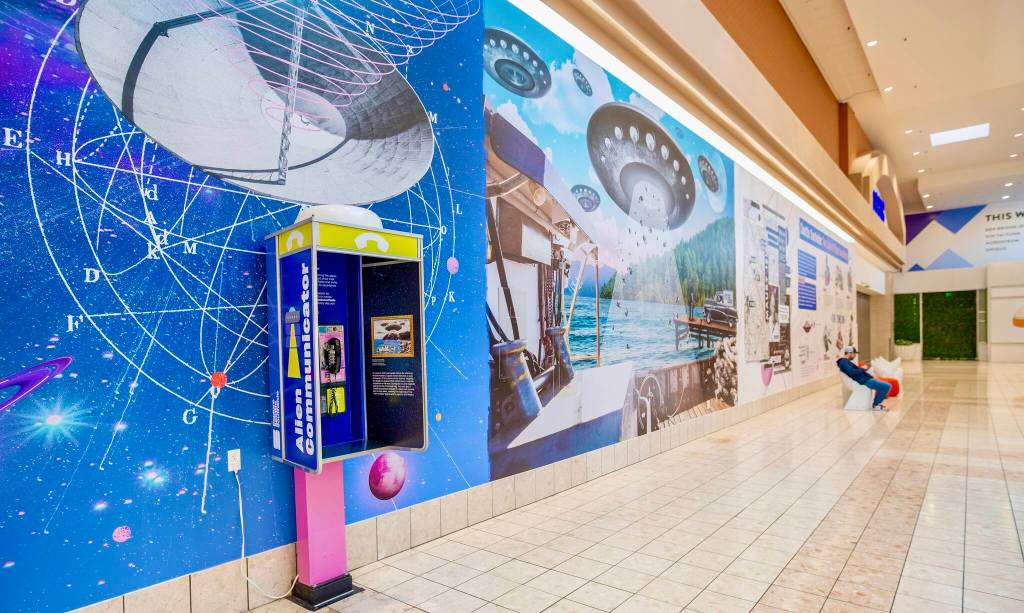
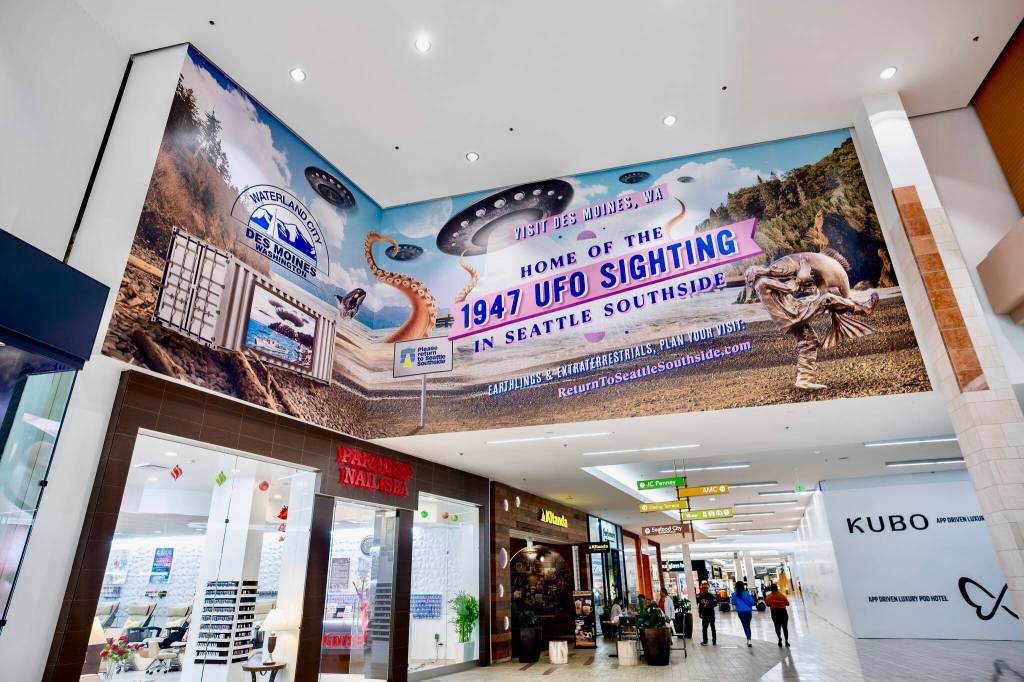
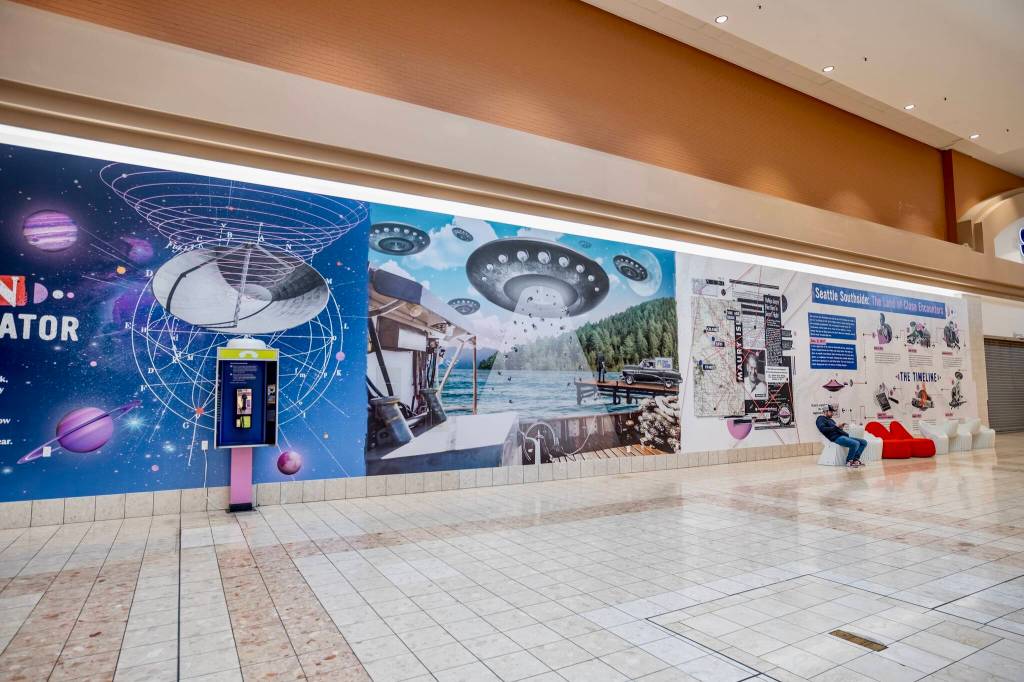
There, the museum-quality UFO Pop-up Experience invites shoppers to “invade” what he calls “an exciting piece of local history with an edgy UFO mystery angle.”
The exhibit opened on the first floor in the southwest corner of the mall in May and is expected to remain on display indefinitely, Edmiston said. It was created by the regional tourism bureau Explore Seattle Southside in collaboration with Edmiston and the Maury Island Incident Historical Society, which Donahue later co-founded.
The pop-up merges history and sci-fi whimsy. It features an alien-abduction photo op, floor-to-ceiling murals showing art and a timeline of events, an augmented reality flying-saucer hunt, and a cosmic phone booth where the Explore South Seattle website says visitors can record greetings “for the aliens” to send across the galaxy. Ten thousand have already been recorded, Edmiston said.
“Some [messages] aren’t very nice,” joked Edmiston. “But many are creative and fun.”
To Edmiston, the Maury Island Incident is less about proving aliens exist than about questioning how stories become labeled “hoaxes” — and how that labeling shapes collective memory. He sees it as a lost chapter of Pacific Northwest history, blending government secrecy and pop-culture mythology.
The incident
It was June 21, 1947, near the start of the Cold War — a time when, Edmiston notes, Americans were just beginning to look nervously up at the sky.
Weeks before the Roswell crash (a reported UFO incident in New Mexico), Tacoma Harbor Patrolman Harold Dahl claimed he saw six large, doughnut-shaped “flying discs” hovering over Maury Island. One appeared damaged and dropped molten debris that rained down onto the boat, scorching Dahl’s son’s arm and killing their dog, Sparky. Terrified, they ran the vessel aground and hid until the craft vanished.
The next morning, Dahl said a man in black arrived at his Tacoma home in a dark Buick, invited him to a diner, repeated every detail of the encounter and warned him never to speak of it — foreshadowing what pop culture later dubbed “the Men in Black.”
Soon after, Dahl’s business partner Fred Crisman shared the story with pulp magazine editor Ray Palmer, igniting what became the 1947 “Summer of Saucers.” Within days, pilot Kenneth Arnold reported seeing shiny objects darting past Mount Rainier — a sighting that coined the term “flying saucer.” Two weeks later came Roswell, cementing that summer as the birth of America’s UFO obsession.
As the tale spread, two Army Air Corps officers from McChord Field were sent to question Dahl and collect samples of the mysterious slag said to have fallen from the craft. Minutes after loading it onto a B-25 bomber bound for Washington, D.C., the plane caught fire and crashed near Kelso, killing both pilots.
The tragedy drew in the FBI, and J. Edgar Hoover personally followed the case. Some agents dismissed it as a hoax after Dahl retracted his account, while one field report stated, “Dahl did not admit (it was a hoax).” Dahl later told investigators he would rather be remembered as a liar than endure the ridicule that followed.
“To me, that means Maury Island should be treated like any other case — investigate it,” Edmiston said. The official record, reinforced by media summaries, labeled the incident a fabrication, and it largely disappeared from UFO lore while Roswell became the enduring legend.
While Edmiston’s exhibit invites visitors to reconsider the “hoax” label, other researchers remain unconvinced.
James Clarkson, a retired police investigator and former head of the Washington State Mutual UFO Network, believes the Maury Island case was a deliberate ruse. He calls it “good news/bad news” — great for storytellers with its Puget Sound setting, shadowy agents and tragic crash, yet flimsy under scrutiny. Clarkson argues it relies on Dahl’s unverified account, later amplified by Crisman, whose credibility was questioned by the FBI. Air Force investigator Edward Ruppelt, head of Project Blue Book, once branded the Maury Island incident “the dirtiest hoax in UFO history.”
True or not, Edmiston buys into the moment.
“I speak for the history, not the UFOlogy,” he said. “I don’t know what Dahl saw, but I can tell you that if the federal agencies were involved at that time, they were worried about Soviet reconnaissance, not little green men.”
While the world leans into UFO mystique with alien-themed motels and neon-green souvenirs, Edmiston and his partners are taking a more creative approach to keeping Maury Island’s mystery alive.
“We’re trying to be creative beyond trinkets and tchotchkes,” Edmiston said.
That same spirit of reinvention runs through the Southcenter Mall exhibit, just across the Sound from where the incident happened nearly 80 years ago. There, art, entertainment and intrigue carry the Maury Island story to a new generation of curious visitors — helping keep one of Washington’s strangest chapters from fading into myth.
“It’s fascinating history, even if we don’t ever know for sure what happened at Maury Island.”
Eddie Macsalka is a contributing journalist for The Beachcomber.