
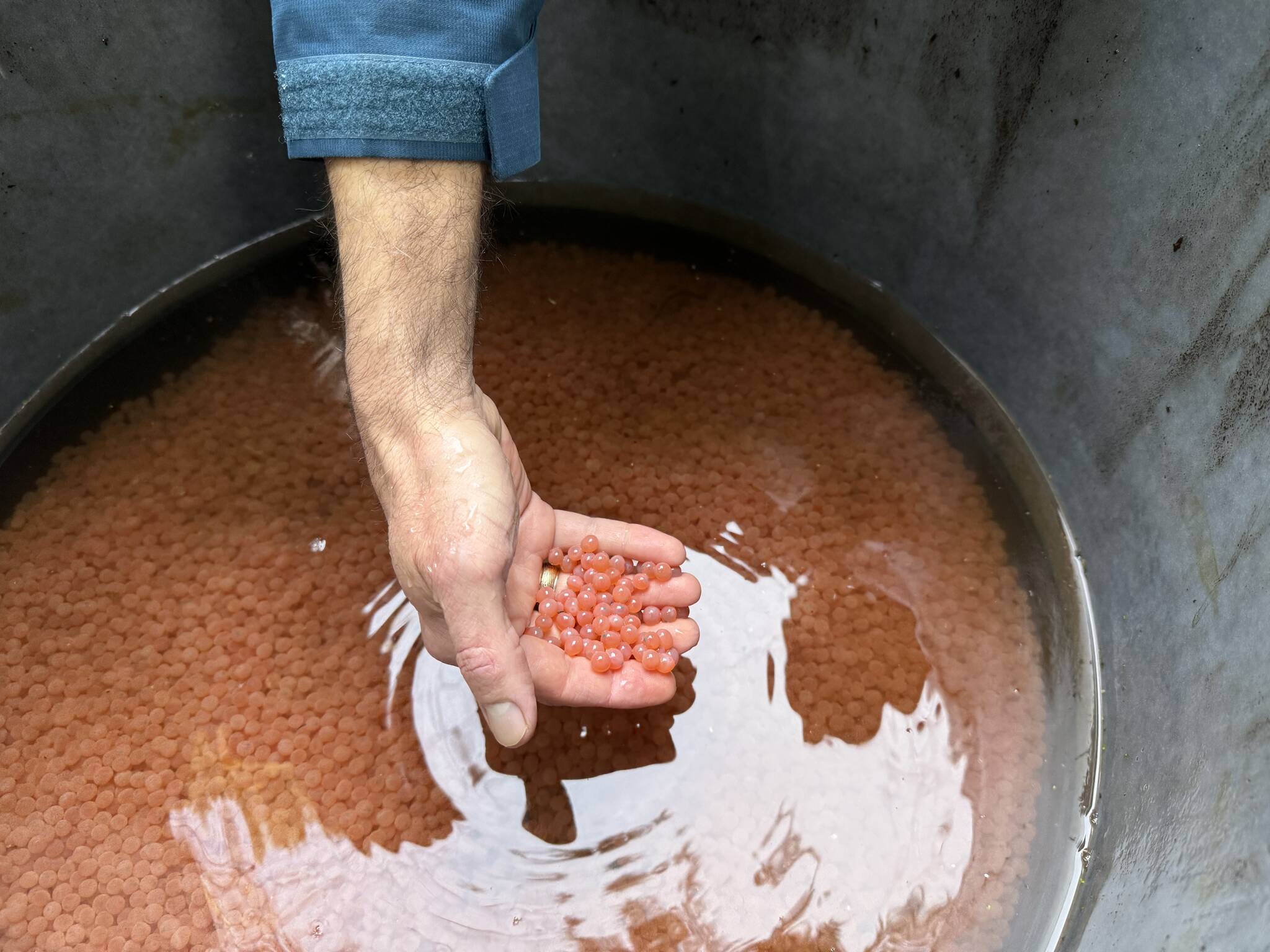
Forty-four thousand two hundred ten. That’s how many chum salmon eggs the Vashon Land Trust carefully placed into an incubator mere feet away from the Judd Creek Loop Trail in early January.
By early March, the surviving salmon fry will swim through the PVC pipe attached to the incubator and take a short waterslide to land in Judd Creek.
The eggs, provided by the Puyallup Tribe to the Land Trust, are a key part of the Land Trust’s recent large-scale effort to restore Judd and Shinglemill creeks through non-invasive species planting, installation of Beaver Dam Analogs (BDAs) and the Judd Creek remote site incubator.
The Land Trust’s overall goal is to work toward restoring the surrounding forest ecosystems, which were originally thrown out of balance by the 18th century arrival of European settlers on Vashon, according to Tom Dean, the conservation director of the Land Trust.
This restoration will make the creeks better suited for salmon, as well as every species that inhabits the ecosystem, Dean said.
This work is also intended to support the Puyallup tribe’s right to fish in its traditional territory, he said. The tribe is historically centered in the Puyallup River basin in what is now the Tacoma area and Vashon-Maury Island is also part of its traditional territory.
Today, the forest lacks the historic conifers that once dominated the landscape, both Judd and Shinglemill creeks flow quicker than they should due to human interference and far fewer salmon are returning than they used to, Dean said.
The first step in the Land Trust’s restoration efforts has been to work to remove the invasive species surrounding each creek — like Himalayan blackberry and English holly — then planting new native trees and shrubs, according to Jenny Stamper, operations manager of the Land Trust.
On the Judd Creek preserve, most of the trees are short-lived alders, which naturally fall down after 50-60 years. Since the trees became established around the same time, the forest is now in decline, Dean said.
“We need to make sure that there’s a contingency plan for the canopy,” Stamper said. “If [the creek is] not shaded, it’s not going to stay cool, and the salmon especially need cold water.”
As a solution, the Land Trust has been planting native shade-giving trees, which will “come up and shade the creek and provide the structure that all the critters need,” Dean said. They’ll also become natural dams after they fall.
So far, they’ve added several cedar, cottonwood, and willow seedlings to the bank — the latter two can adapt well to having wet roots for when creek levels rise.
Yet, all of this clearing and replanting is just a start, Dean said.
“Now we’re looking at restoration 2.0, which is [asking], is the creek really functioning the way it should? Is it happy? What would that look like?” he said.
A large part of this closer look focuses on the level of the creek itself, and the speed at which its waters flow.
Salmon need slow-flowing water to rest, feed and hide in, Dean said, as well as to lay eggs.
“If you slow the water down … then all of a sudden you get all these back channels where the juvenile coho are looking for food, sticks and logs they can hide under,” he continued.
Yet, land management practices have led over time to the creek becoming entrenched, according to Theron Shaw, executive director of the Land Trust. Without obstruction, a creek will cut deeper into the channel bed.
This separation from the floodplain — the flat area of land surrounding a waterway, which usually would absorb excess water during storms — creates a self-perpetuating negative cycle, Shaw said.
“The more it cuts down, the faster it goes, and the faster it goes, the more it cuts down,” Shaw said. “It goes lower and lower and leaves the floodplain behind.”
In order to foster a welcoming environment for salmon populations, which are currently “taking a nosedive” according to Vashon Nature Center science director Bianca Perla, the Land Trust plans to raise the level of both creeks, largely by using Beaver Dam Analogs (BDAs).
BDAs are a human-made mimicry of a natural beaver dam using sticks and brush, Stamper said.
When strategically placed, they will provide obstruction to help water levels rise and slow down flow — “Just the way beavers would have managed this whole thing for free,” Dean said.
“This goes back to trying to fix the very first thing we messed up here,” Dean added, referring to the European settlers who extinguished the native beaver population on the island in the late 18th century.
As natural stewards of the land, beavers would have built dams in the creeks and cut down willow trees, a practice that keeps creek levels high and helps salmon thrive.
The BDAs will act in the same way: even in heavy rainstorms, expected to happen more as time goes on, the dam analogs will slow river flow, widen the creek, and stop it from digging itself deeper. “It’ll ebb and flow with the weather,” Stamper said.
The hope, Stamper said, is that adding artificial beaver dams will begin a new cycle: real beavers will begin to populate the area since they’ll view it as a good place to live.
The Land Trust focuses on rehabilitating two species of Pacific salmon: coho and chum. Each salmon species has a distinct life cycle, but both species are vital contributors to the forest ecosystem, Dean said.
After hatching in creeks, both species of salmon swim to sea, either immediately as in the case of the chum salmon or after one year of rearing in the case of the coho.
Once they have matured, coho and chum salmon return to their birthplace to spawn, ultimately dying before their offspring hatch, according to Shaw.
“Their death brings all those ocean-derived nutrients back to the forest,” Dean said. “That also feeds the food chain, because [it’s] bringing all those nutrients in.”
In fall 2025, Salmon Watch volunteers with the Nature Center counted 36 redds (salmon egg nests) and 118 total salmon in Judd Creek, 101 of which were chum. Since they’ve only been counting since 2016, local teams have to rely on oral histories to know how many more salmon there used to be.
“You hear stories, both from islanders today who remember being young here 50 years ago and also from Pullayup tribal members … whose elders remember seeing thriving, standing populations in these creeks,” Shaw said.
The Judd Creek remote salmon incubator is a squat cylindrical vessel filled to the brim with fresh creek water, which constantly flows in and out through attached PVC pipes.
Inside, a mesh creates a temporary holding chamber for the more than 44,000 chum salmon eggs originally placed inside. Below the mesh is a larger space with a gravel bed and a layer of substrate where hatchlings can grow safely for about two months after they finish eating their egg sacs.
For the Land Trust, this experiment is a way to bet on their future. By hatching the chum salmon now, Shaw said they’re starting the clock on restoration efforts — the pressure will be on to have Judd Creek ready when they return to spawn in three years.
“Hopefully we’ll have a lot of work done by then, and their bodies will nourish that landscape,” Shaw said. “By jumpstarting the fish returns, it’s also jump starting the habitat restoration.”
Perla said that as a scientist, she has mixed feelings about flooding new salmon into a creek with a small but existing chum population.
“The salmon runs are low, but we still have some that are coming back naturally,” she said.
Perla’s main concerns include “overloading the system with young salmon that outcompete the ones that are naturally born in the creek” and decreasing population fitness as a result of less genetic variation.
“When we found out that they were thinking about [installing the incubator], we initially suggested that they move it to a creek that didn’t have salmon,” Perla said. But the wheels were already in motion, so Perla and the Nature Center focused on working with the Land Trust to minimize any potential negative impacts of the project, she said.
The Nature Center guided the Land Trust to revise the number of eggs they’d put in the incubator from 400,000 to under 50,000, since more eggs would “overwhelm the food and habitat capacity of the creek,” Perla said.
They also steered them toward choosing chum salmon, which would immediately swim out to sea, instead of coho and put in place a long-term monitoring plan.
Perla encouraged the Land Trust to view the incubator project scientifically, she said. “It’s important to treat it as an experiment and monitor, adjust, compare … and use what we’re learning from the results.”
For Shaw and the Land Trust, the project is about building a lasting legacy — starting one seedling and 44,210 eggs at a time.
“It’s one thing to conserve the land,” Stamper said. “But if we’re going to be the best stewards of the land, we need to make sure that it is as close to what it could have been before European contact as possible.”
Once the plants and the water are reset, the natural order of the forests hopefully won’t be far behind, Dean said.
“We’re trying to set the stage for long after us,” Shaw said.
Tess Halpern is a contributing journalist for The Beachcomber.
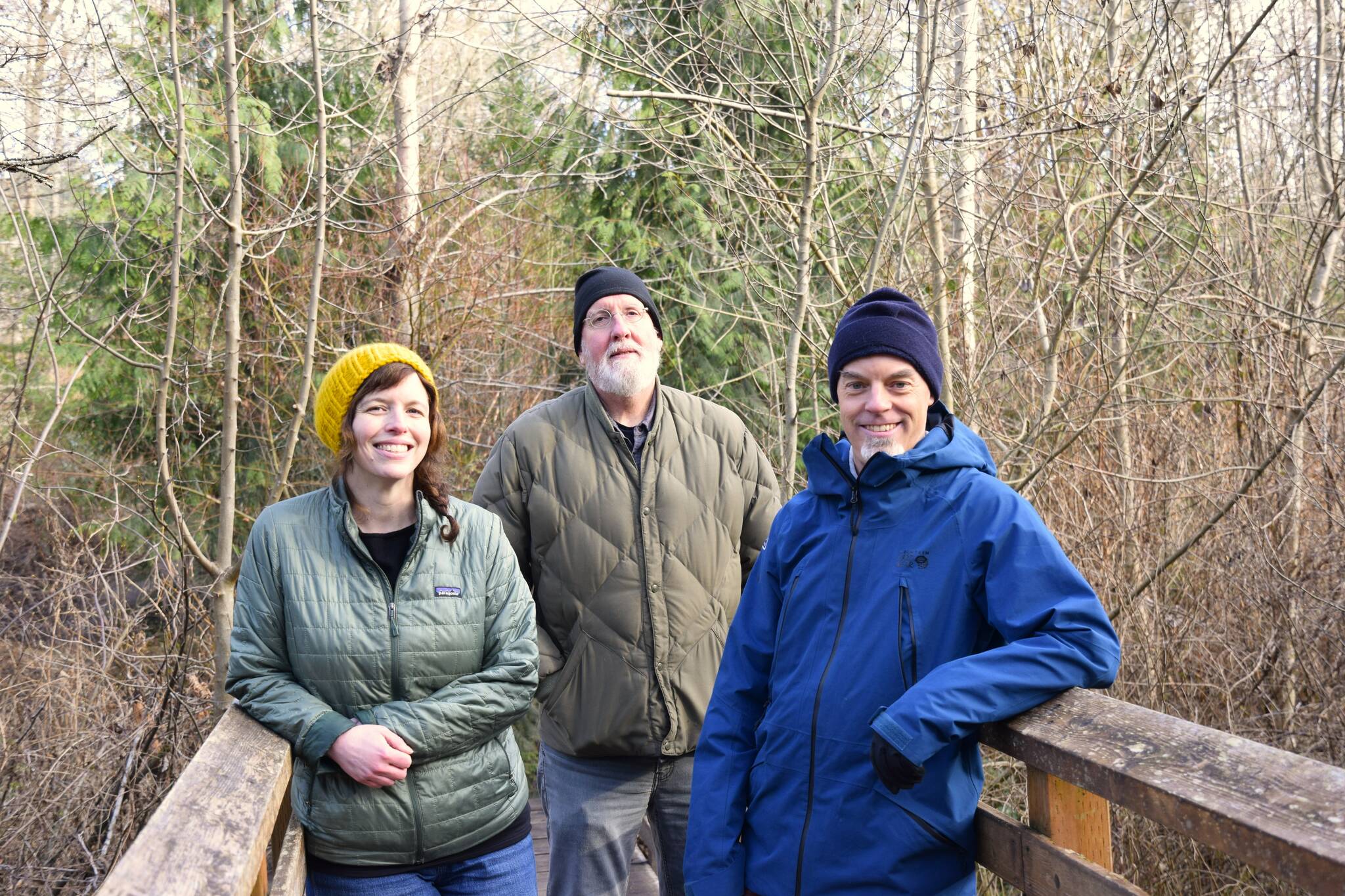
From left, Jenny Stamper, Tom Dean and Theron Shaw. (Tess Halpern Photo)