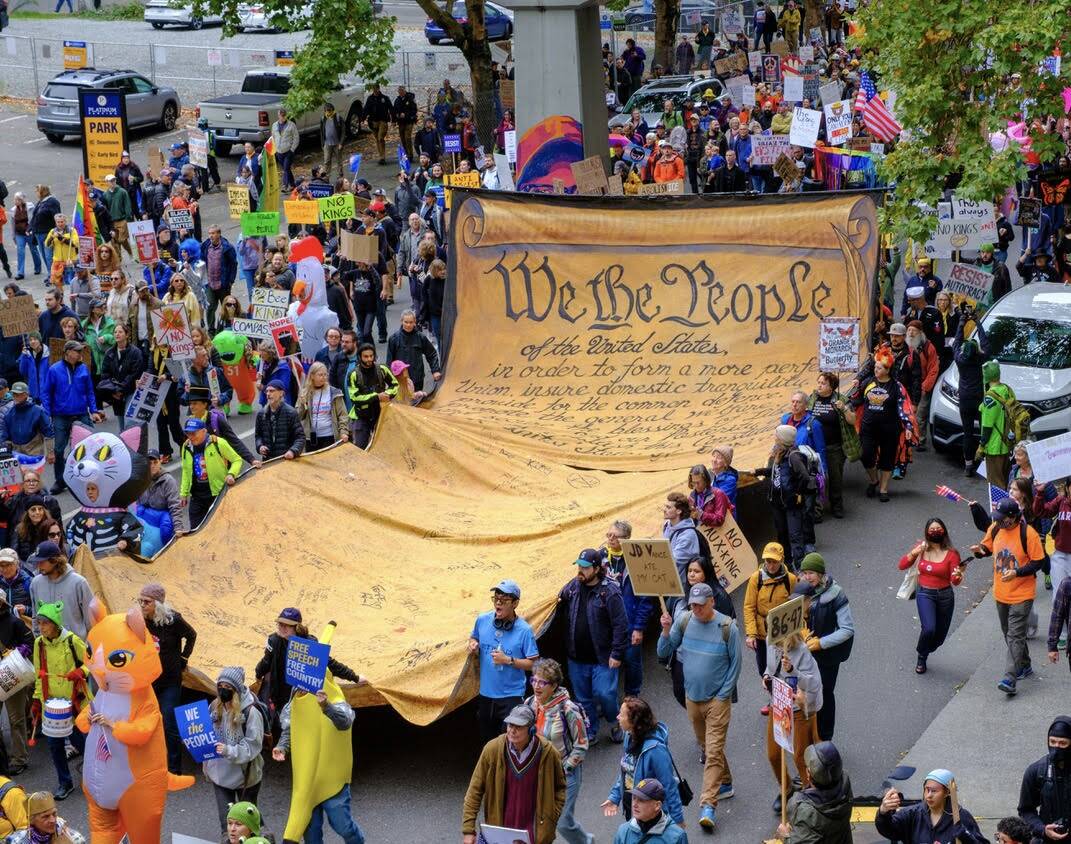
On Oct. 18, three identical banners — each 18 feet wide and painted with the words “We the People” — unfurled in three different cities at once. In Washington, D.C., Chicago and Seattle, marchers — both Vashonites and strangers — held the edges, carrying the scroll through the cities.
The synchronized display was the work of the Backbone Campaign, a nonprofit activist collective from Vashon Island whose protest art has appeared in demonstrations across the state and country for more than two decades.
The “We the People” scrolls — hand-painted reproductions of the Constitution’s preamble on muslin — have been used in demonstrations across the country and featured prominently in national media coverage. They’ve appeared on front pages and television screens from The Daily Show to The Rachel Maddow Show, yet few people know they were created on a tiny island in Puget Sound.
“It’s wound up being hugely effective through time,” Vashon artist and scroll creator Steffon Moody said. “I think part of it is that it’s not a divisive image … it’s ‘We the People.’”
The Backbone Campaign started with a loosely organized group of artists on Vashon — friends gathering for potlucks after 9/11, trying to figure out how they could make a difference in a world at war. The Bush administration’s invasion of Iraq had just begun and they wanted to do something that was both creative and defiant. They were a small circle of friends taking action together — and, like many on Vashon, they were artists or connected to the arts.
“The tradition of creativity and artistry on this island maybe make it the only place a Backbone Campaign could emerge with this kind of nimbleness and authenticity,” Bill Moyer, executive director of the Backbone Campaign, said.
Their first project, 22 years ago, was both literal and symbolic: a giant, hand-built backbone. The idea was to deliver it to Democratic leaders — to “give them a backbone” to stand up to the Bush administration. The humor stuck, and so did the name. The Backbone Campaign was born.
Backbone’s imagery was — and continues to be — theatrical, playful and unmistakably political, designed to make people look twice.
“Backbone quickly became more than just about giving Democrats a backbone,” Moyer said. “It pivoted toward helping to support social movements and protests around the country with creative ideas and imagery, and ways of using materials and tactics to amplify our progressive values in a highly visible and enrolling way.”
The Backbone Campaign now trains activists in overpass bannering, light projection and other forms of visual protest. It’s a small operation with a large reach, guided by what Moyer calls “a spirit of generosity.” “We’re happy to share and learn from each other,” he said. “We’re helping the larger mobilization — not a brand or an organization’s brand, but the movement itself.”
Moyer, Moody and sculptor Bill Jarcho have all been part of the group since its inception. Moody and Jarcho have built many of Backbone’s most recognizable protest pieces.
One of Moody’s longest-standing creations is the “We the People” scroll — an 18-foot-wide muslin-and-starch banner, hand-painted to mirror the preamble of the Constitution and capable of extending up to 200 feet. Created in 2007, the scroll became the kind of protest imagery that defined Backbone’s work.
The scroll has since traveled to hundreds of protests across the country — rolled out by crowds, carried by 50 or more people and signed by marchers like they were adding their names to the Constitution itself.
This summer, Moody made two more. So during October’s “No Kings Day” protests, three of the scrolls were seen in the streets at once — one in Washington, D.C., one in Chicago and one near Backbone’s home in Seattle.
The materials are intentionally simple. “This is just muslin,” Moody said. “It’s not plastic. It’s not printed out. There are some very organic human qualities which make it really perfect for the job.”
Moody said that organic, hand-made quality builds on traditions of the past — a reminder that moving forward often means acknowledging what came before.
“It’s calm,” he said. “Even the color is warm. It’s coming down the street and it’s old, it’s familiar.”
The scroll folds down small enough to fit into a suitcase, he added — “one of the largest-impact things, and still one of the most compact.”
Moody learned the craft from his father — a professional scene painter — a detail that gives the work a sense of irony, he said. “He kind of went to the dark side with Fox News,” Moody said. “So there’s some poetic justice — I’m taking the craft he taught me and using it to defend the world from autocracy.”
The “We the People” scroll has appeared in the Los Angeles Times, New York Times and Chicago Tribune, and on The Daily Show, CNN and more.
“It’s been in almost every major publication in the country as the symbol for the No Kings movement,” Moody said. “It’s nice to see this old technology do good work — and serve a purpose, which it has for centuries.”
While Moody’s scrolls became one of the campaign’s most visible images, Jarcho’s papier-mache creations — oversized, satirical political heads — have carried Backbone’s humor and edge.
In the early 2000s, Jarcho sculpted the “chain gang,” a lineup of caricatured political figures — George W. Bush, Dick Cheney, Donald Rumsfeld and Condoleezza Rice — dressed in black-and-white prison uniforms and linked together by chains. The pieces were absurd, grotesque and funny and they became part of anti-war demonstrations through the Bush years.
“Comic relief is one thing, but it disarms the authoritarians because they don’t like to be mocked,” Jarcho said. “Laughter is powerful. When people can laugh at something, they feel empowered — that’s what I’ve noticed over the years.”
This summer, he revived the project with a new “chain gang” — Donald Trump, J.D. Vance, Stephen Miller and Kristi Noem. The updated heads, each mounted on a helmet and paired with striped prison suits, debuted at the “No Kings Day” protests in Washington D.C., where they drew crowds — and cameras.
“These guys are even worse,” Jarcho said. “They need to be really brought to justice, and through this satirical lens of the chain gang … they certainly made a splash.”
Jarcho’s art often walks the line between mockery and message. “It takes some of the power away from them because they look so foolish,” he said. “It also gives people a lot of hope. It cuts the fear.”
He also created the “LICE agents,” insectoid parodies of ICE officials, turning the acronym into a biting visual pun. The foam costumes — giant lice in tactical vests — were worn by Moody, Jarcho and others at the October protests in Seattle. The characters later appeared on The Daily Show.
“They reminded me of lice,” Jarcho said with a laugh. “So I made ICE agents into LICE agents.”
The project, which took an entire summer and seven costumes to complete, combined absurdity with sting and was created with help from Clare Dohna and Evan Simmons.“That was like the pinnacle for me,” he said of seeing his work on The Daily Show. “[John Stewart is] like my hero, as far as his humor and his empathy and smarts — he sort of encompasses all of it for me.”
For Jarcho, art is both a craft and a responsibility. “I think it’s really important in this time of upheaval to have an organization like Backbone that helps bring people together and motivate them to stand up and not be cowed and frightened by what this administration and Trump are trying to do,” he said. “Hopefully people will want to come and join in — help out, volunteer, because they can definitely use funding.”
Jarcho sees the satire not as a gimmick, but as part of a deeper purpose.
“I have developed over the years a passion for equality and justice,” he said. “This is my talent … I use my talent for good.”
Moyer said that spirit — of art as both resistance and connection — has defined the group from the start. “We always have a spirit of generosity,” he said. “We’re helping, using our creativity and experience to help the movement be more enrolling, more successful.”
Over two decades later, the effort shows no sign of slowing. Backbone has about 10,000 to 12,000 members — and in the past 10 months, it has added another 1,000.
“This moment we’re in has really allowed Backbone to grow,” Stacy Carkonen, deputy director of the Backbone Campaign, said. “Backbone does not function without the support of this community and our volunteers and our donors.”
And despite the massive media attention, “we’re still pretty much under the radar,” she added with a laugh.
For Moyer, recognition of Backbone as the group behind this art isn’t what matters. Acknowledging the artists does — but the “why” of Backbone, he said, has always been about propelling the broader movement forward.
“People around the world are seeing this stuff,” Moyer said. “We’re really helping represent and create icons for this movement that are strong and powerful and are going to help it grow.”
He credits Vashon itself — its creative community and sense of possibility — for allowing Backbone to thrive.
“You’re never going to be able to know all the cool things that come out of Vashon Island,” Moyer said. “It’s a unique place — a place of permission — where people explore their creativity. ”
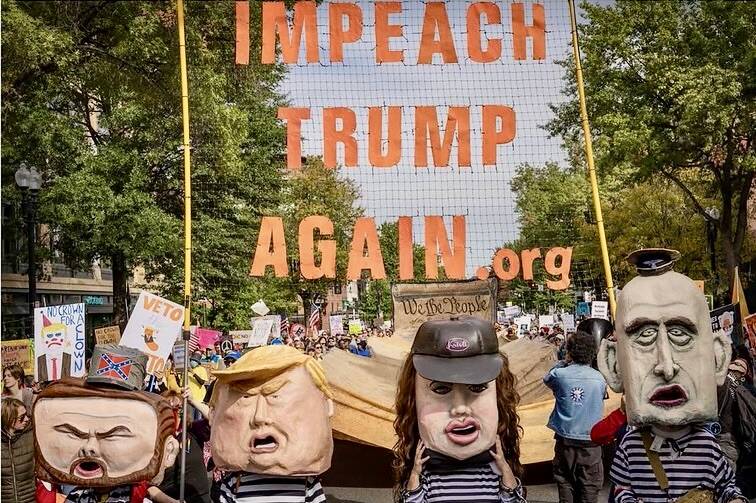
The Backbone Campaign’s “chain gang” puppet heads appear at the Oct. 18 No Kings protest in Washington, D.C. (Courtesy Photo)
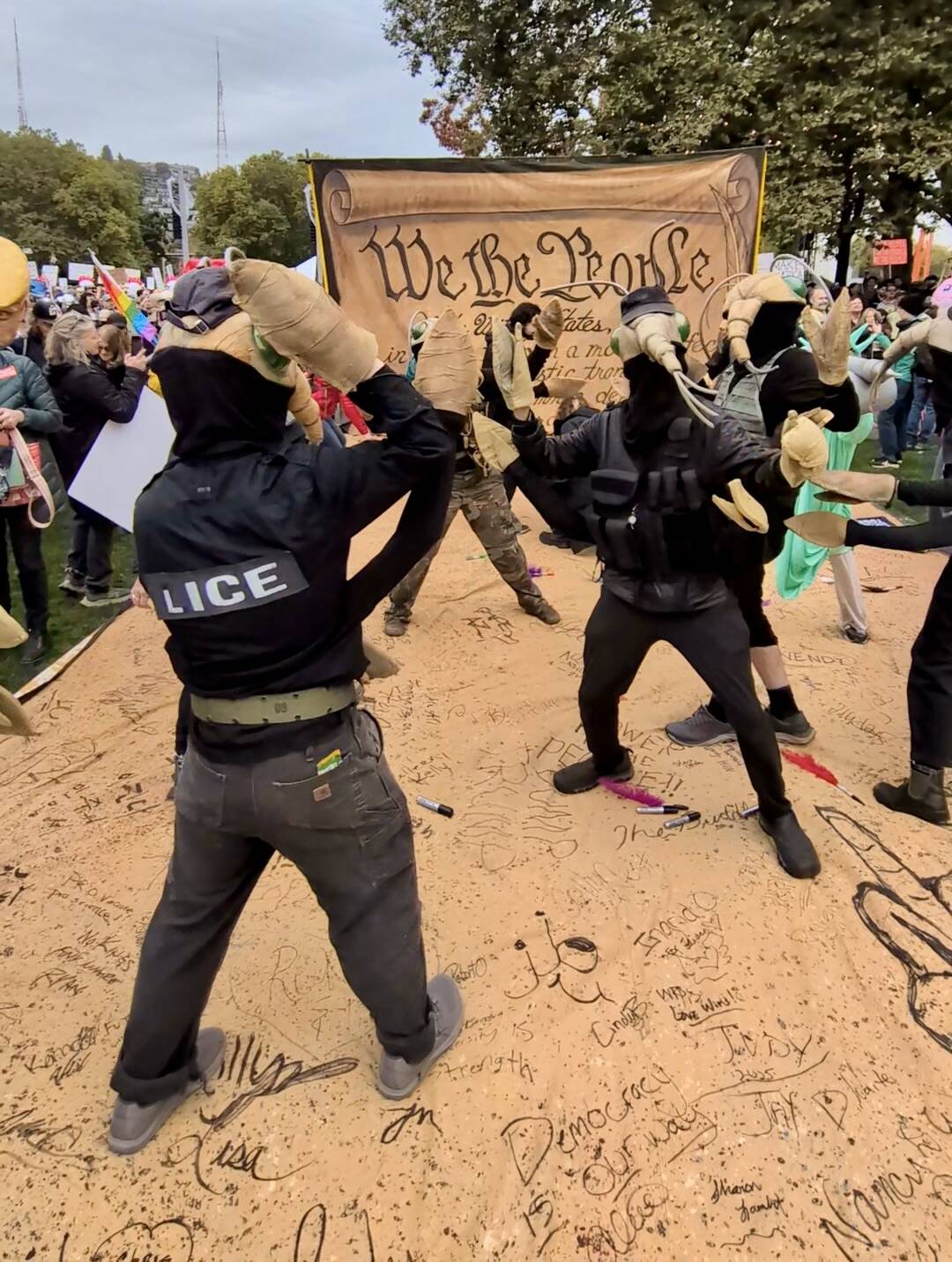
The satirical “LICE agents” — giant lice in tactical vests — join the No Kings protest in Seattle on Oct. 18. (Courtesy Photo)
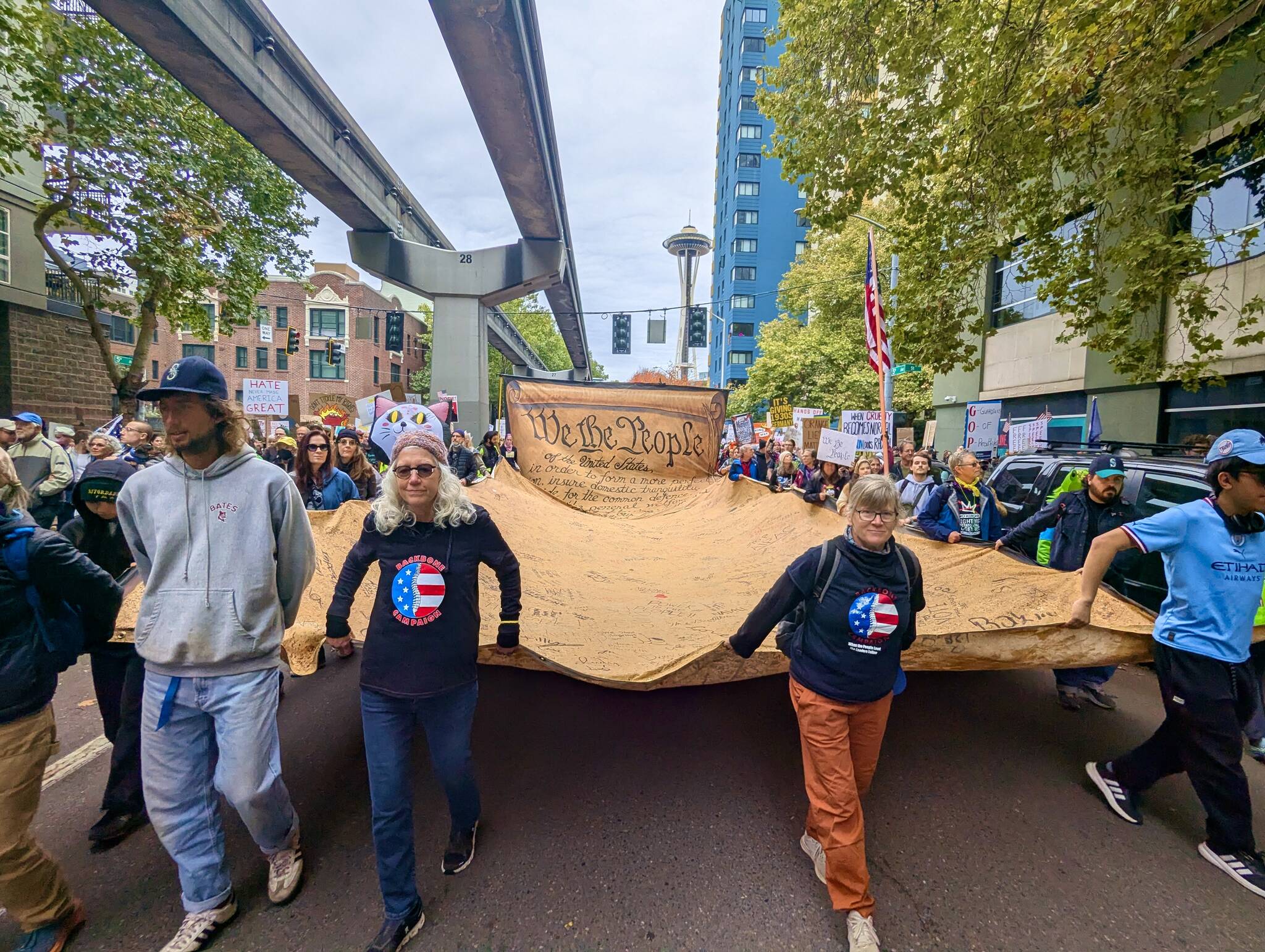
The “We the People” scroll moves through downtown Seattle during the Oct. 18 No Kings protest. (Courtesy Photo)
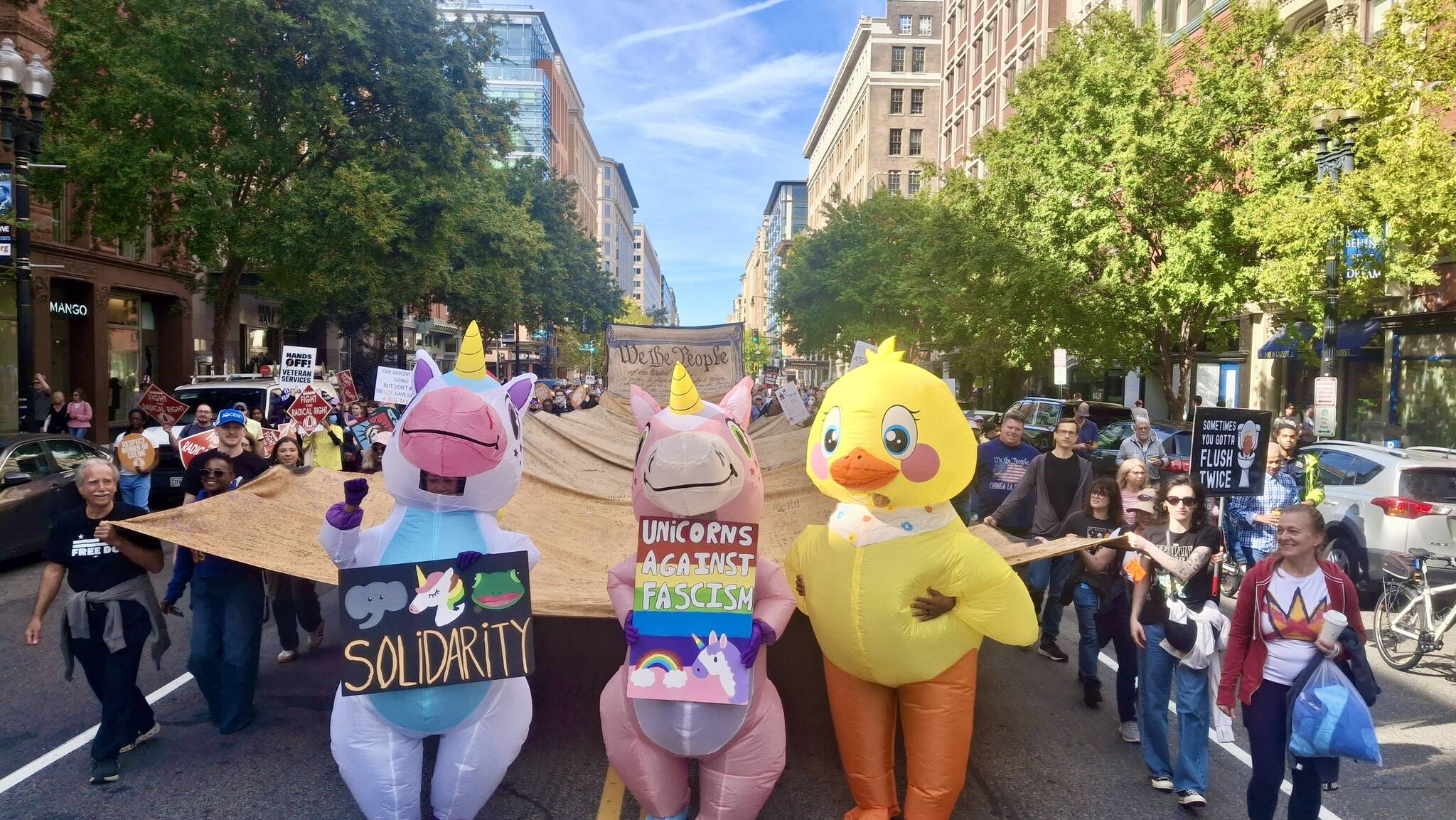
Marchers hold the “We the People” scroll at the Oct. 18 No Kings demonstration in Washington, D.C. (Courtesy Photo)
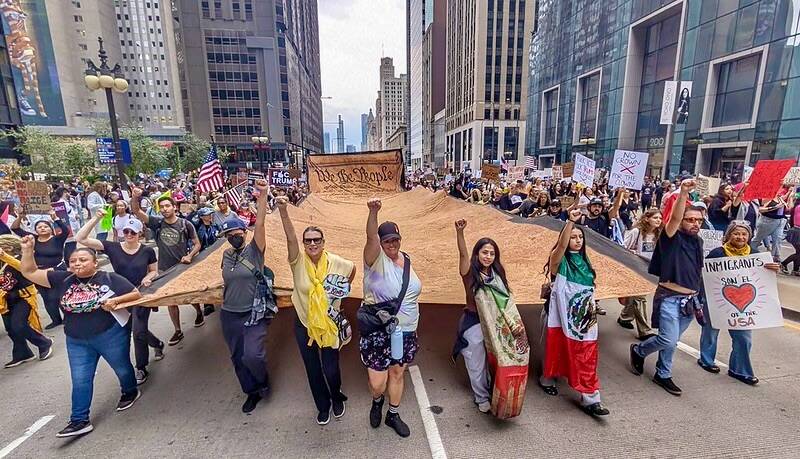
The “We the People” scroll stretches across the crowd during Chicago’s Oct. 18 No Kings demonstration. (Courtesy Photo)
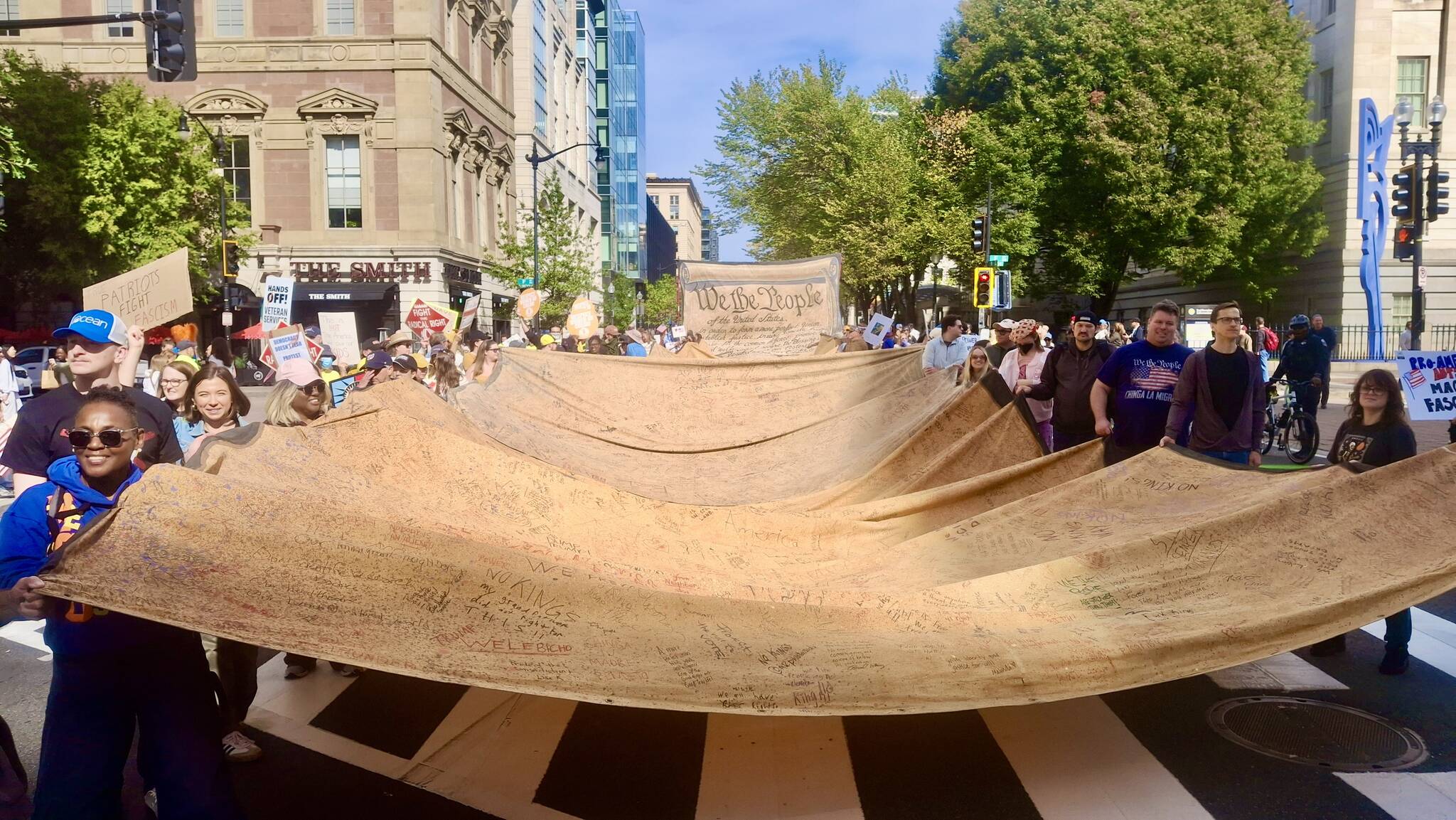
Protesters carry the “We the People” scroll during the Oct. 18 No Kings protest in Washington, D.C. (Courtesy Photo)
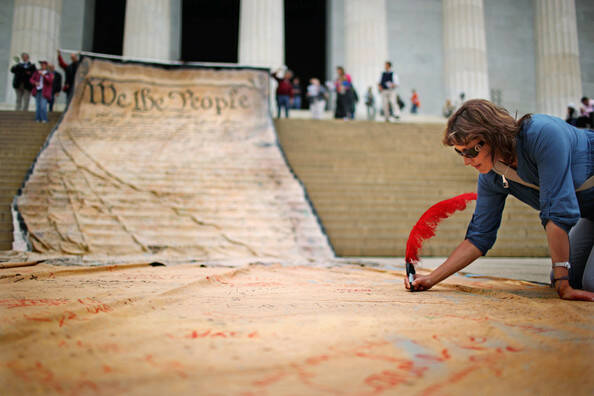
The Backbone Campaign’s original “We the People” scroll in 2007. (Courtesy Photo)
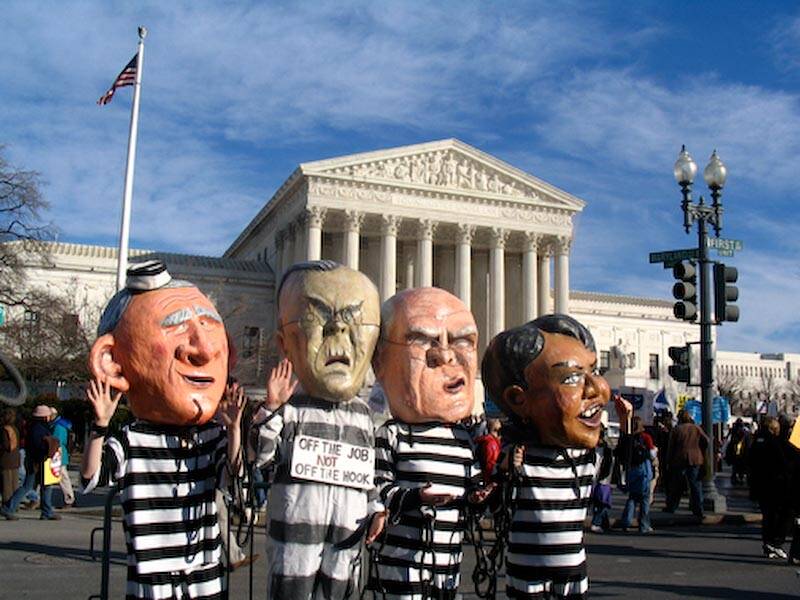
Backbone Campaign’s original Bush/Cheney chain gang debuts at a large public demonstration in New York City on April 29, 2006. (Courtesy photo)
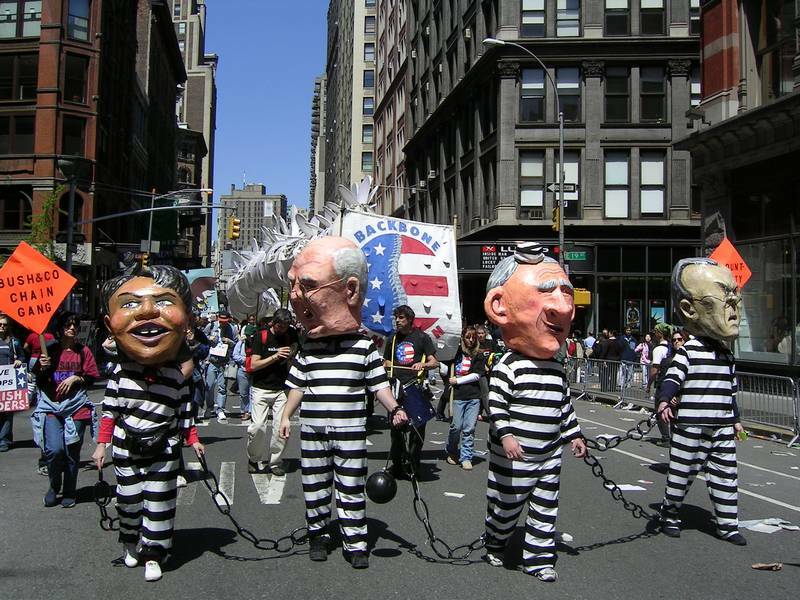
The first big public demonstration we brought the Bush/Cheney Chain Gang to was in NYC on 4/29/06. (Courtesy Photo)