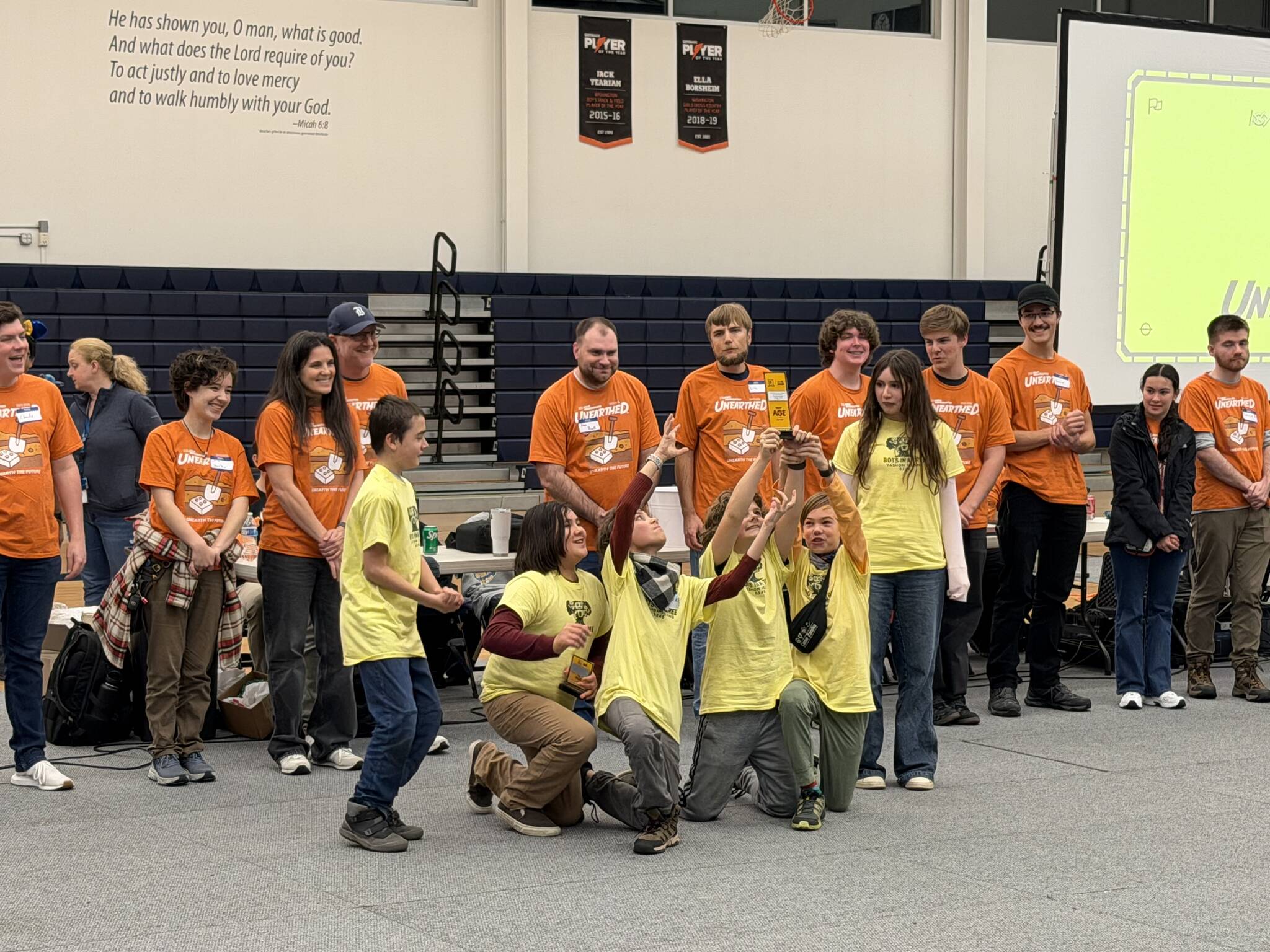
The air hummed with enthusiasm at Bellarmine Prep in Tacoma on Sunday, Dec. 14, as 28 teams from across the South Sound gathered for the First Lego League (FLL) Challenge Robotics regional qualifier.
Hundreds of fifth- through eighth-graders had spent months designing and programming robots and various attachments to tackle a series of obstacles during 150-second competition rounds. They had also devoted significant time to their innovation projects, a core part of the FLL Challenge competition in which teams identify a real-world problem related to the annual theme, research it, design an innovative solution and present it to judges, focusing on problem-solving, creativity and communication to score points.
It all came to a head on competition day when teams presented their projects and designs and competed in three rounds of robot missions.
“My favorite moment was the excitement I felt before our first turn to compete,” said McMurray Robotics Team member Pacha Alvarez.
The two groups representing the McMurray Robotics Team, Bots in a Tree and The Byte Brigade, dominated the event by earning the top six scores in the robot missions and taking first and second place, respectively, in the overall Champions Award. Both groups advance to the state semifinals later this month.
This is the 18th year for the McMurray Robotics Team, led by fifth-year coach Alex Tokar.
Preparation for the competition began in early September when the 11 members — Pacha Alvarez, Jonah Baum, Sota Berleth, Oscar Buse, Ueli HansPetersen, Enzo Hill, Esmae Hill, Aesa Jonasson, Leo McCullagh, Henry Reynolds-Pugh and Baker Starr — first gathered to begin tackling the challenges presented by this year’s archaeology-based FLL theme, Unearthed.
Due to FLL limits of 10 members per team, the students were split into two groups. Guided by Tokar, VHS coach Bruce Johns and parent volunteers, including innovation project leader Allison Reynolds and team leaders Zach Jonasson (Bots in a Tree) and Susan Baum (The Byte Brigade), the teams dedicated six to eight hours each Saturday to researching, building and programming together.
For many of the kids, the robot design and programming elements were a favorite focus of the meetings.
Each team designs and programs one robot and multiple attachments, which are swapped out to try to complete as many of the 15 possible missions as they can in two minutes and 30 seconds.
Second-year team member Esmae Hill from The Byte Brigade said her favorite part of this season is “the new set of missions this year and seeing how different robot attachments could solve multiple problems.”
Leo McCullagh from Bots in a Tree, said his number one element is “the Gyro code because it [gives] us more accuracy” (in simple terms, gyroscopic code helps correct direction as the robot moves for more precise and accurate navigation).
Both teams excelled at designing their robots and creating multifunctional attachments, as well as programming them to complete multiple missions in a single pass. These accomplishments led to each team achieving a top score of 300 at regionals, 100 points higher than any other team scored that day at the local competition.
Sota Berleth’s key moment of the competition was “the moment when we scored 300 points. It made me really happy because I knew then we [would] probably advance.”
Substantial meeting time was also spent on the innovation projects.
Each team conducted research and consulted with professional archaeologists Emma Dubois and Fiona Koehnen to learn more about real-world problems in archaeology and tackle a specific challenge by designing an innovative solution.
“It was really cool interviewing actual archaeologists and getting their feedback on our project ideas,” said fourth-year team member Aesa Jonassen.
Bots in a Tree focused on helping urban archaeologists carry all their gear in a backpack that can turn into a wagon. Oscar Buse explained, “we designed a backpack for archaeologists to carry their supplies safely and efficiently, with coil suspension to distribute the weight and many specific straps for all their tools.”
The Byte Brigade designed a device to help archaeologists more effectively see inside test holes at a site. As part of their process, they consulted hardware engineer Bob Moses.
“He helped us think about making our device lightweight, portable and durable,” Jonah Baum told the competition judges when explaining the development of their prototype.
The scores for the innovation project and presentation account for 25% of a team’s total score for the Champions Award. It would not have been possible for the teams to place first and second without these outstanding efforts.
While the McMurray Robotics Team gained and applied substantial knowledge about robot design, programming and archaeology, many students felt the lessons and experiences related to teamwork were the most impactful.
“Working hard as a team every week, then seeing all our hard work result in success at the competition” was the key takeaway for Bots in a Tree seventh-grader Enzo Hill.
Team leader Zach Jonasson explained, “[the students] worked as a team throughout the season, sharing ideas and code without any sense of ownership. It was rewarding to see all of their efforts translate to such a big success for both teams in the regional competition.”
Baker Starr said his core memory of the season so far is “getting trophies as a team, [it] made me so excited and happy.”
The two teams now look forward to the state semifinals, where they will compete against other top teams from various regional competitions around the state.
Callie Buse is the parent of a student on the McMurray Robotics Team.
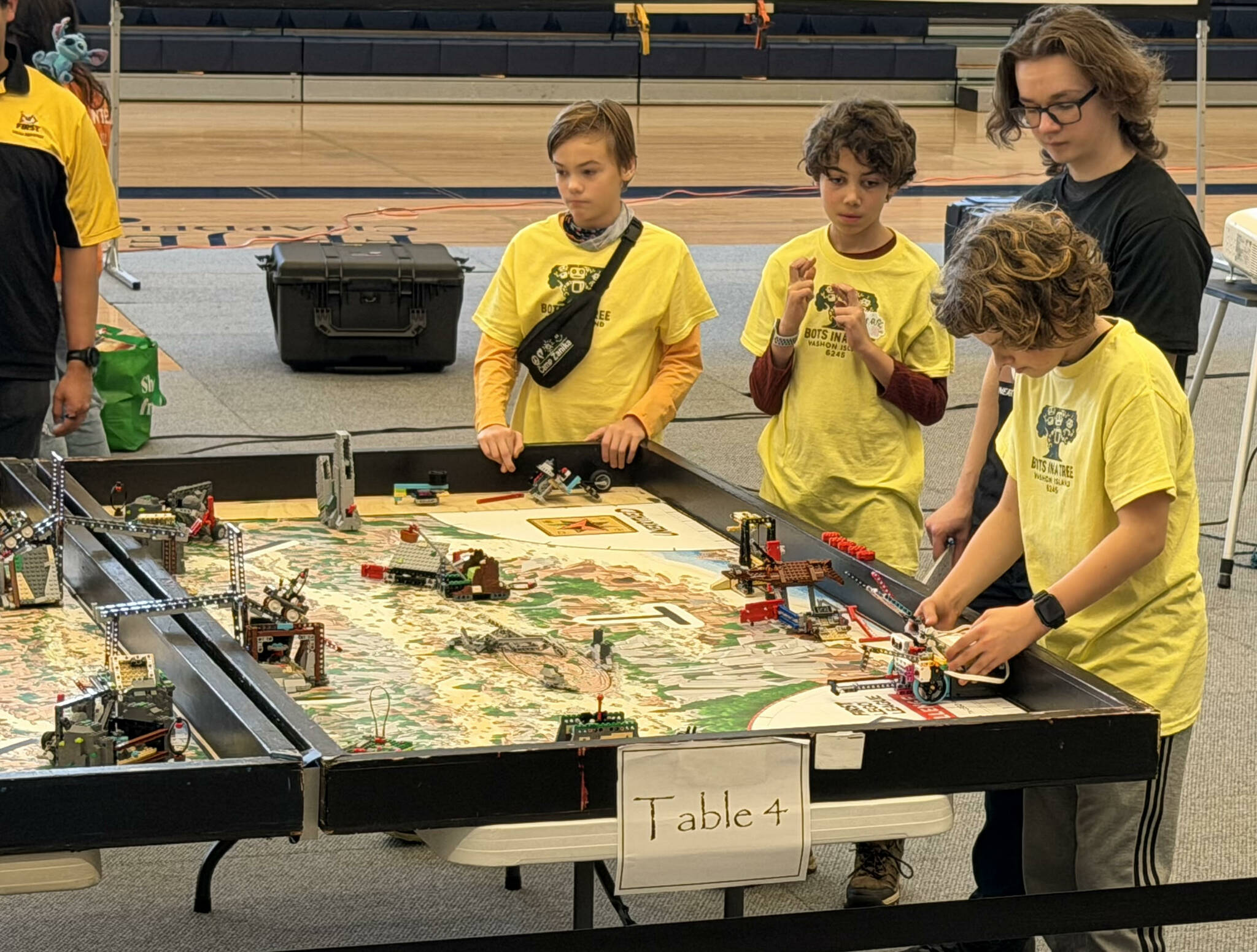
Oscar Buse sets up the robot for a pass at several missions during Bots in a Tree’s 300-point round as Enzo Hill and Pacha Alvarez cross their fingers and hope for success. (Courtesy Photo)