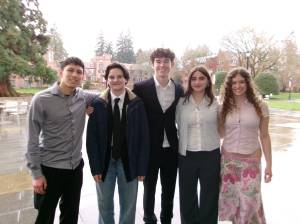
An Islander makes his way down the long path of recovery
Published 11:24 am Tuesday, September 25, 2012
In a longboarding accident on a spring day two years ago, Islander Daniel Haag suffered a brain injury so severe it nearly took his life. Now, after prolonged medical care and rehabilitation, Haag is back on Vashon, living in the place he calls home.
While he has come far from the day of the accident, when doctors doubted that he would live, Haag, 28, still has a long road of recovery ahead of him. Last week, sitting outside on a friend’s deck in the afternoon sun, Haag talked about his life now and his most pressing concerns, including working on his unfinished cabin. For Haag, with a small income and limitations resulting from his injury, such an undertaking weighs heavily.
“I still don’t know how to walk,” he said. “I still fall down. That’s it. Plain and simple.”
In fact, Haag does know how to walk, but his gait is unsteady, some of his movements slow, and his memory, by his own admission, is poor — all typical repercussions of severe head injuries.
To those who know him best, however, his recovery is nothing short of miraculous.
“His progress is amazing,” said Dave Warren, his boss and the director of Vashon Forest Stewards. “He’s fought for every inch of it.”
Warren, who visited Haag frequently during his hospitalizations and rehabilitation, remembers how bleak the picture was. During the two months Haag was in a coma, Warren said he expected a Hollywood ending, where one day Haag would rouse and be fine. But that is not how the picture unfolded.
When Haag came out of his coma, his awareness grew slowly, Warren said. He could not sit, swallow or say more than a few quiet words. He had limited use of one arm, and his memory was extremely limited. Doctors had removed half of Haag’s skull the first night in the hospital to allow for brain swelling, and eight months passed before surgeons replaced it.
He stayed at Harborview Medical Center for three months; then, still unable to sit up or eat, he was moved to a Mercer Island care facility, where he spent several more months. Further hospitalizations were required before Haag finally moved to Delta Rehabilitation Center, a long-term care facility in Snohomish for people recovering from traumatic brain injuries. Haag lived there for more than a year.
Warren credits the Delta center for playing a pivotal role in Haag’s recovery.
“It saved Dan’s life,” he said.
Haag does not recall much of his time in rehabilitation, but he does remember some aspects. “I just had to sit down and be quiet and accept that someone was getting paid to help me,” he said.
Among his friends, Haag is known as being a meticulous and skilled woodworker. Before his accident he built the shell of the small cabin on a parcel of shared, wooded land in the center of the Island, but now the tasks at hand — installing insulation and paneling as well as stairs to his high sleeping loft — present quite a challenge.
“All these tools I have are perfect,” he said. “Only I can’t hold a drill or anything perfectly. It all goes wonk-a-doodle-do.”
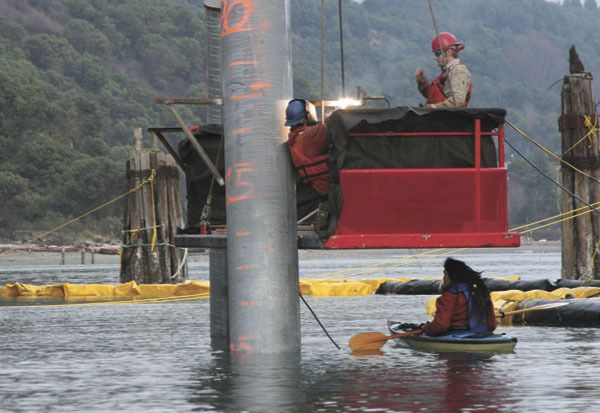
Many Islanders likely recall Haag, a quiet but high-profile Islander before his accident. He wore his jet-black hair in dreadlocks and would longboard through town, his hair flying behind him; sometimes he’d sit on a street corner in town and drum. He also played a role in the headline-grabbing demonstrations against Glacier Northwest; he was one of a handful who dared to kayak under a water-borne construction crane before the corporation decided to sell its holdings on Maury Island.
For several years before his accident, Haag also worked as a sawyer at Vashon Forest Stewards, and Warren welcomed him back to work after he returned to the Island this summer, though Haag quickly points out that his tasks there are much different now.
Warren, who says he has “great affection” for Haag, recounted a story from his early days at the mill. Haag was living in a former school bus at the time. One day the bus was at the mill but Haag was not around, Warren said. Thinking he must be asleep, Warren knocked and went in when no one answered. He did not find Haag but did find Haag’s tools. On one side of the bus, his woodworking tools were organized neatly on a peg board, and his chainsaws, peaveys and other logging equipment were all organized just so on the other side.
“And I thought, ‘Who is this guy?’” Warrren recalled. “Everything was all in place. Very orderly and exact.” Now he knows the meticulousness he spotted that day was typical of Haag.
“That is part of his character,” Warren said. “He is very orderly and exact.”
It is a trait that served him well when he was promoted to the head sawyer at the mill. It is highly skilled work, Warren noted, and large mills pays accordingly, though on Vashon the position paid much less than prevailing wages.
“He ran the mill terrifically,” Warren said.
Last week, after talking about his long recovery, Haag gave a visitor a tour of his tiny cabin — a minimalistic structure with bare frame walls, few furnishings and intended to be both a home and wood shop. A stack of windows rested against one wall; when asked, Haag described an elaborate plan to install them in his roof.
“I have sort of a designer gene that helps me,” he said. “I don’t have the capacity to carry it out anymore.”
Haag, who is slowly growing back his dreadlocks, readily admits to some of the wide-ranging difficulties of his recovery.
He can’t play drums anymore, for instance. “All my musical capabilities have vanished; it is something I hugely miss. My body and my mind are separate things now,” he said. “They do not work together.”
But aware of how close to death he came, Haag said he contends with the challenges in his life now by simply carrying on. “You just wake up every morning,” he said. “It’s just something you do. If you are dead, you don’t.”
Meanwhile, the Forest Stewards plan to help Haag with some projects at his cabin with cold weather approaching, Warren said; the Interfaith Council to Prevent Homelessness will provide additional support. But Warren hopes such help may not always be needed, and he can imagine that someday Haag may run the Forest Steward’s yard again.
“I would have said he would never be back here,” Warren said. “I think it is the challenge he needs. Who knows what his limits are?”