Court victory: Friends of Mukai gain access to historic home and garden
Published 1:30 pm Tuesday, March 29, 2016
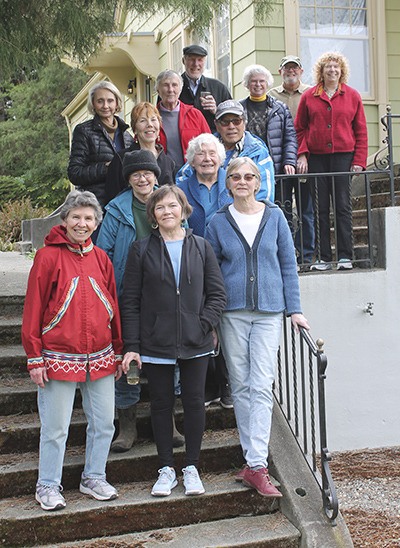
The local group that has been fighting a prolonged legal battle to take control of the Mukai House and Garden scored a legal victory in court on Friday and for the first time has possession of the historic property.
King County Superior Court judge Monica Benton awarded the home and garden to the island’s nonprofit group Friends of Mukai when she vacated a “stay of enforcement” that had been in place since last April, but the legal fight is not over, Lynn Greiner, the group’s attorney, cautioned. The State Court of Appeals has yet to determine that the Friends group is the lawful board of Island Landmarks, which owns the property. While waiting for that decision, which Greiner said she expects within the next few months, the Friends’ board will have access to the property and will be able to make restoration plans.
Most members of the Friends of Mukai board gathered at the home on Saturday and held a small celebration, complete with champagne toast, after walking through the home, which was built by B.D. Mukai, a Japanese-American strawberry farmer who left Vashon during World War II. The property includes a traditional Japanese garden with some American influences designed by his wife at the time, Kuni.
“I think everyone was so pleased,” Greiner said on Monday. “We were so happy to be in there to look at it, that all this work has paid off. It belongs to the public. We can really start to work on it and turn it into a vibrant community gathering place.”
Last April, Judge Benton ruled that members of the Friends of Mukai legally orchestrated their 2012 takeover of Island Landmarks, a decision that would have left Island Landmarks president and Texas resident Mary Matthews no longer affiliated with the nonprofit or the Mukai property. Matthews appealed and was awarded a stay, a legal action that allowed her to retain control of Island Landmarks during the appeal process. However, Greiner said, the court set several requirements for Matthews, who was most recently represented by her husband and attorney J. Nelson Happy. While the couple did put a new roof on the house last fall, they did not fulfill the other requirements, Greiner said, including opening the house to the public and paying all the house-related expenses. Greiner noted that the house has not been open since last June and that Matthews owes $22,000 in back taxes on the property. The home is now in foreclosure.
Because of failing to fulfill the obligations, Greiner said the Friends group filed a motion to vacate the stay. At one point during the proceedings last week, Greiner said that Happy, who telephoned the court from Texas, said he and Matthews were willing to get rid of the stay because they were not going to pay anything more on the property. Benton, then, awarded the property accordingly. On Monday, neither Matthews nor Happy responded to calls seeking comment about the case.
Now, with full access to the property, Friends of Mukai members say they are looking ahead and plan to act on an initial report from Tacoma-based Artifacts Consulting, which specializes in historic preservation. The Friends hired the firm to create a preliminary renovation plan for the home, and Greiner said they will be able to bring experts in and begin to make plans.
“We need people to come in and help us figure out what needs to be done and what is in OK condition,” she said. “Once we have the Court of Appeals decision, we will be ready to go immediately.”
She noted that while the house looks better than some board members had expected, there are some significant problems, including a crumbling chimney, daylight visible between the chimney and the roof and an outdated electrical system. Historian and Friends of Mukai board member Bruce Haulman noted that the problems also include a furnace that has not worked since 2008, cracks in the foundation and a basement that floods with heavy rains.
But, he said, the problems can be remedied.
“For an 80- to 90-year-old house, it is in good, restorable shape,” he added.
The Friends group has received substantial financial support from the organization 4Culture and the state to restore the property, and Haulman noted it will be tapping into those funds as it moves ahead.
As for the most recent ruling, Haulman said he, too, is excited.
“I think it vindicates what a number of us have said over the last 15 years. Mary Matthews did a great job of … raising money to buy the house and and gardens. I think we have to give her proper credit for that,” he said. “The problem arose with daily management and public money. Few of the provisions that came with that money were fulfilled,” he said.
Now, he said, a group of more than 30 volunteers, including three landscape architects, is ready to plan the restoration of the garden. The Friends of Mukai already hold three to four educational programs a year, and that effort will continue, with events held at the home itself. He added he believes there will be activities there as early as this summer, including during the Strawberry Festival. And, he said, the property will give a home to the Japanese Presence Project, which he helms with islander Alice Larson to tell the story of the island’s Japanese residents over the years, many of whom were sent to internment camps during World War II.
Last Saturday, one of those celebrating the legal victory for Friends of Mukai was Flo Lentz, who worked for 4Culture for 12 years and recently joined the board of the Friends group now that she has retired. She noted that 4Culture provided $100,000 to Matthews for the purchase of the property with the conditions that it be maintained and open to the public. Those conditions were not met, and the property became one of the top three “problem children” for the organization. Over the years, individuals and organizations concerned with culture and historic preservation tried to address the problems at Mukai and find a new steward for the property without success. Once the Friends of Mukai formed, it quickly garnered support, Lentz added.
“Our efforts and other efforts would have led nowhere without the Friends of Mukai,” she said, gesturing to the group of islanders gathered on the home’s porch. “It was the local support that made that happen.”