VIFR’s ability to respond to emergencies questioned as volunteer force falls
Published 1:30 am Tuesday, May 2, 2017
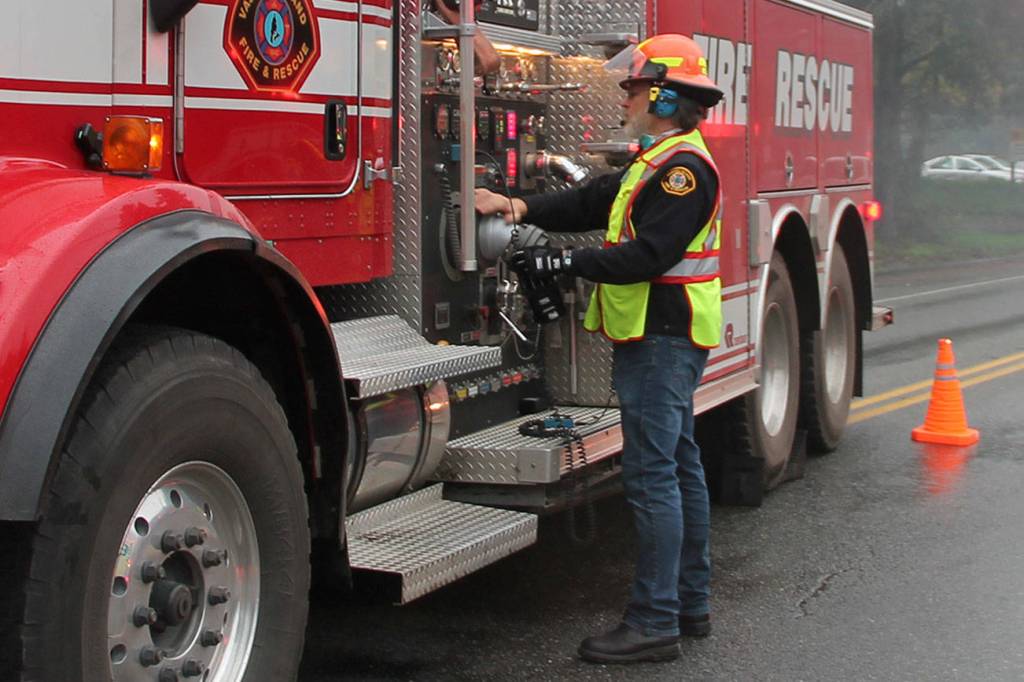
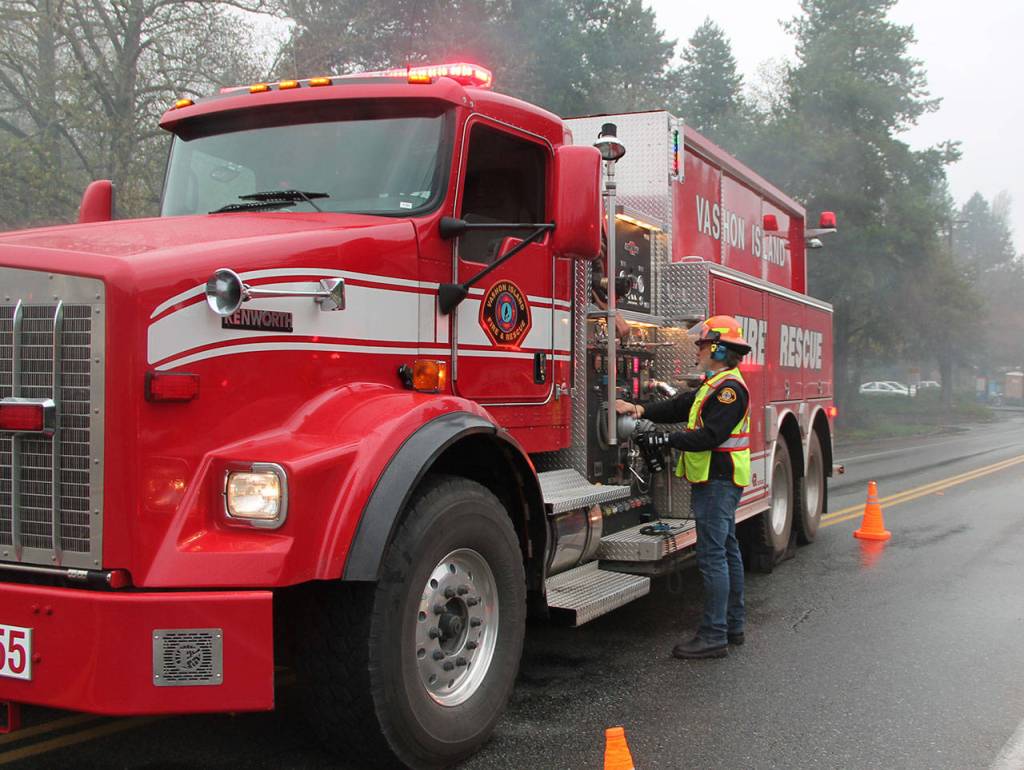


Facing a decline in its volunteer ranks, many at Vashon’s fire department say personnel numbers have become so low that they are concerned they will not be able to respond adequately to fires or a cluster of medical emergencies.
Last week, Chief Charlie Krimmert, who began his position in January after 16 years as a volunteer with the department, addressed the staffing issue at a Sunday board retreat and at the regular commissioners’ meeting two days later. There, as part of a series he is delivering to the board about the state of the department, he displayed a chart that showed the number of career and volunteer firefighters and emergency medical technicians (EMTs) at the fire district. The chart showed that Vashon Island Fire & Rescue’s (VIFR) staffing for emergencies — a combination of paid firefighters and volunteers — is far below desired levels. Krimmert also delivered the framework of a possible plan that could help address some of the challenges: begin charging for ambulance transports to area hospitals and use that revenue to hire part-time firefighter/EMTs.
The current personnel shortage applies only to VIFR career staff and volunteers and does not pertain to paramedics, who respond to life-threatening emergencies and are employed by King County Medic One.
“Volunteerism is very cyclic, and unfortunately we are at the bottom of the cycle, and we have fewer volunteers now than when we originally opened this organization in 1942,” Krimmert told the commissioners at the Tuesday meeting.
Moreover, he said that in the last 17 years, while Vashon’s call volume has increased some 60 percent, the department’s volunteers have decreased by nearly 70 percent. Paid staff have increased in that time, but by less than 40 percent — meaning that fewer people are being relied on to do more work. Noting the rigorous training demands for volunteers, Krimmert acknowledged the challenges involved in recruiting and retaining sufficient volunteer numbers.
“Volunteering is not so much volunteering as it is taking on a second job, especially when your numbers are low, and we are demanding more and more call backs, more and more attentiveness, more and more leaving dinner,” he said.
Members of the local firefighters’ union have also expressed worry about staffing. Union President Randy Tonkin, a captain at VIFR, called staffing for emergencies the union’s biggest concern. He noted that the district operates with a minimum of two career firefighters on duty. While there are times additional career staff or volunteers are working, there are shifts with just two people on.
“At that level, we can handle one medical call at a time, nothing more,” he said in a recent email.
With more staff on duty, they can respond to up to three medical calls or one motor vehicle accident. When calls come in beyond what the duty crew can handle, the department puts out a call to its members to assist. Currently, there are only 20 on-island volunteers, a number district officials have called an all-time low. This includes two who are firefighters, five who are EMTs and two who are both. The remaining 11 local volunteers fill support roles at fires and motor vehicle accidents. Additionally, there are currently 19 off-island volunteers, and while they play an important role when scheduled, given the time involved commuting to Vashon, it’s the island volunteers who are most helpful when the need for extra personnel arises quickly.
As the staffing picture currently stands, Tonkin said the district is not adequately equipped for fighting fires.
“Our opinion is that, at all times, we do not have enough qualified firefighters to safely conduct operations that would typically be expected at a residential structure fire,” he said.
In fact, the effects of the current staffing situation were evident at a March house fire on Deppman Road. The first engine responded with two firefighters on it, and it was more than 15 minutes before additional help arrived. Tonkin, who responded to that fire, said smoke had likely destroyed the contents of the home by the time the first engine arrived. However, he said that the fire conditions called for “an aggressive interior attack to knock down the seat of the fire” in order keep the fire from spreading and preserve the structure and belongings to the extent possible. In order to take such action, however, state law requires that four firefighters be present. This is commonly known as the two-in, two-out law, which dictates that when firefighters enter a burning structure, two must go in together and two must remain outside, ready to assist if necessary. If there is potential for loss of life, three firefighters are required, with two entering the building, one waiting outside and confirmed reinforcements on the way. No occupants were trapped inside at the March fire, but Tonkin said it is important to consider what might have happened in such a situation.
“Without at least four firefighters on scene, we are put in a difficult situation of jeopardizing ourselves and disregarding state law in order to do what is actually the single most important function of our job: to save lives,” he said.
At a typical house fire, Krimmert told the commissioners, the district currently would be fortunate to have 12 firefighters respond, both career staff and volunteers. However, a more likely turnout is eight, he added — a number significantly lower than what most fire departments respond with, as they rely on either a large staff of their own or help from nearby departments, which is not available quickly on Vashon.
Krimmert is concerned enough about VIFR’s fire response capabilities that he told commissioners that he believes the district must “re-think” its approach to fighting fire. He noted that the department has 14 career firefighters, a number that accounts for two new firefighters who have been hired and will come on next month, and the resignation of a temporary firefighter, who will leave soon. Once the new firefighters start, three shifts will have three career firefighters scheduled and one shift will have two, according to Assistant Chief Bob Larsen. Krimmert said that he would like to see three career staff on each shift and at least two volunteers on duty as well.
“Of course volunteers self staff when they can or want, so we do not have much control in that regard,” he added.
Fire-related calls currently make up 20 percent of the department’s calls; the remainder are for medical assistance. Based on call volume, the board previously directed the department to have adequate staffing on duty to be able to field 2.5 aid calls at a time — the half call being an EMT responding to, but not transporting, a patient. Currently, the district is “pushing it” to meet the board’s directive, Krimmert said, particularly on weekends, when few volunteers have been signing up for shifts. Two years ago the department was able to meet the board’s directive 68 percent of the time. Last week, Larsen said that number has declined to 57 percent for this year.
In an effort to keep EMTs on the island when calls come in, the fire department has increased its reliance on a private ambulance service for hospital transports. The patient is transferred on the ferry dock, where the private ambulance takes over care and transportation to the hospital, and the Vashon EMTs travel back on the same ferry they arrived on.
Krimmert made clear no one is fond of this approach. It is not used all the time, and the EMTs make the decision about when it is used, but reliance on it has increased.
“We do not like it, and we imagine the patients don’t like it,” he added.
Right now, however, its use is considered important because hospital transports can take three hours, and this method means that emergency responders can return to the island far more quickly than they would otherwise, ready to field other calls.
At last week’s meeting to begin to address some of these issues, Krimmert presented the outline of a possible plan that would have VIFR charge for ambulance transports to hospitals. In turn, the district would use that revenue to hire part-time firefighters/EMT in what he called the Enhanced Volunteer Program. He noted that many who volunteer at the district are seeking to make a career of firefighting, and volunteering is a step in that process. VIFR pays its current volunteers a stipend for their service, and Krimmert said the district’s chief competitors for career-minded volunteers are private ambulance companies. If the district could match what those companies pay — $11 to $15 per hour — it could see higher numbers of volunteers and improved ability to respond to emergencies.
Both private and public ambulance service providers commonly charge for transporting patients to medical facilities, but Vashon has not done so for many years, although the board voted in 2004 and 2008 to institute such a program. The latter attempt was quashed just days after it was implemented, in part because of concerns that a fee for transport might deter islanders from calling 911 when they needed it. Now, however, many at VIFR say that additional personnel are essential for the department to better serve the island, and that the new revenue, covered largely by insurance, would be helpful in paying for that staff. Fire commissioners have given their informal approval for such a plan, still under development, and the program could be implemented as early as this summer.
Speaking for the union, Tonkin expressed frustration with the board and former administration for the problems growing as grave as they are, but he said the members support Krimmert and Larsen.
“We are encouraged by their awareness of the challenges facing the fire district and believe they are attempting to put forth important initiatives to improve our resiliency and ability to serve the needs of the community appropriately,” he said.
Next week, Krimmert will continue his state-of-the-district series and will focus on the condition of VIFR’s facilities and fleet. The meeting will be at 6:30 p.m. Tuesday, May 9, at Station 55 on Bank Road. The public is welcome.