Talks at Arts Center To Offer Insights on Salmon and More
Published 1:30 am Thursday, May 13, 2021
Mark your calendars for two upcoming talks at Vashon Center for the Arts, one centered on preserving salmon as the lifeblood of Puget Sound, and the other about the trials and accomplishments of an accomplished endurance athlete.
“Living Waters | Salmon Flash Talks”
The talk will take place at 7 p.m. Thursday, May 20, on Zoom. Advance registration is required at vashoncenterforthearts.org and there is a suggested donation of $10 to attend.
Living Waters is a partnership between Vashon Center for the Arts, Vashon Nature Center, Vashon Heritage Museum and the Natural History Museum to increase public awareness of efforts to restore the health of salmon, whales, and the Salish Sea.
Salmon are the lifeblood of the Salish Sea. More than 137 species depend on salmon, including humans. Yet, over the last 200 years, human activity has caused salmon populations to decline drastically. Through a series of short flash talks, six experts will share stories about their work discovering innovative ways to help recover Salish Sea salmon populations. A discussion and Q and A with speakers will follow the talks.
Several speakers will offer insights based on their experience in the field.
Angela Dillon, Puyallup Tribal Member, SEPA Reviewer for Puyallup Tribe Fisheries Department, will explain the work done by the Puyallup Tribe Fisheries Department on the juvenile salmon smolt traps on the Puyallup and White Rivers, the prey resources study on Clear Creek, and efforts regarding restoration and conservation. Dillon previously worked as a Stock Assessment Biologist, monitoring juvenile salmon on the Puyallup River. Currently, she is researching juvenile salmon diets, invertebrate prey resources, and restoration on Clear Creek, in Puyallup.
Stephanie Blair and Chelsea Mitchell, of Washington State University’s Stormwater lab, will present a talk on Coho salmon urban runoff mortality syndrome and how low impact development can solve the problem of toxic stormwater. The pair will discuss how urban stormwater runoff is the largest source of pollution entering Puget Sound, containing contaminants responsible for killing an estimated 40 to 90% of returning coho spawners annually in some urban streams before they can spawn. Both Blair and Mitchell are Ph.D. candidates and researchers at WSU’s Puyallup Research and Extension Center.
Jason Toft, Principal Research Scientist at UW School of Aquatic and Fishery Sciences, will discuss the impact of bulkheads on salmon and the targets for removing bulkheads and restoring shorelines in Puget Sound.
Tessa Francis, Lead Ecologist at Puget Sound Institute of UW Tacoma, will share results from a two-year study of the effects of armor removal on nearshore fish abundance. Her team surveyed nearshore subtidal fish at restored (armor removed), armored, and natural shorelines of six sites around the Salish Sea, finding no effect of shoreline structure on salmonid abundance. Herring and smelt were more abundant at natural or armored shorelines. They found no positive effects of shoreline restoration on nearshore subtidal fish abundance. Francis’ work focuses on linking science to decision-making, the ecology and conservation of coastal ecosystems, and the dynamics at the terrestrial-aquatic interface.
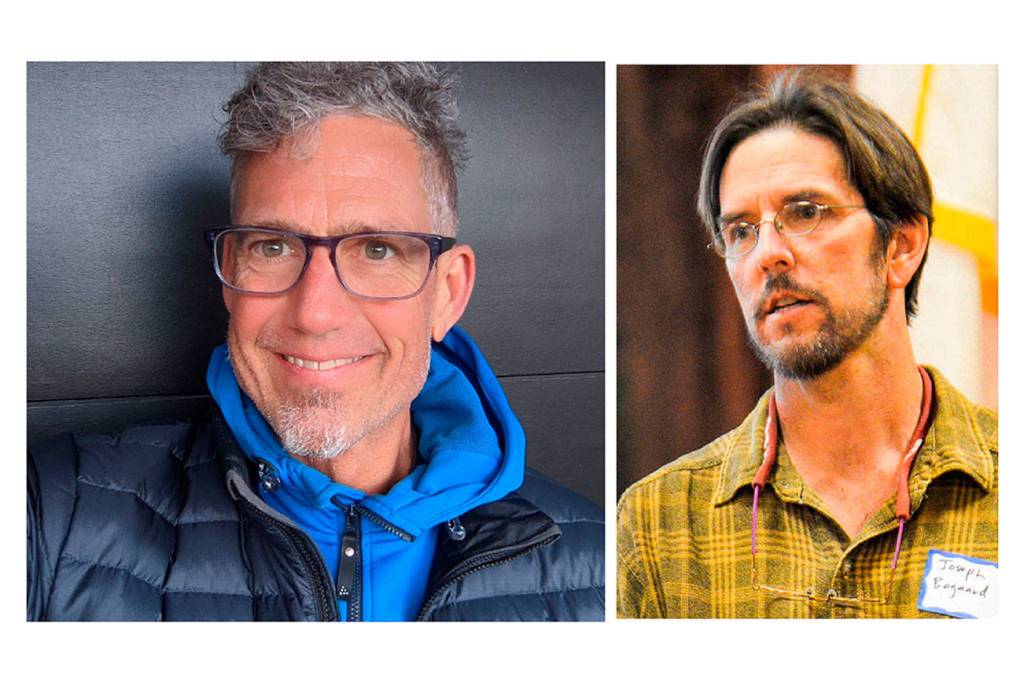
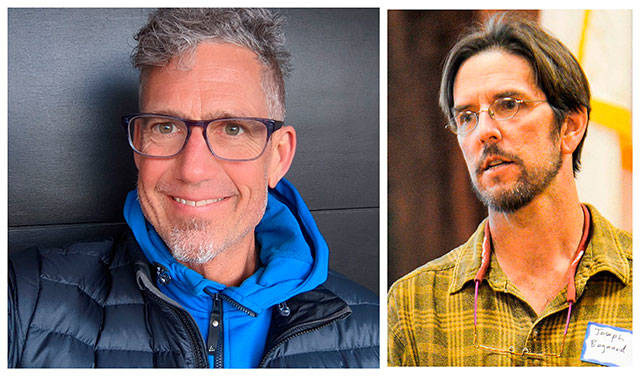
Joseph Bogaard, islander and Executive Director of Save Our Wild Salmon, will discuss restoring the lower Snake River as the best opportunity to recover endangered salmon and orcas. His talk will provide an introduction to the lower Snake River and its historic salmon populations; discuss how salmon connect to human and non-human communities across the PNW; describe the tremendous restoration opportunity before us today – and explain how people can help.
TALK on the Rock | Martin Criminale
This talk will take place at 7 p.m. Wednesday, May 26, at Vashon Center for the Arts.
Endurance athlete Martin Criminale came to athletics relatively late in life.
“In college, some guys I looked up to rode bicycles,” he said. “Since they were cool, by association cycling was cool and I gave it shot. Soon I was all in and racing in every cycling discipline there was back in the early 90s — road, track, mountain bike, and cyclocross.”
After about 20 years of total immersion in cycling, Criminale had a bad mountain bike accident and separated his shoulder. While recovering it hurt less to run than to ride, and since he had already been dabbling in running as “cross-training,” he decided to switch his focus. As is obviously his nature, he went all in here as well. He chose trail running over road running, and gravitated toward the longer “ultra” events. Criminale has identified as a runner since 2012 but says he still loves cycling.
“During my athletic career, I have numerous ups and downs but one constant is that I love being active, being out in the woods, and exploring/adventuring no matter what the speed,” he said. “If I can get you excited about being outside and moving, mission accomplished.”