COVID Update: Infectious subvariants are gaining ground
Published 1:30 am Wednesday, July 6, 2022
Editor’s Note: Read COVID updates by VashonBePrepared in Spanish and English at tinyurl.com/yan39zeh.
Vashon’s reported case count to date passed the 1,000-mark last weekend.
Early evidence from a survey in New York, however, suggests that actual case counts may be as much as 30 times higher than reported counts. So, which data should we follow to get a better sense of how things are going?
Hospitalization rates and death rates are likely to be far more accurate than case counts because medical providers are required to report these numbers to the state.
On Vashon, the hospitalization rate (166 per 100,000) and death rate (46 per 100,000), to date, are far lower than those for King County as a whole (554 and 127.7 per 100,000, respectively). This puts Vashon’s hospitalization and death rates at about 30% and 36% of the county rates, respectively (see more details at tinyurl.com/KC-data).
Although Vashonites mix frequently with residents of the rest of King County, preventative behaviors here continue to help reduce the spread and severity of COVID-19. These behaviors include being vaccinated and boosted, wearing masks in higher-risk environments, improving ventilation, avoiding crowded indoor spaces, and holding events virtually.
Although case rates may be less accurate at this point in the pandemic, Vashon Medical Reserve Corps (MRC) continues to aggregate data from the official statistical dashboard maintained by Public Health — Seattle & King County (PHSKC), the COVID dashboard from Vashon Island School District, test data from Vashon Pharmacy, and islanders’ reports to the MRC helpline. Keep helping MRC track island COVID trends by reporting your positive home tests to the MRC helpline: (844) 469-4554.
More Infectious Omicron Subvariants Spreading Widely
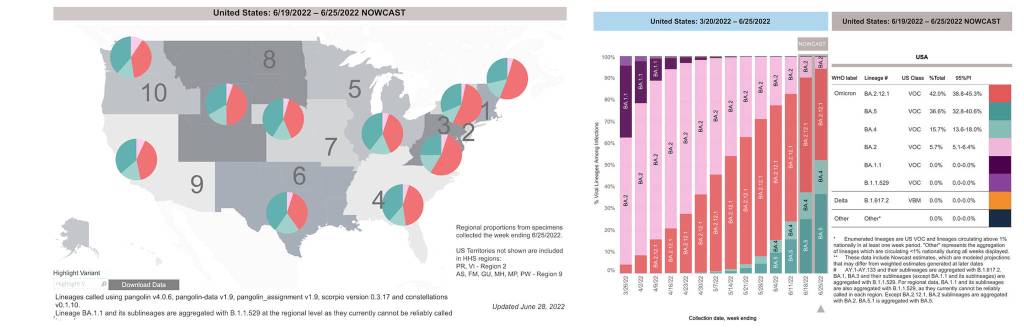
The Omicron variant continues to drive COVID-19 infections, as the more infectious BA.4 and BA.5 subvariants gain ground nationally and locally.
BA.4 and BA.5 now account for more than half of new COVID-19 infections in the United States, according to the US Centers for Disease and Prevention (CDC). For the week ending June 25, CDC data show that BA.4 and BA.5 accounted for more than 52% of cases nationwide and in the Northwest region, which includes Washington, Idaho, Oregon and Alaska.
Public health officials say it is too soon to tell if these two subvariants will cause more severe disease than other Omicron subvariants, but because they are more contagious, it’s likely they will make more people sick. BA.4 and BA.5 evade the body’s immune response, causing infections in people who have some immunity from previous infection or vaccines. Vaccines and boosters continue to reduce the risk of severe illness.
Vashon Medical Reserve Corps (MRC) physicians caution islanders who received boosters, had COVID-19 in recent months, or both, that they are likely still susceptible to infections from BA.4 and BA.5.
“We do not want people to have a false sense of security and let their guard down,” said Dr. Jim Bristow, of the MRC. “Current boosters offer protection for a relatively short time against infection, although they do protect against severe illness for longer. And we know that people who were infected with a previous variant may become sick again after exposure to BA.4 or BA.5, sometimes as quickly as 1 or 2 months later.”
Many experts expect increased infections later this summer and fall, as BA.4 and BA.5 continue to spread.
Some good news may be on the horizon, however. Last week, advisers to the Food and Drug Administration (FDA) recommended changing COVID boosters to better protect against the Omicron variant. The FDA will determine the exact recipe for the vaccine, which manufacturers hope to make available for fall. The FDA’s decision is expected during the first week of July.
“The better the match of the vaccine to the circulating strain, we believe may correspond to improved vaccine effectiveness and potentially to a better durability of protection,” said Dr. Peter Marks, director of the FDA’s Center for Biologics Evaluation and Research.
COVID Summer Safety Tips
School’s out for summer, bringing family vacations, camps, water sports, parties and picnics, and other fun reasons to gather. To stay in the game and not be sidelined by illness, check off these safety tips for your family:
• Get the whole family caught up on vaccinations, not just COVID but vaccines for all vaccine-preventable diseases. Your healthcare provider can advise on the best vaccination schedule for each family member.
• Test at home before attending any gathering. Stay at home if testing positive or having symptoms. Remember to order more free tests at the beginning of each month, at sayyescovidhometest.org or COVID.gov.
• Move activities outdoors, where transmission is less likely. Remember the sunscreen!
• Improve air circulation at indoor events and activities by opening doors and windows.
• Opt for masks when in close quarters or indoors with folks outside your immediate household.
• Consider skipping the dining (unmasked, at close quarters) part of an event. Eat at home, then join in on activities. Bring a water bottle marked with your name so you don’t accidentally drink from someone else’s.
• Ask older kids for their ideas about ways to stay well this summer. It’s cool to keep your friends healthy, so everyone can keep having fun.
Resilience Reminder: Refresh Your Go-Bag
In warm sunny weather, thoughts naturally turn to washing the car, cleaning gas receipts out of door pockets, and vacuuming old Oreo crumbs off the seats before the next road trip. Add one more thing to that list: refresh your go-bag.
A go-bag can be an old day pack or duffle, filled with items that make a long ferry wait more comfortable, or help you stay safer when changing a flat tire. Bring energy bars and snacks, plenty of water, a flashlight or headlamp and extra batteries, cellphone charging cable and power bank, a poncho, some band-aids, or a full first aid kit.
Winter kits may include warm clothing and boots, while summer kits include sunscreen and hats. What else does your crew need to stay safe and comfortable while on the road, or stuck in a line? There are lots of great lists on the internet, including this one: tinyurl.com/WA-gobag.
Latest Vashon COVID Statistics from the King County Dashboard
Source: Public Health — Seattle & King County (PHSKC) and Vashon Emergency Operations Center. New and historic case counts shown here reflect test results from the public health reporting system which does not capture results from home tests.
23 = New cases reported since the last weekly report.
1,016 = Total COVID cases for Vashon residents since the pandemic began.
18 = Patients hospitalized since the pandemic began.
5 = Deaths since the pandemic began.
94% = Percentage of Vashon residents age 5+ who have completed the primary series, compared to 86.3% of the King County 5+ population.
68.4% = Percentage of Vashon residents age 5+ who have added a booster shot to their completed primary series.
For King County, the PHSKC dashboard for the last 30 days says people who are not fully vaccinated are 1.4 times more likely to get COVID, six times more likely to be hospitalized for COVID and nine times more likely to die of COVID.
For more resources, visit VashonBePrepared.org or visit the group’s Facebook page. Sign up at tinyurl.com/4smk364m to receive email updates.