Islander revives vibrant folk art form on local barns
Published 1:30 am Wednesday, November 1, 2023
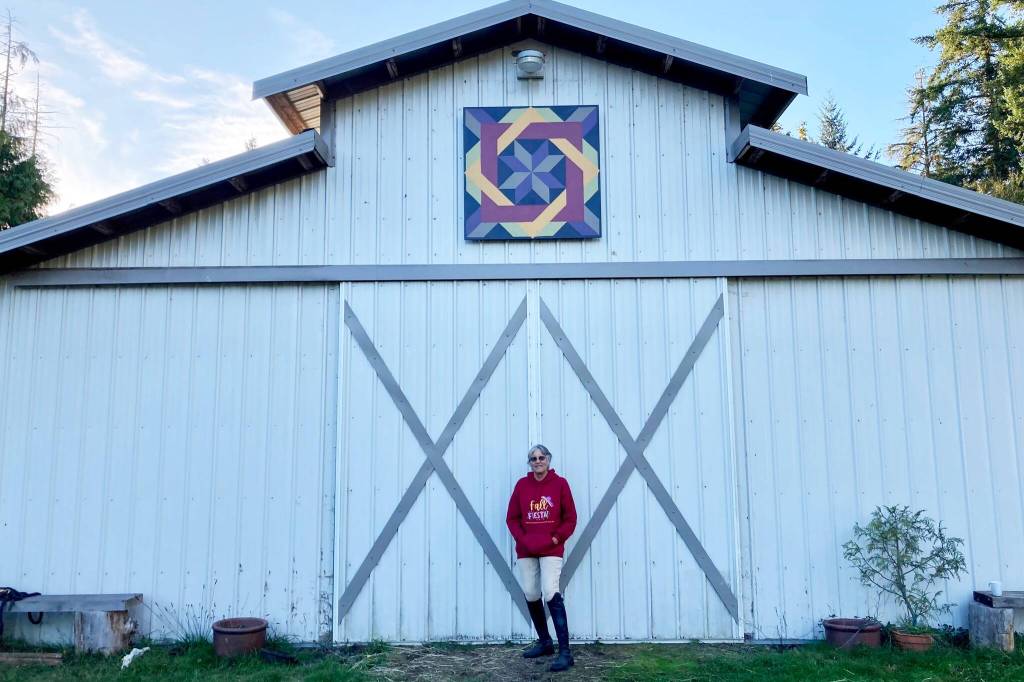
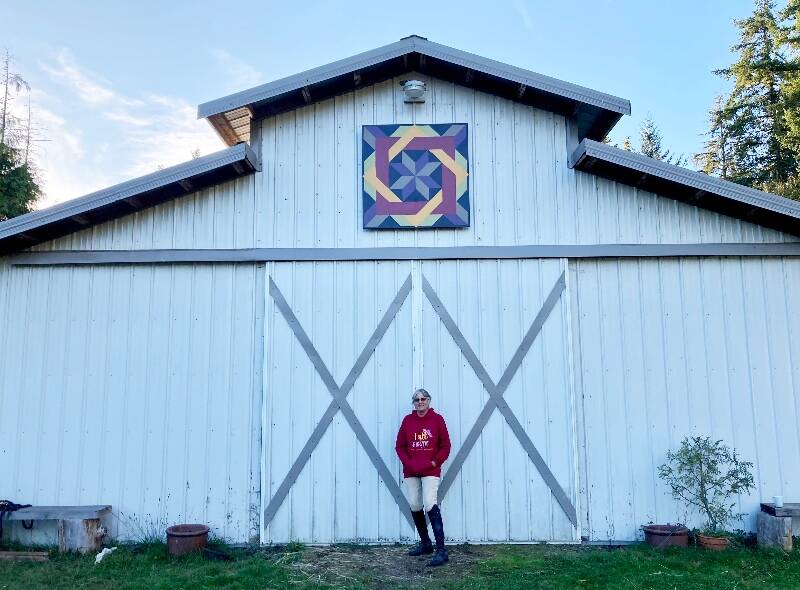

Have you seen the beautifully painted quilts that decorate the north side of The Minglement and a few local barns, from Frog Holler to Luana Beach, and wondered who created them and why?
Long-time islander Carrie Chambers doesn’t consider herself an artist, yet she’s created four 4-foot by 4-foot colorful barn quilts and several smaller prototypes. Each one is a labor of love, requiring 10 hours or more to research, design, paint, and hang.
Chambers spotted her first barn quilt — a quilt pattern painted directly onto an outdoor building or painted on a piece of wood and mounted there — from a car window. She and her family were driving across the state when, near Ellensburg, her eye caught a blur of bold color and she noticed a quilt hung on a barn at the edge of a distant hay field.
She was struck by the contrast of the bright quilt pattern against the rustic backdrop of the faded building.
Chambers’ own barn on Vashon is her happy place. She spends hours there, taking care of her horse and doing farm chores. She loved the idea of honoring the building and the animals in it with homemade art.
She didn’t know if she could make a barn quilt — or even how to begin the process — but after seeing the pop of color and cheer in that Eastern Washington landscape, she was determined to bring the same to her own barn.
History of barn quilts
Like many traditions in American history, this one started on the East Coast and spread west. It was originally a way for families to display their own distinct quilt patterns, but they served a practical purpose as well when they were used as landmarks and directional markers.
For example, you might have received instructions to find a particular farm as you “turn right at the red barn with the green quilt, go over the bridge, then turn left at the big oak tree.”
Paint and materials were expensive back then, but as they became more affordable and available it allowed a growing number of barn owners to show their pride and display their family’s unique design.
Eventually, advertising displays came to supersede some quilts. Yet the folk art of nearly 300 years persists. Today, in parts of the country — especially on the East Coast, Midwest, and in the South, but even as close as Ellensburg — one can follow a quilt trail to see historic and modern designs decorating barns, garages, sheds, and other outbuildings.
Quilt-making process
Chambers had never made a quilt out of fabric when she set out to paint her first barn quilt on wood. Perhaps the lack of experience helped her develop a process that, while still based on geometry, was more intuitive and forgiving.
Quilters might choose a pattern that matches their sewing level and who the quilt is being made for. They would cut the fabric and assemble each “block” by sewing sections together, eventually matching the pieces of the front to a solid back and quilting the two together with some batting in between. The edges are finished with a binding.
That is nothing like Chambers’ process — she approaches the design and painting of barn quilts in a different way. To start, she works with wood instead of fabric and there’s no assembly required.
First, she finds quilt patterns — traditionally a compass rose or interlocking squares. She studies the repeating designs and recreates them on graph paper in order to determine the proportions of each element; she modifies and embellishes the patterns to her liking.
Next, she draws horizontal, vertical, and diagonal bisecting lines on the primed plywood, and, using a compass and ruler, creates the pattern. She said she relishes this more analytical aspect where she uses geometry to get the angles and dimensions right.
For the color scheme of her first quilt, Chambers used a Persian carpet from her dad as inspiration. She played with shades of maroon, yellow, turquoise, and purple in colored pencil on graph paper to get a sense of the interplay and find which colors work best next to each other and at opposite sides of the design.
While she has a better sense now after making a few quilts of how the colors play together, she doesn’t decide on a final palette until she puts the first coat of paint on the plywood. Chambers uses three coats of exterior latex paint without a sealant, which allows her to touch up the paint or change the colors at any point.
Her final step is to make a frame on the back of the quilt to stabilize the plywood; she fastens two stout hangers so it can be hung as a square or a diamond. It takes three people and an extension ladder to hang the 25-plus pound quilt on a tall barn. Chambers relies on the adept help of her husband and son for this step.
Chambers has cut plywood to make quilts that measure 4 feet by 4 feet, 2 feet by 2 feet, and even a wee 1 foot by 1 foot quilt that looks just right on a friend’s garden gate. Each one stretches her math skills and challenges her design chops in all the right ways.
Finding art in unexpected places
A physical therapist by profession, Chambers has no desire to give up her day job. She uses the barn quilts as a creative outlet and a way to spread cheer and color in her community.
She loves finding — and creating — art in unexpected places, barn quilts included. And glorifying barns and outbuildings, which are traditionally places of dirt and drudgery, gives her joy.
While she loves seeing her own barn quilt as she pulls into her driveway, it gives her just as much pleasure to create them for friends.
She donated her most recent work to a fundraising auction to benefit Coulter Verharen, an island-raised equestrian who had a life-changing accident this summer and faces a mountain of medical bills on the road to his recovery.
She is currently at work on a new quilt for the barn of her friend Rebecca Benson in honor of Rebecca’s late husband Tom Wallace, a horseback rider and farrier who passed away this summer.
Perhaps someday Chambers’ quilts will put Vashon on the map and the island will have its very own quilt trail.
Until then, look out your car window as you’re driving by barns and outbuildings around the island and see if you can spot one of her colorful creations.
Beth Lindsay is an islander with an eye for unexpected beauty. She has been active in many local organizations and causes.