High drama and a new baby with J Pod
Published 4:03 pm Wednesday, September 24, 2025
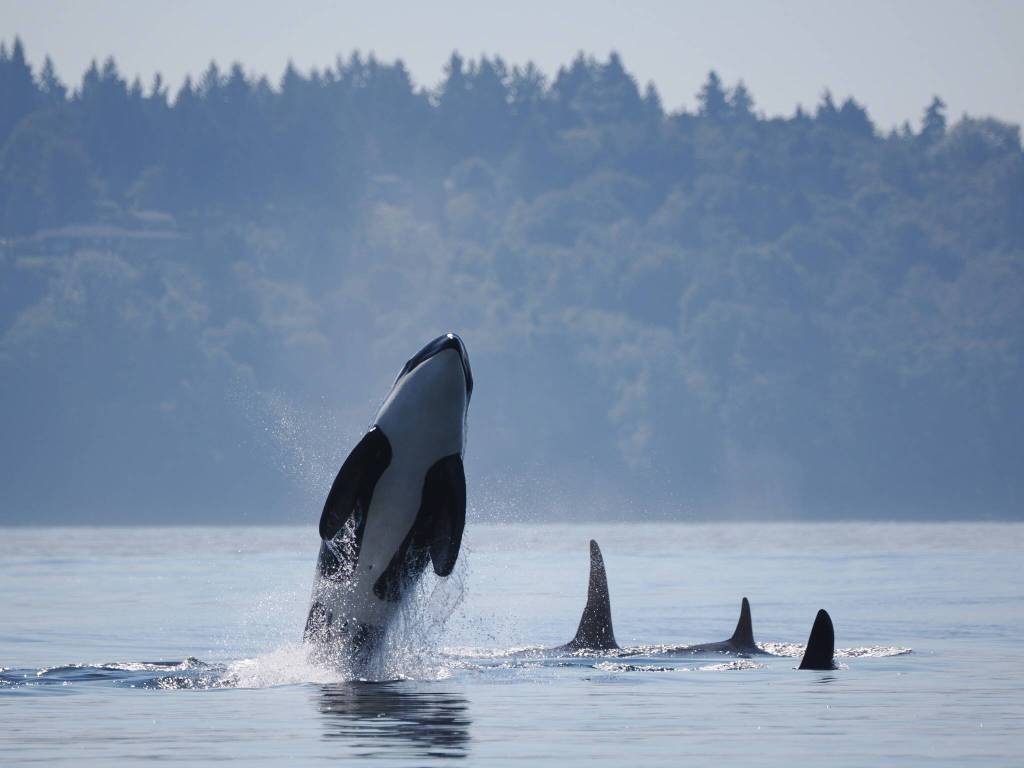
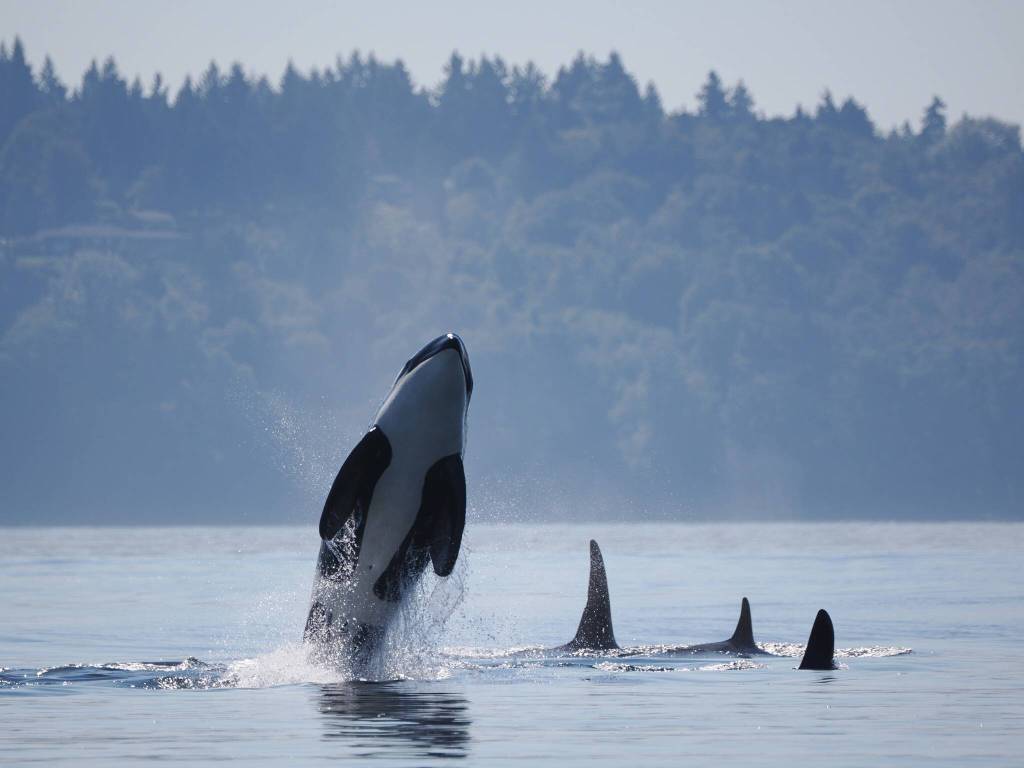
Around noon on Sept. 17, J Pod, one of three critically endangered Southern Resident Killer Whale (SRKW) pods, visited Point Robinson atypically early for late summer/fall.
The pod separated into two groups before reaching the point, with the trailing group a half mile behind the lead group. Both groups engaged in intensive surface activity: spyhops, breaches, pec slaps, tail slaps, dorsal slaps and cartwheels.
J Pod then circumnavigated the island, arriving at Southworth by 4:30 p.m. The orcas did not pause to forage, despite plentiful coho salmon jumping everywhere: J Pod had to contend with numerous fishing boats in their travels through Puget Sound between Sept. 13-21.
Last autumn, J Pod did not venture to Point Robinson in daylight until Nov. 1. Southern Resident orcas usually foray south of the Fauntleroy-Vashon ferry lanes in October or November, though SRKW — J Pod, Onyx (L87) and K13s — journeyed to Vashon-Maury waters several times in mid-to-late September 2019. Salmon were abundant that year, too.
Presumed mother Echo (J42) had a newborn with her on Sept. 17. I saw a tiny, peachy baby through binoculars as J Pod approached Point Robinson, surrounded by immediate and extended family, and spoke with experienced Vashon observers who also believe they saw the baby. (As of press time, there has been no definitive photographic proof of the baby’s passage through Vashon waters on that day.)
This is not unusual, as spotting a newborn from shore can be challenging. SRKW are extremely cautious with their newborns, encircling them in a protective formation of close relatives and podmates. The baby’s matriline, the J16s, traveled farther offshore at Point Robinson on the 17th and again on the 19th.
The J16s did not have a baby with them on Sept. 16 when researchers observed J Pod in the Central Sound north of Vashon. SeaDoc Society researchers confirmed the presence of a newborn with 18-year-old Echo (J42) and the J16s on Sept. 18 in Saratoga Pass.
This birth is especially poignant because Echo’s older sister Alki (J36) was seen on Sept. 12 carrying her own dead neonate on her rostrum in Rosario Strait.
J Pod returned to Vashon-Maury waters on Sept. 19 and 20. On the 19th, J Pod transited Point Robinson in two groups. The J16s and J17s were almost mid-channel as they negotiated many fishing boats and a work barge. The other J Pod families were closer to shore. Both groups were highly surface active, exhibiting the same behaviors as described on the 17th.
In Dalco Pass, the pod split as the J16s and Kiki (J53), a 10-year-old female from the J17s, headed north in Colvos Pass and the rest of J Pod went south through the Tacoma Narrows into Carr Inlet.
The large group stayed overnight in Carr Inlet near Minter Creek Hatchery, which “operates as a production facility for fall Chinook, coho, pink and chum for various Puget Sound fisheries,” according to the Hatchery Scientific Review Group.
On Sept. 20, the J16s meandered in East Passage but they did not travel to Point Robinson. The large J Pod group exited the Narrows through Colvos Pass, where I and others observed them going north in the late afternoon. All of J Pod headed out of Puget Sound on Sept. 21 via Admiralty Inlet. The orcas were northbound in Haro Strait off the west side of San Juan Island by about 4:30 p.m.
The food source in Carr Inlet would have to be spectacular for J Pod to consider returning there after 50 or more years. J Pod has not been documented in Carr Inlet since the era of brutal live captures of SRKW for marine parks, 1965-1977. J Pod and other SRKW were terrorized in the South Sound on multiple occasions during this time at Carr Inlet, Henderson Bay, Vaughn Bay and Fox Island. Precious family members were stolen for entertainment or killed in botched capture attempts.
Removing a breeding generation of SRKW in the capture era put them on a potential extinction trajectory. In addition, the SRKW are critically endangered because their preferred prey, Chinook salmon, is depleted throughout their range.
Nearly 70% of SRKW pregnancies fail. Too many SRKW are immunocompromised. SRKW habitat is degraded by toxicants and underwater noise. Recreational boaters appear to be largely unaware of the new 1,000 yard distance law enacted to protect SRKW.
J Pod has 28 members including the newborn, likely to be designated J64. K Pod has merely 14 members and L Pod has 33 members. At just 75 total, this fragile population is far from recovery.
Count your blessings when you catch a glimpse of any SRKW, especially the babies.
Orca Annie Stateler is an Indigenous marine naturalist, educator, researcher, stranding responder, and founder of the Vashon Hydrophone Project.