Solar power rises at Vashon Market Plaza
Published 1:30 am Tuesday, June 2, 2026
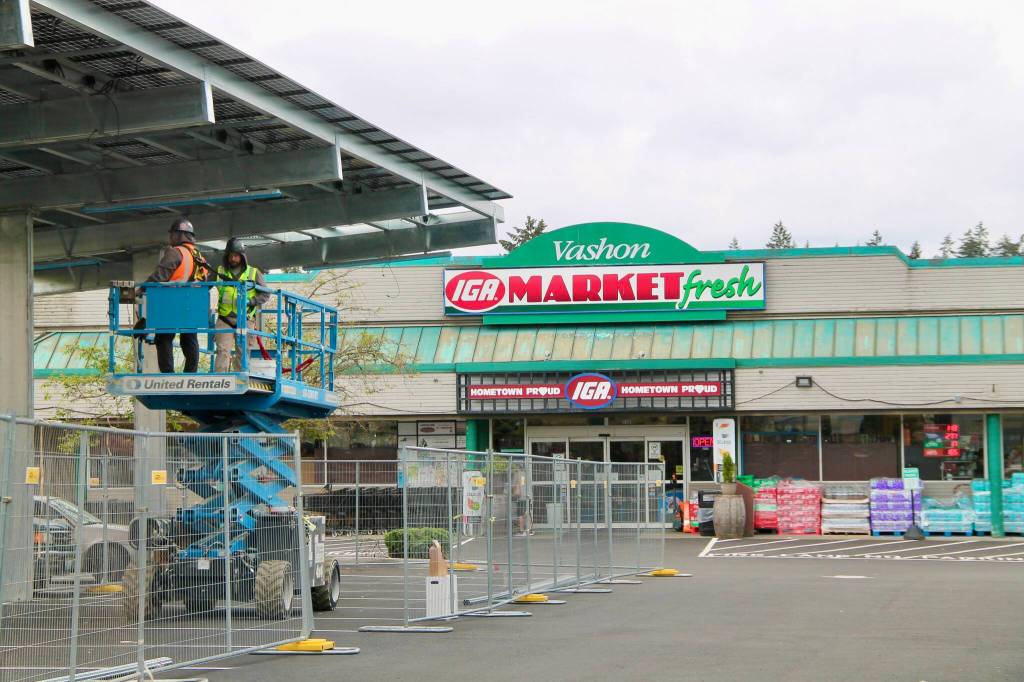
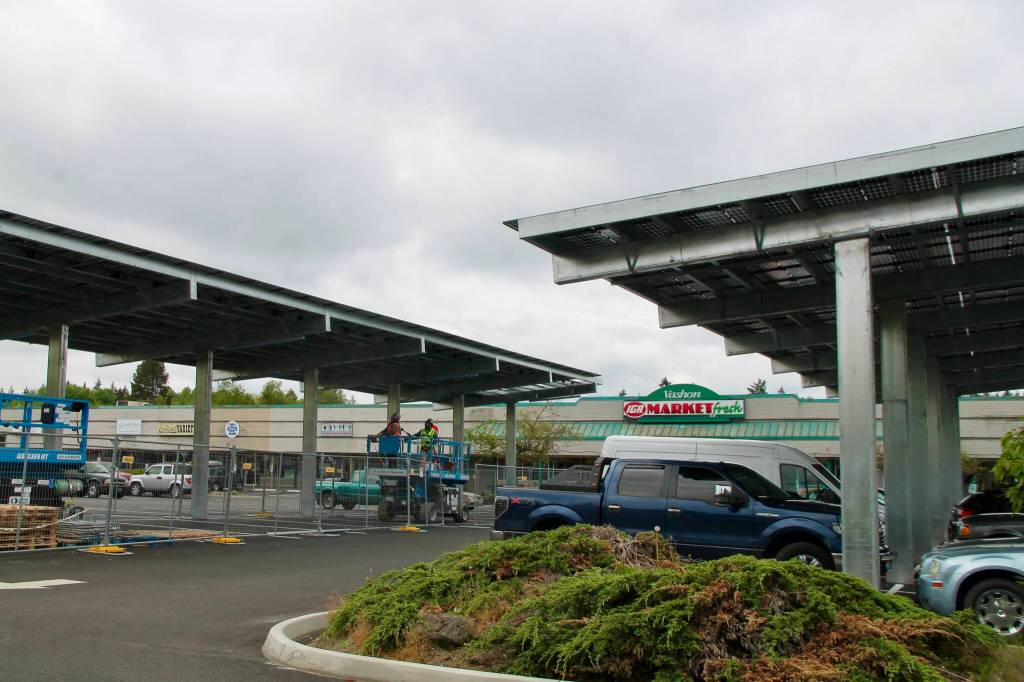


As construction on the new solar pavilion at the Vashon Market Plaza nears completion, one of the island’s largest solar-collection systems will soon be up and running.
In the parking lot of the plaza, right outside of IGA, islanders can spot dozens of solar panels that sit on tall overhanging carports and atop roofs elsewhere in the plaza.
With a total of 300 solar panels, under ideal sunny conditions, the pavilion can produce 350 kilowatts of energy an hour, said Shawn Hoffman, owner of the plaza complex and Vashon Market IGA, who initiated the project.
“It’s a substantial amount of power that he’ll be contributing,” islander Joe Yarkin, who has worked as a renewable energy engineer, said. “That is, to my knowledge, the biggest system on the island.”
The project began several years ago, when Hoffman said he secured a partial federal grant through the USDA’s Rural Energy for America Program (REAP), which funds renewable energy projects for agricultural workers and rural small businesses.
While the original idea was to mount the panels on top of Vashon Market, the store’s roof couldn’t structurally support the panels’ weight, and carports were added instead.
Some of the many panels are also located above Granny’s Attic, on a refurbished roof with reinforcing rafters to support the extra weight, as well as other businesses in the plaza.
On Vashon Island, like most places, electricity is delivered to homes and businesses from a vast, interconnected power grid — fed by power plants and other energy sources.
Because Vashon Market requires constant electricity to keep food refrigerated and frozen, it consumes a significant amount of power, Hoffman said.
Solar energy allows users to generate their own electricity and rely less on the power grid. Hoffman said he’s glad he can help reduce the store’s burden on the shared grid, especially as electricity demand in the United States has surged in recent years.
“This will allow the power grid we all use to have some relief,” Hoffman said in an email. “Having a source producing this locally on island we hope can somehow benefit the community.”
In simple terms, solar panels work by absorbing sunlight through photovoltaic cells, which is then converted into usable electricity that powers homes and businesses.
Solar panels can still generate energy in cloudy conditions common in the Pacific Northwest, according to reporting from the Bellingham Herald, with summer months providing ideal conditions.
Because leftover electricity is fed back to the local electric grid, panel owners can receive financial credit for that extra power, offsetting electric bills.
”Every one of these systems is connected to the power grid, and they’re feeding it,” Yarkin, who himself uses a home solar system, said. “When we have a sunny day, I’m not only feeding my house, I’m feeding my neighbors’ houses.”
The cost-saving nature of solar power was a motivating factor for installing the pavilion, Hoffman said, and is expected to save IGA up to 70% on its power bill, depending on the final cost of construction.
The renewable energy source has seen growing popularity in recent years, both for its ability to save users money in electric bills and as an alternative to fossil fuels driving the global climate crisis.
Since 2020, solar power generation in the United States has more than tripled, according to data published by Statista.
And on Vashon, solar panels now adorn many of the island’s homes — and businesses. At Vashon Center for the Arts, 210 solar panels now sit atop the building, generating power for the facility.
“It’s had tremendous growth on this island,” Yarkin said.
As construction crews finish mounting the last of the solar panels, Hoffman said he hopes to be producing electricity later this month.