Water district project stirs up brown water complaints
Published 1:30 am Tuesday, June 23, 2026


A recent Water District 19 project to replace sections of corroded steel pipes has, for some customers, led to more instances of brown water entering faucets.
The project was part of the district’s Capital Improvement Plan, a long-term effort to replace aging infrastructure and improve experiences for customers of the largest public water system on the island.
Since September 2025, crews worked to excavate pipes along Vashon Highway SW, SW Monument Road and SW 216th Street, lay down new pipes, and tie them into the system. All major work on the project was completed in May, officials said.
With many pipes in use for more than 40 years, officials say they’re past their useful lifespan and can cause problems by leaking or depositing sediment, according to Water District 19 Commissioner President Seth Zuckerman.
Replacing these aging pipes is where the Capital Improvement Plan will invest the most resources, the plan said.
As part of that work, crews must shut off and drain water from existing pipes to connect the new ones to the system. During this process, sediment sitting in the old, corroded pipe is churned up, and when the water is turned back on, it moves downstream at a high velocity.
Under ideal circumstances, that material would drain out of a downstream hydrant. When that doesn’t happen, it can enter household plumbing.
“Sometimes not all the brown water does get out, or some of it escapes downstream, and that’s when we have problems,” Water District 19 General Manager John Martinak said.
Between January and May of this year, the district received 53 brown water calls — most of them related to the most recent project — Martinak said at a June 9 water district meeting.
That’s compared to an average of 56 brown water calls annually over the last four years, according to Martinak.
Main breaks — when a pipe cracks or bursts — can also cause brown water events. Rachel Waldron, a customer in the district, said tea-colored water ran out of her faucet on May 27 after a water main broke on May 26 during construction on Monument Road SW and SW 216th Street, water district officials said.
The district aims to warn customers of these kinds of disruptions, and often recommends people open their hose bibbs and let the dirty water run out, Zuckerman said. Customers aren’t charged for the water they use for this.
But Waldron said she wasn’t notified.
“I only found out because my neighbor and I were talking, and she says, ‘How’s your water?’ and I said, ‘Disgusting,’” Waldron said.
For Waldron and her neighbors, who live in the south end of the district near Tramp Harbor, that event was just one of countless instances of brown water, she said.
In the six years that Waldron has lived in her current home, she said her water has been “consistently not clear.” Sometimes slightly discolored, other times the amber color of apple juice.
Her toilet tank is marked with mineral sludge, she said, and her dishwasher is completely coated in debris, never fully cleaning dishes despite attempts to double-wash them.
Before her laundry machine fully broke and had to be replaced, she said a big chunk of her wardrobe was ruined.
The family drinks from a pitcher attached to a heavy-duty water filter. And bathing in the water is its own challenge, she said.
“It’s horrific, I have to wash my hair three times, and sometimes even that doesn’t work,” Waldron said.
The goal of the Capital Improvement Plan is to decrease these kinds of brown-water experiences, Zuckerman said.
“We don’t want that, and unfortunately, it just takes ongoing investment in our infrastructure to abate that,” Zuckerman said.
Until these long-term projects are completed, Zuckerman said, the district recognizes that some people may choose to install a filtration system in their homes.
Waldron said she tried to install one of those systems, but because of the age of her home, she was told the entire plumbing system would need to be retrofitted.
”I guess it’s just the costs that add up from all of these things,” Waldron said. “They’re saying, you know, ‘Just add a filter to your shower, add a filter to this,’ and I’m like, ‘You pay for it then.’”
Martinak said the area surrounding SW Quartermaster Drive, SW 216th Street and onto Maury Island — where Waldron lives — is particularly vulnerable to brown-water episodes.
That’s because the main sources of water for the district are located at the north end. So when sediment gets churned up, it all flows south, Martinak said.
“The vast majority of our brown water calls are down in that area,” Martinak said. “In town and north of town, there’s rarely any calls.”
The water district aims to flush the system once a year to clear out debris. But Martinak said they may need to start flushing more than that in some areas.
Water District 19 relies on both ground water and surface water, which are both monitored for contaminants. And while surface water is filtered at a rapid rate surface water treatment plant, groundwater from wells receives chlorination for disinfection.
Some of the discoloration observed by customers is a result of iron and manganese being oxidized by the chlorination process, Martinak said.
Implementing green sand filtration — a specialized system that removes dissolved minerals from well water — could be another possible Capital Improvement Project, Martinak said.
Like all water districts, District 19 water is tested for a wide range of contaminants against Environmental Protection Agency standards, Martinak said.
According to data from the Washington State Department of Health, the vast majority of water samples taken in the district throughout 2026 fell within regulatory limits, with a few exceptions. One sample, collected on April 7, exceeded limits for arsenic and manganese, and had a color level of 15, meaning it was visibly tinted. Another sample, collected on May 19, had high levels of trihalomethanes — a byproduct of chlorine reacting with organic material.
The district has been issued a green operating permit by the Washington State Department of Health, meaning it is in “significant compliance with applicable drinking water regulations,” Washington State Department of Health Public Information Officer John Doyle said in an email.
When water may be contaminated and unsafe to use, the district imposes boil water advisories. Over the past two years, around five of those have been issued, Martinak said.
For islander Dan Bockus, a former Water District 19 customer, the fact that the district’s water often tests within legal limits isn’t necessarily comforting.
“There’s still risk associated with any level of contaminant,” Bockus said. “These days, with the EPA being gutted, and restrictions and regulations being altered, there’s higher acceptable limits for certain things, and a lot of things they don’t even have to report.”
A former marine ecologist, Bockus spent decades studying human disturbances to water sources, taking samples in sites like Antarctic waters with some of the highest concentrations of polychlorinated biphenyls — a highly toxic synthetic chemical — in the world.
Bockus’ home was located in the north end of the system, and while he didn’t experience constant discoloration that Waldron describes, he remembers periodic episodes.
When events that temporarily flushed sediment into the system occurred, Bockus said he often wasn’t notified.
”They say that there’s a system in place to notify customers when they’re doing work on the lines,” Bockus said. “That’s a failed system; it only happened about half the time.”
Bockus eventually opted to install a separate filtration system in his home. Since moving homes, he now relies on his own well water, which he tests himself.
“Just being autonomous, with my level of education and expertise, serves me better than relying on a municipality or a district to make sure they’re covering stuff,” Bockus said. “I just didn’t trust them, I guess, is the bottom line.”
Water District 19 officials say they take incidents of brown water seriously and work to address them.
“Nobody wants brown water in their home; the district certainly doesn’t wanna deliver brown water,” Martinak said. ”We are trying to resolve these issues.”
Part of the challenge, district officials say, is balancing the need to complete projects that improve infrastructure with the desire to keep costs manageable for consumers.
“It’s a problem across America, aging infrastructure of utilities,” Martinak said. “It’s very expensive, so it’s a huge commitment, but we have to do it.”
This year, Water District 19 imposed a rate increase, in part to help pay off the current project, which required a loan of around $2.5 million through the State Revolving Fund, Martinak said.
Even though Water District 19 is the largest public water system on Vashon, it is still small compared to systems in cities like Seattle or Tacoma. And with fewer customers, costs are spread over fewer households.
“The economy of scale works against us,” Martinak said. ”We have to maintain the same water quality standards as a large municipality, but we don’t have the revenue base.”
The challenges associated with aging infrastructure are compounded by the geographic realities of the island. A sole source aquifer system, Vashon receives all its water from rain, which flows into streams, wells and eventually homes.
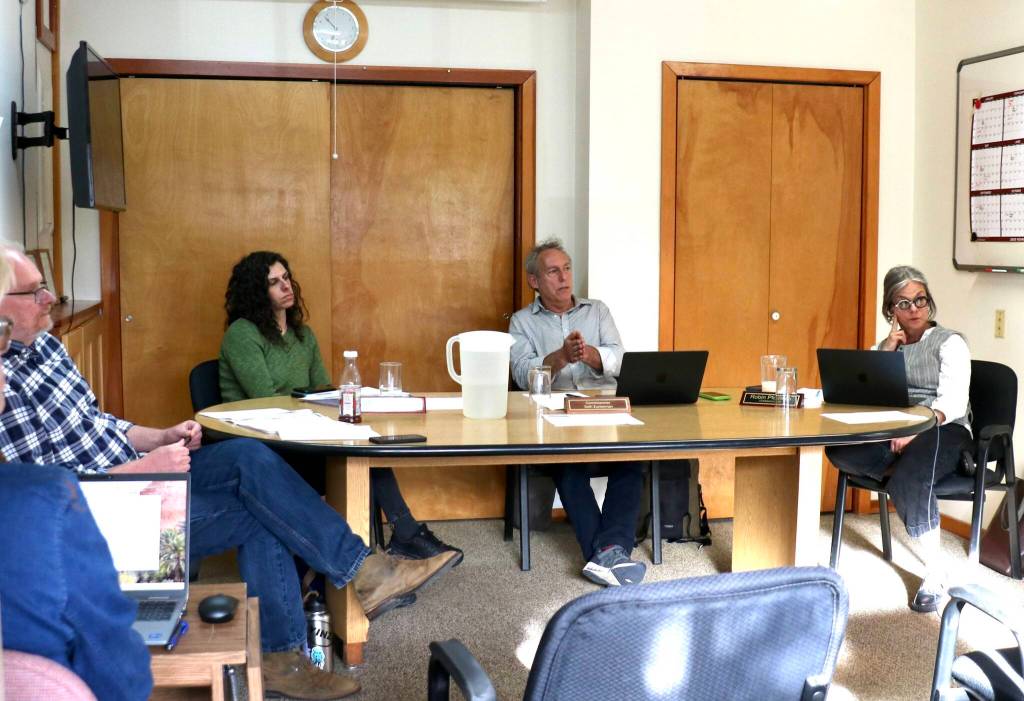
”One of the things I’ve learned is how precious and vulnerable our water system is here; it’s not like Seattle, it’s not like Tacoma,” Commissioner Robin Pfohman said during the June 9 meeting. “It’s a much more vulnerable system that has not been adequately invested in for many, many, many years.”
While officials eye possible solutions, Waldron is hopeful that concern can be turned into action.