New doc details islander Amanda Knox’s quest for closure
Published 1:30 am Tuesday, February 3, 2026


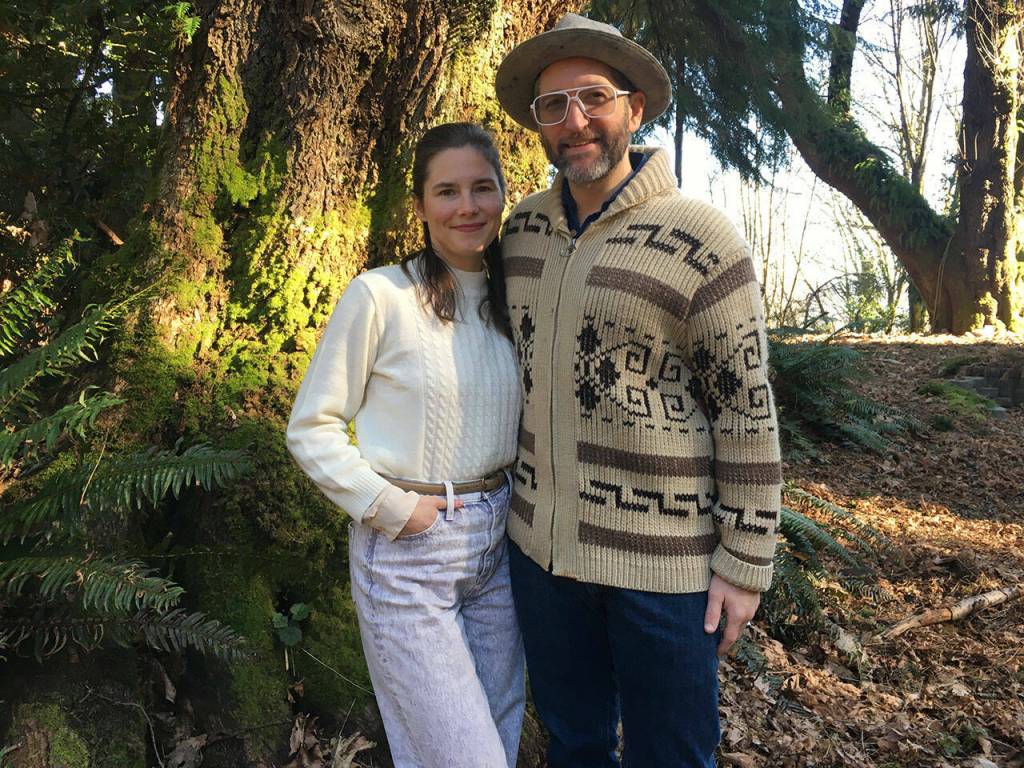


In the back of Little Cup on a recent winter afternoon, soft, slanting sunlight light filled the coffee shop as a drumbeat sounded outside.
“There’s a dark shadow hanging over all of us right now,” islander Amanda Knox said, settled at a table in the back of the coffee shop. A small group of protesters were just a few feet away at the four-way stop in a last-minute demonstration, calling out ICE operations nationwide — particularly in Minnesota.
“Everyone’s suddenly very interested in the question of, what does accountability for law enforcement look like?” she said. “And I have a long history of trying to figure that out for myself.”
It’s a question many Americans are asking in one form or another — about policing, immigration enforcement, courts, power, consequence. For Knox, it’s also personal history.
That search — for accountability, for closure — is the spine of the couple’s new documentary, “Mouth of the Wolf: Amanda Knox Returns to Italy,” now streaming on Hulu.
The film — the feature documentary debut of Chris Robinson, a writer and poet and Knox’s husband — follows Knox on a return trip to Perugia and beyond, where she meets face-to-face with the prosecutor who once argued she should spend her life in prison.
Back to the “mouth of the wolf,” which draws from the Italian phrase for good luck (in bocca al lupo — into the wolf’s mouth) and symbolizes her confronting the man who prosecuted her.
The documentary opens with Knox on a bed. “It’s almost like the only way to run away is to confront it as fast as you can,” she says, in tears.
“I’m really proud of it,” Knox said, turning toward Robinson. “I’m really proud of what you’ve accomplished.”
Despite years in the public eye — years of documentaries, books, opinion columns, podcasts and courtroom updates — Knox said this project feels different, and is something she’s admittedly a little nervous about.
“It’s really, really intimate,” she said. “It’s not stuff that happened 18 years ago. It’s stuff that happened two years ago, which feels much closer.”
Knox and Robinson moved to Vashon Island in 2019, building a quieter daily life: a home, two small children, ferry rides and island errands.
The film moves between scenes in their island home and quiet shots of ferry crossings — then onto the plane to Italy, and into moments far from any courtroom.
It lingers in the in-between seconds: her daughter barreling toward her as Knox says, “mi amor,” or Knox stretched out on an orange bedspread in an Italian hotel room, looking up at Robinson.
Robinson said those “in-between” moments were not filler. They were the point.
“One of my big goals was to just reveal the full, complex human that Amanda is,” he said.
“That’s the opposite of what you would get from your typical documentary,” Knox replied.
The film doesn’t chase perfect lighting or neat confessionals, Knox said. “It’s very home video,” she said, laughing.
That choice, Robinson said, was also a quiet challenge to the way true crime is usually made.
“It almost never shows how people heal in the aftermath of tragedy,” he said. “And I think that’s what makes this unique. It’s not about destruction … It’s about finding closure and healing when the justice system failed to deliver those things.”
The world first learned Knox’s name in 2007, when she was studying abroad in Perugia, Italy. On Nov. 2, 2007, the body of her British roommate, Meredith Kercher, was discovered in a bedroom of the house she shared with Knox and two others.
Knox has said she was questioned for more than 53 hours over a five-days, without legal counsel.
She was convicted in the case and sentenced to 26 years in prison, serving nearly four years before an appeals court overturned the conviction after an independent review raised doubts about key DNA evidence.
Italy’s highest court ultimately cleared her and her then-boyfriend of the murder in 2015.
Knox’s case has long been subject to massive — often horrendous, sexualizing — media attention.
And even after exoneration in the murder case, Knox has continued to fight one remaining legal stain tied to the statements she said she was coerced into signing during her interrogation: In June 2024, an Italian court reconvicted her of slander.
Her case is back before the European Court of Human Rights — a rare second review of the same case.
“Her name is not fully clear,” Robinson said.
The long, grinding nature of that legal afterlife is part of what “Mouth of the Wolf” tries to show: not only what happened, but what keeps happening — and how a person lives inside that.
The film’s central relationship is also its most unusual: Knox’s evolving connection with her former prosecutor, Giuliano Mignini.
Knox began reaching toward him years after her release, drawn by a desire for answers and acknowledgment.
“It’s a strange and fraught and unique relationship,” Robinson said. “There’s no easy labels.”
One of the documentary’s most striking moments comes during their second meeting, when the prosecutor reaches for Knox’s hand — kisses her on the cheek, meets her children — and Knox realizes she wouldn’t have any of it if she hadn’t been exonerated.
The nuance of this relationship — to Knox — is part of the point. True crime often insists on clean roles: villain and victim, monster and hero, she said. But life — especially life after public catastrophe — doesn’t stay inside that kind of script.
The film is also, unexpectedly, musical. It includes original songs Knox wrote, a reflection, Robinson said, of how she used music to survive years in prison.
“People don’t know what they don’t know,” Knox said, referring to her own musicality — the parts of her that never fit inside the tabloid version of her.
That expansion into public life has taken other forms, too. Knox said she began doing stand-up comedy in part because she felt safe trying it on Vashon first — safe enough to bomb without becoming a punchline in someone else’s story.
“I will say I would not be doing stand-up comedy if it were not for Vashon,” she said.
Robinson echoed that sense of protection.
“Knowing that the community has our back in that way probably does psychically help us feel safer in terms of doing something like this film,” he said. “You can’t control how people react to it, but at a very minimum, you know you’ve got a friendly audience here.”
When they arrived home from court in 2024, they found flowers and notes covering their front door. “I just started bawling,” Knox said.
It’s part of why, she said, she feels safer on Vashon than she does across the water.
“Vashon has always kind of had my back,” she said. “I didn’t know that I needed that until I got here and found that for myself.”
The documentary also had island ties, including executive producer and consulting editor Eric Frith and music collaborator Chris Ballew of The Presidents of the United States of America. Leah Andrews worked on the film as an assistant editor.
They hosted a free premiere screening and conversation at The Neptune Theatre on Jan. 26, the same day the documentary began streaming on Hulu.
University of Washington student and then-19-year-old Amanda Knox remembers walking past her college event venue — “where real people have real shows,” she said — The Neptune, when it was her alma mater.
“I never would have imagined, as a 19-year-old walking along, that I was gonna have a show there one day,” Knox said.
Knox said she hopes the film lands as something more than a retelling.
“We’re hoping that it connects with people,” she said. “I very much hope that people watch it and it resonates with them and it inspires them to be more curious about justice systems and the broader question of accountability.”
The film is also about something universally true right now: how to approach accountability — if it’s real — in a world where we’re struggling to connect, hear each other.
“We live in a world that is extremely divided, where people feel like connection is impossible,” Knox said. “These big existential questions have unfolded in our lives in a really personal way that have universal implications.”
Watching Knox reconnect with her prosecutor changed him, Robinson said — reshaping how he thinks about his own relationships, and prompting him to reach out to an estranged friend.
“It’s possible to be firm in your principles, to care about the truth and hold people accountable for their actions, but at the same time to do so with kindness and passion and to build a bridge over what seems like an impossible divide,” he said.
And why she keeps telling her story, Knox said, is about this desire for connection.
“I was isolated for a really long time — I was put in a cell and locked away from the rest of humanity in very developmental years of my life,” Knox said. “Even when I got home from prison, I felt really isolated, like everyone was judging me, like I didn’t even belong to the rest of humanity.”
So she shares her story — to connect, and to help others find language for their own trauma.
“The case is the thing that matters and that history matters,” Robinson said. “But there’s a reason I began the film just talking about the woman I fell in love with.”
What’s next for the couple? The original songs Knox performs in the film will be released, and the pair said they plan to keep making films through their small, island-based production company, Knox Robinson Productions — and to keep speaking up, showing up.