VHS forum puts cell phone policy on the table
Published 1:30 am Tuesday, May 19, 2026





Before Vashon High School students, parents and teachers began talking about cell phones Thursday night, interim Superintendent Jo Moccia asked them to do something simple: put their own phones in the middle of the table.
Around the Great Hall, about 50 people seated at eight roundtables did just that.
For the next hour and a half, the devices at the center of each table became the subject of the night — whether phones help students feel safe and connected, whether they distract from learning and community and whether Vashon High School’s current “off and away” policy is enough.
The May 14 forum followed an April 23 school board discussion about student cell phone use, held days after district leaders notified families of a “serious breach of privacy” at the high school. As The Beachcomber previously reported, two students left a phone recording in a restroom stall, where it recorded two other students without their knowledge or consent.
The incident accelerated a review of the district’s cell phone policy, which dates to 2011.
“This is not a decision-making meeting, and it’s not a vote,” School Board Chair Juniper Rogneby said at the start of the forum. “The goal is not to debate or persuade, but to gather perspectives that can inform a future discussion.”
Rogneby said the board had received “many, many emails” about cell phones in schools.
“Tonight is an opportunity for school board members to listen,” she said. “The evening is about hearing from students, staff, families and community members about their experiences with and thoughts about cell phone use in our schools.”
The forum opened with updates from school leaders, including Greg Allison, principal of McMurray Middle School, who described the school’s “away for the day” policy, which requires students to turn in their phones during the school day and retrieve them after the final bell.
“We have made different adaptations along the way to how we collect the phones, how we distribute them back to students, and we continually look to reset expectations with our students throughout the year,” Allison said.
Allison said that as McMurray nears the end of its second year under the policy, teachers have reported students are more present in class and more socially engaged at lunch. Students, he said, are talking to each other more often, rather than retreating into screens.
“One teacher said, ‘Get into good trouble,’ things like climbing trees, writing notes and passing notes in class,” Allison said.
Teachers have also noticed less anxiety among students about what others might be seeing, saying or photographing, Allison said. Enforcement has also become easier over time, with fewer phones being confiscated as expectations have become more routine.
Turning to the high school, Principal John Erickson said VHS had a cell phone policy “on paper” when he became principal in fall 2023, but also “a de facto way of being.”
Before that school year began, Erickson said, the high school established its current “off and away” rule, making clear that there was “never a reason for cell phones to be out in class.”
Since then, Erickson said, the school has continued adjusting its approach, including requiring students to trade their cell phone for a bathroom pass.
“When I walk into a classroom, I never see cell phones,” Erickson said, while acknowledging the policy can slip in some situations, such as when substitute teachers are in class.
Students also had a chance to weigh in.
After the April 23 board meeting, student school board representatives Hazel Nielsen and Henry Hughes sent a survey to Vashon High School students in grades 9-12. Of about 500 students, 230 responded, Nielsen said.
More than 90% of those respondents opposed a bell-to-bell phone policy at the high school, Hughes said.
Students raised several concerns in the survey, including the ability to contact parents, call 911 in an emergency and communicate about after-school jobs, sports and transportation. For students who commute, safety and coordination were especially common themes.
“Schools in America aren’t safe enough for students to not have a way to contact their parents,” one student wrote in the survey.
Others said high school students need more autonomy than middle school students, and that learning to manage technology is part of preparing for adulthood.
“High school spans the largest-feeling transition from childhood to adulthood,” another student wrote. “Treating us like children will only make us act like children.”
Nielsen acknowledged that there are real concerns about phone addiction and distraction, especially while students’ brains are still developing. But she said students also need to learn how to live with technology.
“Phones are going to be in our lives forever at this point, or at least some version of technology,” Nielsen said. “Learning to adapt and use this tech would help us out into the world.”
Nielsen added that phones aren’t always isolating — at lunch, students use them together to look at colleges, play games or share things with friends. “There are a lot of positives that come with phones,” she said.
She also said the current “off and away” policy is largely working, and that she has seen phone use in class drop since her freshman year, before VHS adopted the policy.
“I’m not necessarily saying that a complete ban is bad,” Nielsen said. “I see the benefits of that. I just think there’s a level of trust that we need to have for students, especially juniors and seniors who are becoming adults.”
Not every student has the same level of maturity, she said, but “a lot more kids have maturity than we’re giving credit for.”
In a conversation after the forum, Hughes, a junior, said most teachers enforce the rule strictly during class. Phones may not always be in backpacks, he said, but they are usually concealed.
He said he is not opposed to the possibility of a stricter policy someday, but does not support moving immediately to a bell-to-bell ban without bringing students along.
“There needs to be a dialogue between parents and kids and teachers and higher-ups in school on what it means to have kids bring their phone to school,” Hughes said.
Students, he said, need to understand why any change is happening.
Hughes said the restroom recording incident should be taken seriously, but not used to drive the whole conversation. “It’s just a case of kids doing bad things, which is going to happen no matter what,” he said.
Still, he said, the possibility of being recorded at school does affect students.
“You’re scared to do something too weird,” Hughes said, out of fear someone might record it. “It’s not a major issue, but it’s for sure there.”
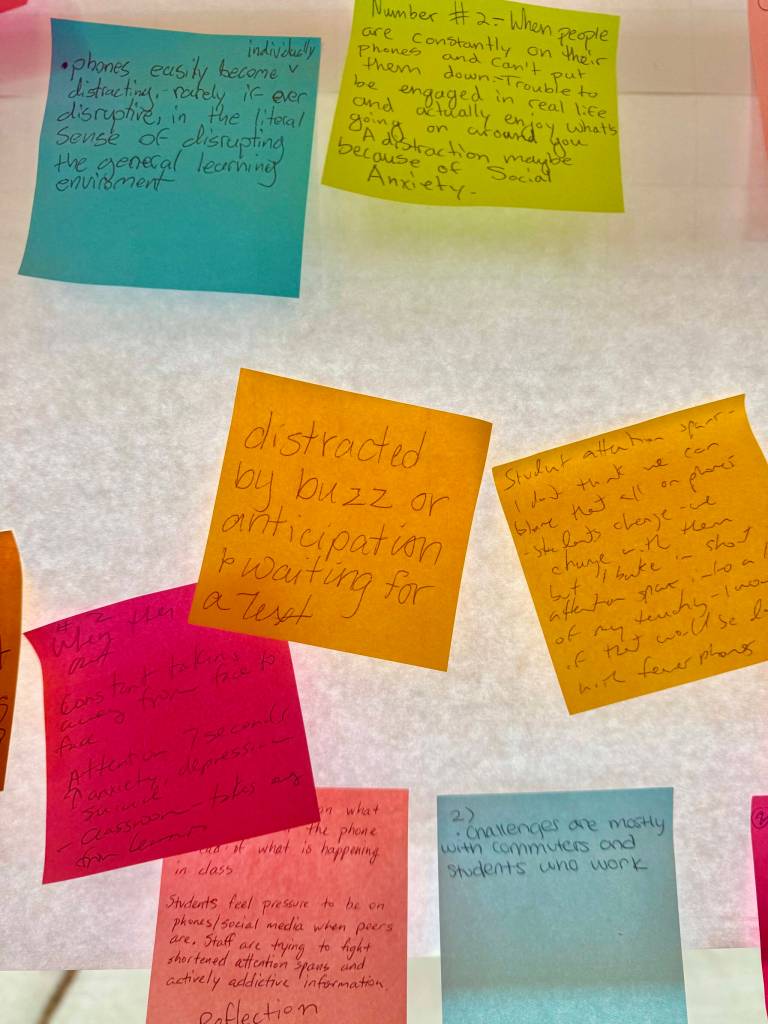
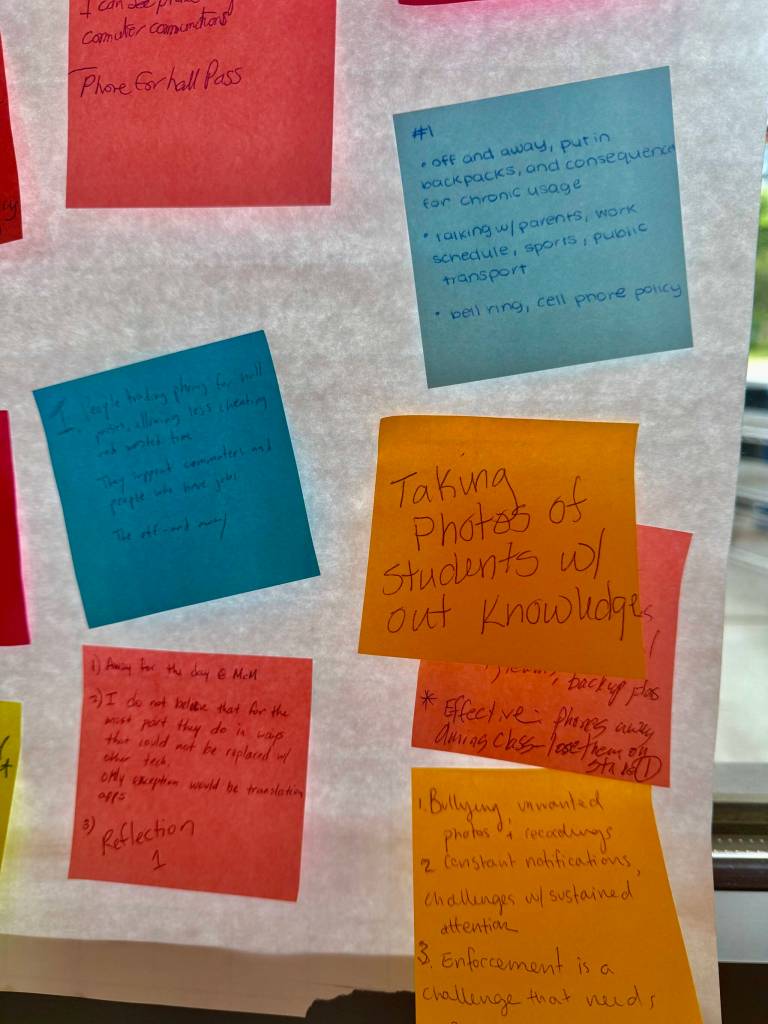
After the presentations, the forum shifted to roundtable discussions. Moccia offered four prompts, asking participants to consider how smartphones help students, how they hurt them, what people hope for the future of phones in schools and what role parents should play in regulating phone use.
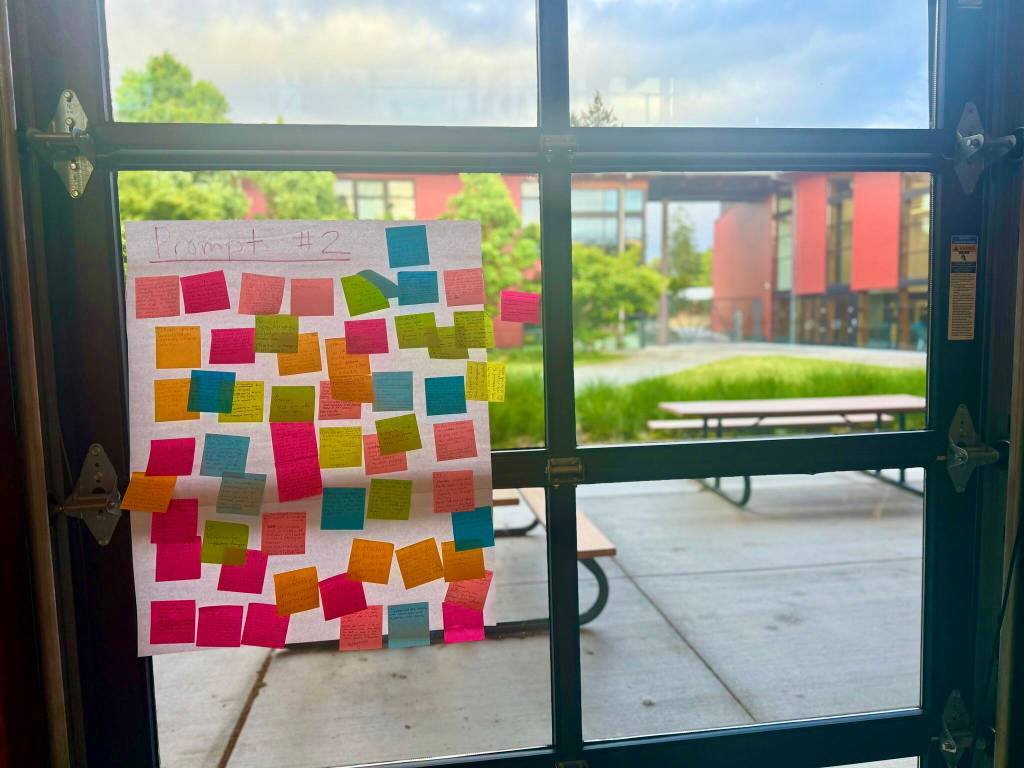
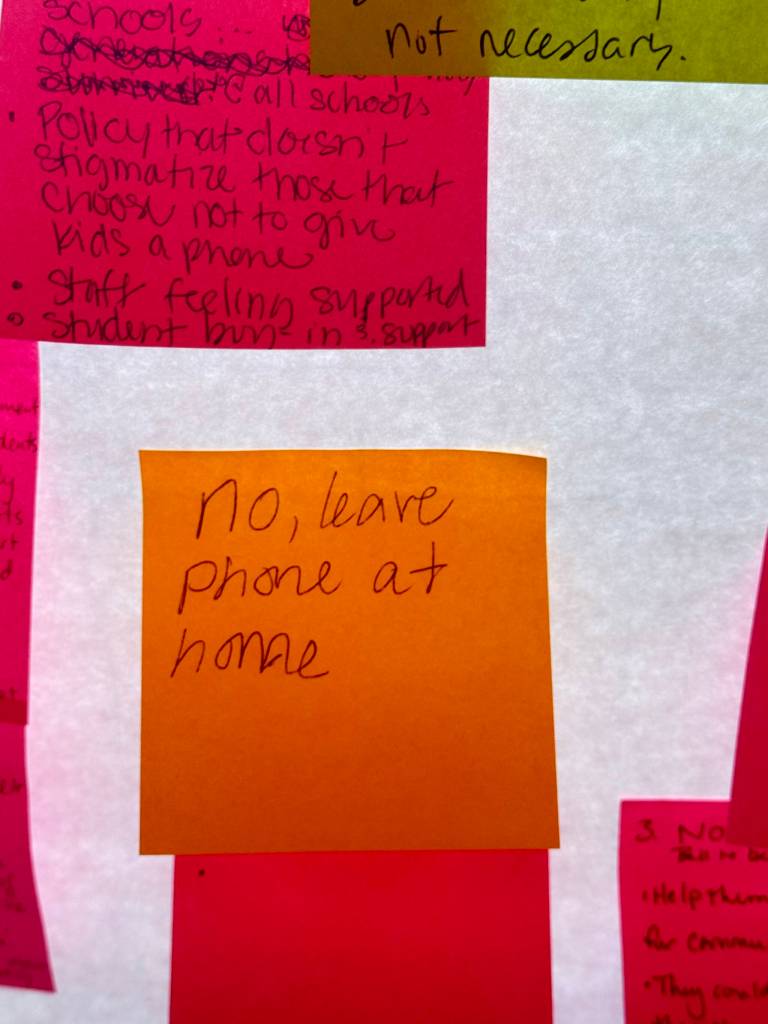
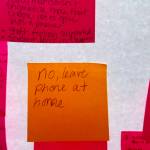
Participants wrote their responses on neon sticky notes, then posted them on large sheets of paper around the room. At the end of the night, people walked through the room gallery-style, reading what others had written.
During a closing discussion, several people said the high school’s current policy appears to be working. Others said the district should go further.
Sarah Powell, a Spanish teacher at Vashon High School, said the “off and away” policy has made a clear difference since it began in fall 2023.
“It’s night and day from where it was three years ago, ” Powell said at the forum.
One student noted that college-bound teens will eventually need to manage phones independently.
A Distraction Free Schools Washington representative pushed for a stronger policy, arguing the issue shouldn’t be left to individual districts to solve: “No one made the conscious decision to put phones into schools.”
The forum was not recorded. Moccia said the next step will be continued discussion by the school board at its May 28 meeting, though no decision is expected that night.
If the board does change the district’s cell phone policy, Moccia said, the change would take effect in September.