New ferry plan keeps pressure on Triangle Route
Published 1:30 am Tuesday, May 19, 2026
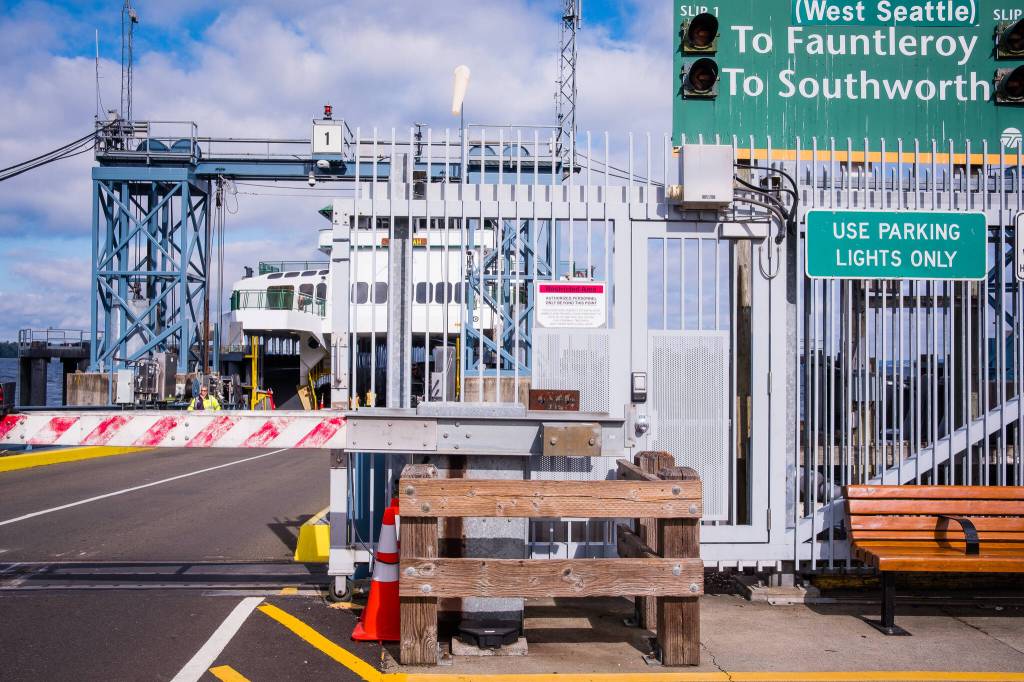
Despite lobbying from islanders, Washington State Ferries’ new service contingency plan still calls for removing a boat from the Triangle Route when a vessel goes out of service elsewhere in the system.
The plan, released in April, says the Fauntleroy/Vashon/Southworth route — which ordinarily uses three boats — can operate with one fewer vessel with fewer negative effects than other routes would face.
But many islanders disagree, saying the two-boat schedule has led to missed doctor’s appointments, longer wait times and an unreliable ferry system.
The WSF document was the latest update to the annual plan, outlining how the agency expects to meet rider demand despite ongoing constraints like a limited and aging fleet of boats that frequently break down.
WSF has no designated relief vessels and operates an 18-boat schedule with 18 boats. Three of WSF’s 21 total boats need to be in planned maintenance at any given time.
That means that when a relief vessel is needed, it’s moved from another run.
Under the current plan, the Triangle Route is used as the first relief vessel option, WSF official Hadley Rodero said. The Seattle/Bremerton and Port Townsend/Coupeville routes are also listed as relief vessel options, which may be reduced to one-boat service.
Because of the Triangle Route’s multi-destination service and because there are three vessels assigned to it, WSF officials say the route is better equipped than others to provide a boat.
The agency is still able to complete 75-80% of trips on the Triangle Route with two boats, WSF official Justin Fujioka said in an email.
“The reason that sort of works is that the sailings are so frequent, even on a two-boat schedule,” Rodero said. “You don’t have to wait more than, in most cases, half an hour to an hour until the next sailing.”
On other routes, like the Bremerton run, removing a vessel would leave only one boat for service, creating wait times that sometimes exceed two and a half hours, Rodero said.
But many islanders say they’ve felt the burden of the two-boat schedule, which strains Vashon’s only connection to the mainland.
“Our options are to take the north end ferry or the south end to Tacoma, and both of them are consistently off schedule,” islander Kim Voynar, who commutes off-island for work several times a week, said.
Throughout 2025, the document said the Triangle Route, along with the Bremerton run, were two routes that frequently operated with reduced service and on alternate schedules.
That reduction was present even after WSF returned to full domestic service in the summer of 2025 for the first time since the COVID-19 pandemic, years earlier than expected. The decision helped boost ridership by nearly 1 million passengers from the year before, the document said. But for Vashon, it hasn’t always translated to full service on the Triangle Route.
Because the two-boat schedule cancels some sailings, it creates larger-than-usual gaps in service that can add hours to islanders’ commutes.
“A two-hour process could turn into six hours because of the gaps in the two-boat schedule,” said Wendy Aman, a member of Islanders for Ferry Action.
And while the occasional addition of an unscheduled, third “bonus boat” or “ghost boat” — which has helped improve service by picking up slack left by the two-boat schedule — islanders are still unable to reliably plan around it.
For Vashonite Toby Nichols, who commutes off-island for work several times a week, the two-boat schedule often requires extra planning for his trip home — yet even he still finds the ferry system unreliable.
“I need to plan my exit from work so that I can get a reasonably scheduled boat, but I was never really sure when that was gonna be,” Nichols said. “You could hope for a bonus boat, but you couldn’t depend on it.”
In an email, Fujioka said WSF is currently “looking at the potential benefits of developing a schedule that includes the bonus boat.”
The updated plan comes after months, if not years, of community action attempting to revise it.
In a February letter to Gov. Bob Ferguson, Islanders for Ferry Action urged the governor to prioritize restoring full three-boat service to the route.
“Where there’s a will, there’s a way. It’s time for the governor to gather the will to make something happen on the Triangle Route,” the group said in its Feb. 5 letter.
Hoping to address the community’s feedback, Rodero said, WSF included data showing average vehicle loads during past two-boat schedules on the route. It was the only route for which WSF provided that data.
“I think we overexplained the triangle because we’d heard so many comments from community members and others there like, ‘Why is it our route,’” Rodero said.
The data showed that during the week of November 3, 2025, there were several sailings that exceeded maximum vehicle capacity, but also many that didn’t reach that threshold on the two-boat schedule.
“We were using that data to sort of illustrate that although there are several sailings that do overload in the middle of the day, by and large we don’t exceed capacity on two-boat service on the route,” Rodero said.
However, for Aman, the ridership data felt like an attempt to justify keeping the Triangle Route as a relief vessel option rather than finding an alternative solution, she said.
“They took a point in time, one week, and they used that as a rationalization for utilizing the Triangle Route as the first relief vessel for this contingency plan,” Aman said.
The latest contingency plan also outlined how WSF plans to maintain service during the World Cup, which will take place in Seattle this June, and is expected to draw thousands of visitors.
The agency said it will plan to have two vessels out of planned maintenance during the World Cup, with a total of 20 available vessels to operate the 18-boat schedule. WSF said they will also have additional crew on standby, additional terminal staff and will deploy relief vessels more quickly after disruptions occur.
Discussion about how the World Cup might affect the ferry system is set to take place at WSF’s May 26 community meetings, where the agency will also discuss the updated pet policy, the new service contingency plan and take questions from the public.
The meeting will also cover changes to service caused by the summer sailing season, which will begin on June 14.
To read WSF’s latest service contingency plan, and for more information on community meetings, visit wsdot.wa.gov/travel/washington-state-ferries.