King County’s 45-acre thinning project slated to start this summer
Published 1:30 am Tuesday, June 30, 2026

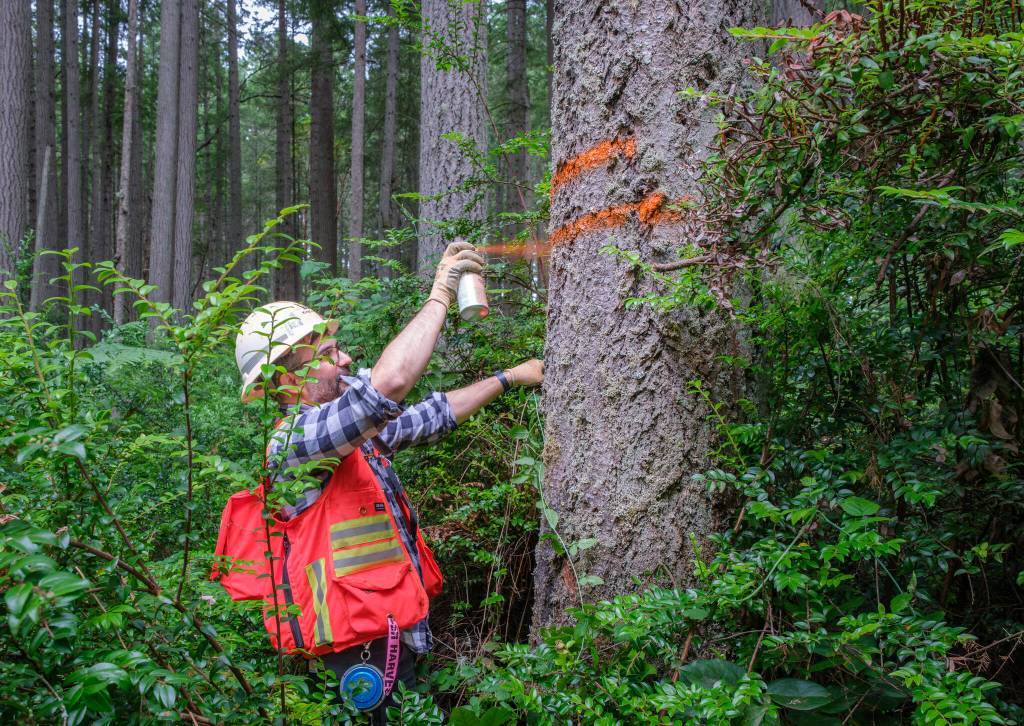
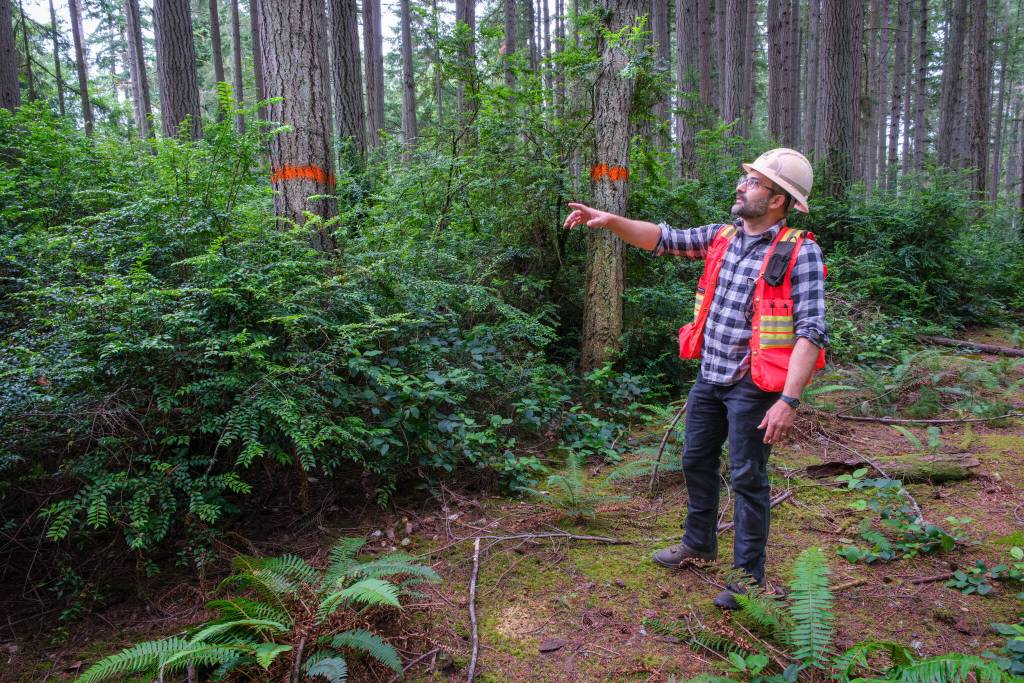
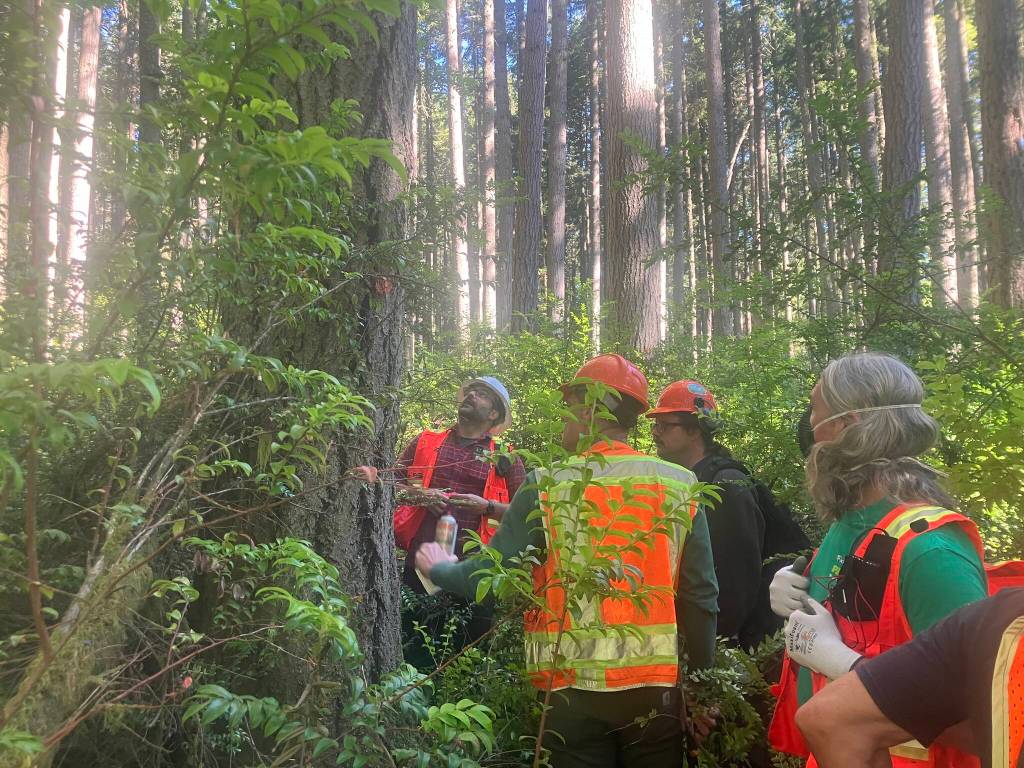


A King County forestry crew gathered in the dappled sunlight near a trail in Island Center Forest last week, where Paul Fischer, the county’s senior forester, discussed how to spot signs of distress in the Douglas firs that surrounded them.
He held a laser pointer in his hands, directing it at various trees several feet away. Some, he said, had multi-stemmed crowns due to sunlight, others due to disease. Instructing them on how to tell the difference, he added: “Our job is to respond to the conditions of the forest.”
The crew members — each one equipped with a can of orange spray paint — were there to mark the trees that will be felled as part of a logging operation scheduled for late-summer. Before they dispersed into a thick understory of evergreen huckleberry to begin marking trees, Eliza Wild, a senior member of the team, reminded them of their edict.
“We want to leave our biggest and best,” Wild told them.
The commercial thinning operation is the third one in Island Center Forest since 2005, when the county took ownership of the forest from the state Department of Natural Resources. In terms of harvest size, it is also the largest. All told, the equivalent of 110 loaded log trucks will remove Douglas fir, red alder and other tree species from 45.4 acres of Island Center Forest. In another 4.7 acres, loggers will cut aging alders and leave them on the ground.
The project was slated to take place in 2024, but faced delays for a variety of reasons, Fischer said. He plans to put the project out to bid in late July, after the county has the last of its needed permits in hand, and to have contractors begin logging in September. Portions of the forest, including several popular trails, will be closed for part or all of the project, expected to last two months.
“The only variable is whether we can get a contractor to do it on this timeline,” Fischer said.
The thinning, he said, is needed for forest health. One of his mandates is to help build a forest over time that can naturally resist or recover from an array of expected climate-induced threats — longer, drier summers, high winds, intense heat, even fire.
The project will establish buffers to keep root rot — a naturally occurring but potentially devastating fungus — from spreading; create canopy openings that will allow for a more diverse understory; and, through revegetation, increase species’ diversity and age variation. It will also help to address the drier conditions expected in the future, Fischer said, since fewer trees will be competing for scarcer amounts of soil moisture.
“The results will be a forest that is better able to withstand the hot dry summers we know are coming, better able to resist root rot that is spreading through some stands, and ultimately be a climate change-resistant forest long into the future,” he said.
“In the face of climate change,” he added, “no action is a riskier pathway.”
Island Center Forest is also what the county calls a “working forest,” a designation that distinguishes it from county-owned natural areas or parks. The county owns 29,000 acres of forestland; of that, about 3,800 are designated as working forests.
“I have the management direction to manage this forest for sustainable wood products,” Fischer said.
Pieced together over the years, Island Center Forest is now a 440-acre expanse of mostly second- or third-growth Douglas fir, as well as small patches of cedar, maple and alder. Ten miles of trail wend through the forest, skirting past two ponds, through ravines and along wetlands. The forest is also a birding hotspot — migratory songbirds are found there in the spring and summer; ducks with rafts of babies are seen on the ponds each spring; year-round birds like chickadees, nuthatches and kinglets are spotted every winter.
Fischer acknowledged that the logging operation will have an impact. “I understand that this is a big project and a big deal for park users. People, myself included, love and know these parks. And that familiarity is important. This is a big change.”
Closures, phased to minimize impact, will be significant for users, Fischer added. The parking lot near Mukai Pond will be closed for four to six weeks — it will serve as a yarding area for downed trees. During the second phase of the project, the trailhead at the Cemetery Road entrance will close for two to four weeks.
Several trails will also be off-limits during the project, including portions of Techmo, Landtrust, Gallops, Fir Hill and Valley of the Firs trails. One trail — called the 188th Bypass between 115th Bypass and Fir Hill Trails — will be obliterated and revegetated after the project is over.
To guard against a forest fire, the company that takes on the project will be required to have a 300-gallon water truck with a hose and pump on site. One member of the crew will also be required to remain an hour after operations cease each day to watch for fire. Fischer or another member of his team will visit the site every day to monitor operations.
As part of the permitting process, islanders were given the opportunity to comment on the project, and many have. According to the county’s website, some said the harvest area is too large for a forest as popular as Island Center Forest; others said it won’t recoup enough money to make it worth it.
The county, in its response, defended the size, noting that the project area is based on forest conditions, not a dollar figure the county is trying to attain. “The project area is about 10% of ICF land area. Previous projects at ICF had more acres,” according to the county’s website. As for project costs, the county expects the project to generate enough revenue to offset costs for needed road improvements on SW 115th Avenue, one of the roads that leads into Island Center Forest.
The Vashon Bird Alliance also weighed in with comments, writing that the project — originally slated to take place mid-summer — would harm nesting birds, including many migratory songbirds that sometimes nest in mid- to late-summer. Fischer said those comments had an impact on the project and on county forestry projects moving forward.
The project timeline was moved to later in the season — it won’t start until September, when the nesting season is over, he said. What’s more, he added, “We now have a countywide moratorium for in-forest work. April 15 to July 31 will be a no-harvest timeline.”
Steve Hunter, president of the Vashon Bird Alliance, said his organization is pleased by the county’s response.
“This will help birds in Island Center Forest and throughout the county,” he said. “At a time of serious bird decline, this is the kind of policy we need our public agencies to embrace. I’m glad King County was open to our input.”
Last week, as Fischer’s crew spread out into the forest, their orange hard-hats disappearing into the underbrush, one of the workers paused to talk about the project.
“For a lot of people, it may seem like what we’re doing is destructive,” said Layne Cihon, who works for King County Parks. “But it’s actually for the health and benefit of the first. It’s crucial. Critical, even.”
In the distance, the flute-like song of a Swainson’s thrush filled the air.
Leslie Brown is a former editor of The Beachcomber.