Desert Island Bookworm spends Sunday at Vashon Library
Published 10:41 am Wednesday, August 27, 2025




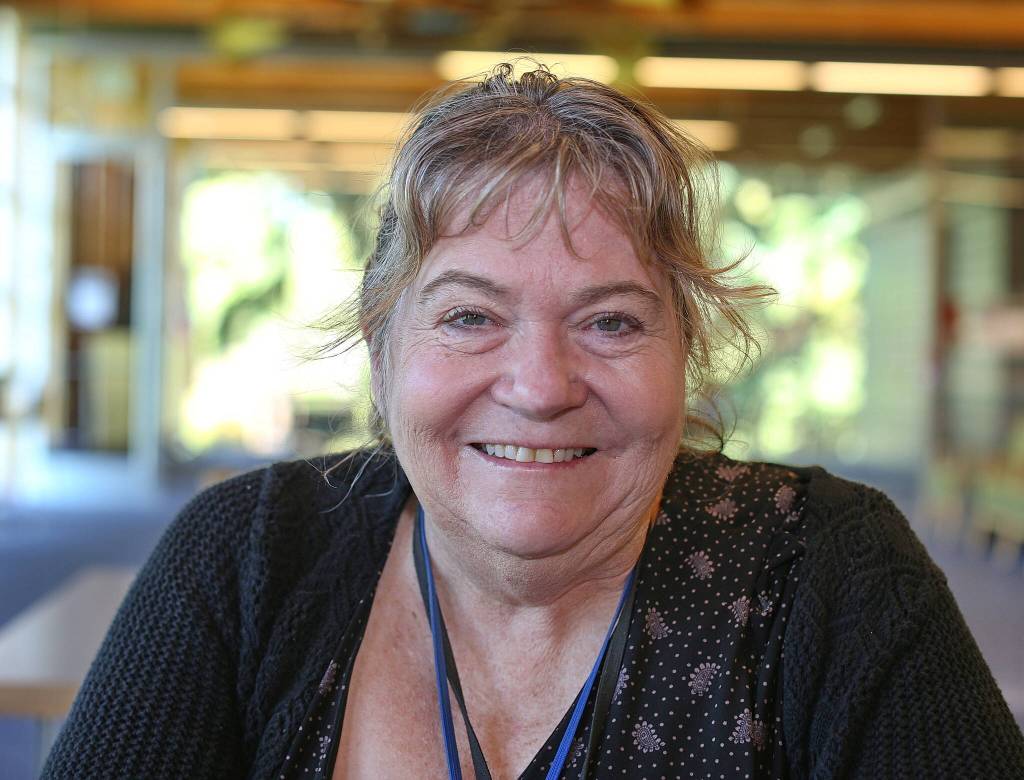


Last Sunday marked the first day that the Vashon public library was open seven days a week.
That being so, as the person who often writes Beachcomber columns about books, it seemed appropriate to visit the library on this first Sunday and chat with some patrons and staff about what they’re currently reading.
Nita Dickerson has lived on Vashon for thirty years, and has worked for the library for ten.
At the moment, Nita is reading “The Barn at the End of the World,” by Mary Rose O’Reilley. Subtitled “The Apprenticeship of a Quaker, Buddhist Shepherd”, it’s a spiritual exploration of the world; O’Reilley notes that “”My religious nature is omnivorous. I can worship anything that occupies a certain slant of light.”
“I’m not a religious person,” said Dickerson, “but I love this book.”
What would she take to a desert island? Something she knows well — a book that’s a sort of “comfort zone”, as she puts it. She’d pick “The Aeronaut’s Windlass”, a sci-fi/fantasy novel by Jim Butcher. “It’s kind of steam-punk,” she said. “It has swashbuckling pirates, talking cats and a lot of mystery.”
Cody Allen has been the library’s operating manager for the past nine months. He currently lives off-island but hopes to move here eventually. Allen has been a librarian since high school, working with books through university and to a job with the public library in Billings, Montana.
He reads a lot of books with a political and social theme. Currently, it’s “Franchise: The Golden Arches in Black America” by Marcia Chatelain, which investigates the complex relationship between black communities and America’s largest fast-food chain. “It’s not a long book,” Allen noted, “but there’s a lot to chew on there” (pun — I think — unintentional).
Other choices: Jason Stanley’s “How Fascism Works”, and Timothy Snyder’s “On Freedom” — grim reading with an obvious relevance to today’s world.
In a rather lighter vein, he recommends “Words of Radiance”, by Brandon Sanderson. “It’s a long, pulpy fantasy,” he said, “and a nice change from books about fascism.”
A recent read is George Elliot’s “Middlemarch,”one of his partner’s favorite books. Allen admits to usually having some difficulty with the writing style of 19th century British authors, but he loves Elliot’s writing, and her humor. “Anyone who’s lived in a small town can relate to the story,” he said.
Which books would he take to a desert island? Steinbeck’s “Of Mice and Men”, to which he describes having “a deep, visceral, emotional reaction.” And Orwell’s “Animal Farm”, which was for him “a formative book, and very moving.”
He’d also take Lawrence Wright’s “The Looming Tower” — about the events leading to 9/11 — which Allen characterizes as “a masterclass in reporting.”
Finally, he’d take a collection of short stories, probably by Hemingway or Nabokov (whose novel “Pale Fire” he particularly enjoyed).
Next, I chatted with Daisy Jones, an 18-year-old high school senior who had come to the library to work on a college application essay. She’s headed to college in a year, but still unsure what she wants to study — perhaps political science and communication, though, because she is good at English and loves history, she said. Jones is the editor-in-chief of The Riptide, Vashon High School’s official newspaper.
She has enjoyed some recent assigned reads, including “The Great Gatsby.” “I like how Fitzgerald describes things,” she said. She also loved “Catcher in the Rye.” “The main character of Holden Caulfied is pretty relatable,” she said.
Like Cody Allen, she found “Of Mice and Men” enjoyable, if depressing.
Her recent reads include Frank Herbert’s “Dune”, the reading of which was prompted by the movie. But she said she found the writing to be a bit of a slog — and for what it’s worth, this writer agrees.
Desert island book choices? Amusingly, Jones’ first is a favorite which she read because the title contains her name: “Daisy Jones and the Six” (by Taylor Jenkins Reid), about a girl coming of age in Los Angeles who becomes the vocalist for a fictional, dysfunctional band called The Six. “It’s a story about a famous rock and roll band in the 70s and why they broke up” the Vashon Daisy Jones said, adding that she believed the book was loosely inspired by Fleetwood Mac.
She recommends Reid’s other books too, including “The Seven Husbands of Evelyn Hugo” and “Malibu Rising.”
The last set of book recommendations came from Mary Sue Houser, a regional manager who oversees six library locations. She’s been a librarian since 1992, starting in school libraries before moving into a job with the public institutions.
Like her colleague Cody Allen, she’s recently read Timothy Snyder, but this time “On Tyranny.” She’s also enjoyed a Japanese novel published in 1984, “The Memory Police”, by Yoko Ogawa, an Orwellian novel about the terrors of state surveillance where people’s memories are taken from them and their world keeps shrinking. It’s dystopian sci-fi, and “a metaphor for dementia”, said Houser.
The first of Houser’s desert island book choices are the novels of Gabriel García Marquez, notably “A Hundred Years of Solitude” and “Love in the Time of Cholera.” These books feature magical realism; in Houser’s description, “They truly take you to a different time and place in a very fundamental way. You have to suspend your temporal understanding and float in that universe.”
Her final desert island book is Ken Follett’s “Pillars of the Earth”, a sprawling fictional saga of 12th century England centered on the peak period of cathedral building, when medieval architects figured out how to build edifices that were huge and light-filled without the whole thing crashing down around them.
And what have I been reading lately? The Irish author Niall Williams, whose novel “The Is Happiness” is one of the most beautiful books I have ever read. Poignant and tender, with obvious affection for his novel’s inhabitants, Williams creates within the fictional Irish village of Faha a gloriously detailed world of small happenings, and brings to life a cast of characters who are in turns comical, tragic, eccentric, and above all real.
The story of the village (narrated by an elderly man looking back at his youth) is set at a time when Faha is about to experience electrification, and as such it portends the end of an era and a way of life that had been essentially unchanged for hundreds of years. In this, it reminds me of Laurie Lee’s wonderful memoir, “Cider With Rosie,” which chronicled a similar change in the English Cotswolds, brought by the coming of the motor car and industrialization.
If you love great language, pick up a copy at the Vashon library; it’s a truly memorable read.
Phil Clapham is a retired whale biologist who lives on Maury Island. His comic romance novel “Jack” (under his nom de plume Phillip Boleyn) is available on Amazon.
Correction: Quotations from Daisy Jones have been changed in this online version of the article to reflect accuracy. We regret the error.