
On a recent sunny afternoon, a handful of workers at Plum Forest Farm prepped items for sale: They washed leeks, bagged carrots, harvested parsley and ferried a large wheelbarrow full of vegetable scraps to three voracious Scottish Highland cows.
They bantered about politics and chatted about their kids. One worker showed up with a cartful of freshly picked kale, its purple-fringed leaves shimmering in the afternoon light.
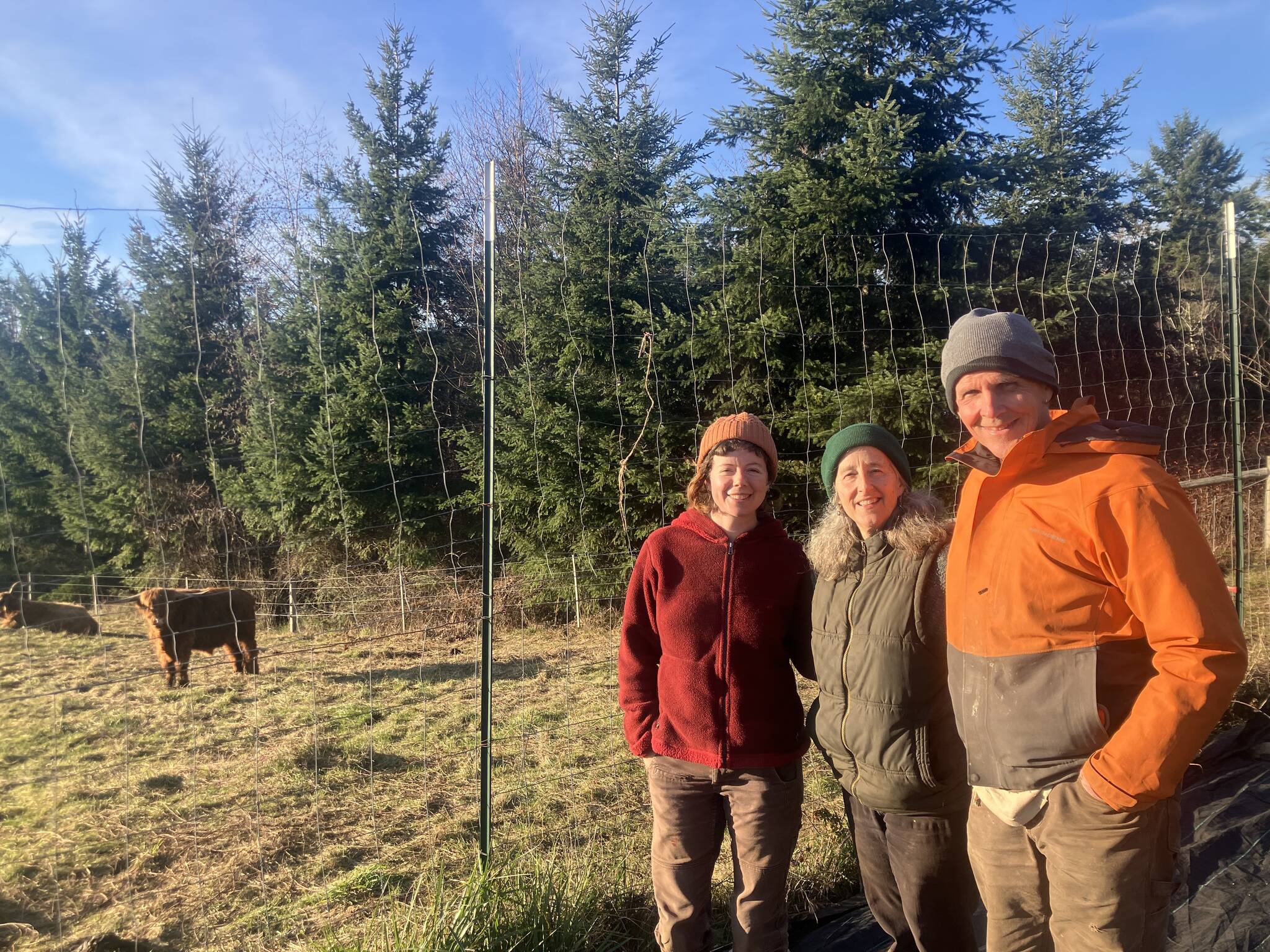
Such are the rhythms of a small organic farm, and at this particular one — perched on a hillside in Paradise Valley – it’s a scene that has replayed over some two decades. Rob Peterson and Joanne Jewell — stalwarts in Vashon’s farming community — purchased Plum Forest Farm 26 years ago.
But there was one difference on this sunny afternoon: Peterson was there as a volunteer. And Olivia Mancl, who has worked on the farm for the past six years as a seasonal intern and then an employee, was there as his boss.
On Jan. 1, Peterson, Jewell and Mancl consummated a deal long in the making: Mancl purchased the business that is Plum Forest Farm; Peterson and Jewell retained the land, agreeing to lease to her most of the property — from the barns and fields to the greenhouses – for up to 10 years.
For all of them, the deal marks the realization of a dream. Peterson, 63, and Jewell, 66, get to retire. They get to remain in their modest white farmhouse where they raised their family, live in a place they’ve come to love and even, if they want, work the land a couple days a week.
And Mancl — energetic, determined and full of ideas — gets to own a farm.
Mancl, 30, has been farming since she was a college student at Willamette University — working at both large, commercial-scale farms and small organic ones. But none possessed the combination of qualities she found at Plum Forest Farm — small, agriculturally diverse, community-supported and ecologically solid.
“I fell in love with it,” she said.
Standing with Jewell and Peterson next to rows of kale and cabbage, she acknowledged the “huge shift” that has unfolded. “I’ve always tried to work very hard for Rob and Joanne. But it’s a different kind of pressure when you become an owner,” she said.
At the same time, she’s excited about what lies ahead — eager to continue the strong farming practices Peterson and Jewell have honed over the years, while also experimenting with some different crops and techniques. “I feel really solid,” she said.
“A lot of farmers are aging out. We need young farmers coming in,” Jewell said.
Peterson, for his part, says he’s now sleeping better at night and relishing his new role. Smiling, he added: “I’m looking forward to being a seasonal part-time employee.”
By almost any measure, Plum Forest Farm is a modest operation. The actual farmland is around five acres, pieced together through both ownership and lease arrangements. A few cabins provide housing to seasonal employees. The harvest shed is a small, open-sided structure, with a free-standing tub for washing the greens.
It is also a place that has thrived over the years, becoming one of the longest-running farms in single ownership on Vashon.
Peterson and Jewell raised two daughters on their small farm; employed interns and seasonal workers; pivoted to meet a changing market and garnered a loyal following along the way. Peterson guesses about 1,000 customers regularly buy produce at their farmstand on 107th Avenue Southwest.
The farm is certified organic under the USDA certification program, as well as under a new, more progressive certification program called Real Organic — one of only two vegetable farms on Vashon so certified.
The team grows an array of vegetables – from carrots, to beets, to Peterson’s favorite, brussels sprouts — as well as raspberries, strawberries and blueberries. During the height of summer, they have as many as 200 laying hens.
Off and on, Peterson and Jewell have had to supplement their farm income with other part-time work – Peterson has been both a bookkeeper and a builder, and Jewell, among other things, managed the Vashon Farmers Market for two-and-a-half years.
But mostly, they said, they’ve farmed.
“We feel really lucky that we were able to make a living, raise our kids here, be outside and eat well,” Jewell said.
“It’s kind of the dream,” Peterson replied.
Peterson and Jewell were both working at Seattle Tilth in 1996 when they decided to team up with a small group of friends and look for land they could collectively farm. It was a frustrating process — they explored Arlington, Mount Vernon, Snohomish and other rural communities in search of acreage they could afford.
One by one, their friends quit the group — the last one on a Sunday afternoon in 1999. The next day, Peterson recalled, they got a phone call that changed their lives: Bob and Bonny Gregson, friends who owned Island Meadow Farm, one of Vashon’s first organic farms, called to tell them a five-acre parcel next door to them was about to come on the market.
“The minute we saw it, we said, ‘This is it,’” Jewell recalled. “It had southern exposure and good drainage. It was on a super cute road. We walked around with the agent, then went to Lisabeula Beach. … We had a 1-year-old, and I thought, ‘Gosh, can you imagine her growing up here?’”
Within three days, they made an offer, and within a month they took possession. Then began the wild ride of turning the property, full of potential but in disarray, into a working farm.
They quickly began to manage weeds by growing cover crops, Peterson said. They installed a well, dotted the land with water spigots, replaced the roofs on the barns, built their first greenhouse and erected a farmstand. They balanced parenting and earning an income by sharing one full-time schedule at Seattle Tilth, their hours opposite of each other’s.
Within a few years, they began turning a small profit. “We lived really cheaply,” Peterson said.
But Peterson was still working part-time as a builder, and in 2008, they decided it was the moment of truth.
“We were either going to jump in with both feet or give up,” Jewell recalled. “We gave ourselves two years.”
Peterson began farming full-time. He employed a rotating crew of interns and recruited a few loyal volunteers. Their CSA began to garner more subscribers; they also sold produce at Vashon Farmers Market, biking there each Saturday with their two young daughters, Mira and Rose.
Then in 2020, the pandemic hit and the Farmers Market closed, and Peterson and Jewell pivoted again, selling produce only at their farmstand, a small outbuilding next to their driveway. It could have been a dark time, they said, but Mancl had joined the team just days before the lockdown — and the small crew became a “COVID bubble,” a tight-knit group working together to help feed the island.
“It was a nice thing,” Jewell recalled. “We got to work together; we got to work outside. We all become quite close.”
Add to that another surprising result of the pandemic: Business at their farmstand was brisker than ever. They had started a program a few years earlier where a customer could pre-pay $500 and get an extra $40 in produce. During the pandemic, Peterson said, “a whole bunch of people put down $500.”
Meanwhile, Peterson began to notice Mancl’s skill and dedication and asked her to stay on beyond her internship. Eventually she became a full-time employee and then the farm’s co-manager, a new position at the farm.
Mancl was also impressed by what she saw at Plum Forest Farm.
Peterson and Jewell were intentional on how the land was cultivated, strict about crop rotations and unwilling to succumb to the common practice of only growing crops that made a lot of money, she said.
She was also struck by how they integrated animals into the farm: Their three cows and hundreds of chickens eat the vegetable scraps, their manure becoming compost made right on the farm — a full circle not seen on many small farms.
“There are a lot of amazing farmers out there, but for me, this one stood out,” Mancl said.
Progressive farmers talk a lot these days about “regenerative farming practices,” Mancl added, but she prefers to think of it more simply: “It’s farming for the long term. … It’s all about soil health.”
The fact that Jewell and Peterson have been farming one small piece of land for over 20 years is a testament to the wisdom of their approach, she said. “It’s labor intensive. It takes more time. But it’s worth it.”
When Jewell and Peterson decided they wanted to sell their farm to Mancl — and she decided she wanted to buy it — they faced a new set of challenges: How to price the farm in a way that worked for them and penciled out for Mancl. As Mancl noted, she’d been a farmer for the past several years, not a software engineer.
Eventually, they decided on a lease arrangement, addressing some of the surprising details with creative solutions. The cows, for instance, “were weirdly valuable,” Jewell said. “Olivia came up with this great idea – why don’t we just continue to own the cows.”
A lawyer told them they had to be represented by separate attorneys. “We said, ‘No,’” Mancl said. “We’re all invested in this working out.”
As if purchasing a farm wasn’t enough, Mancl was also juggling her role as a new mother through the transition. August, her daughter, was born in November 2024.
Eventually, they signed documents and made the transition, and now life is unfolding a bit differently at Plum Forest Farm. Mancl’s partner, Nick Jones, a former aide to a Seattle city council member, is learning a thing or two about farming, she said. Now working part-time, he brings August out to the farm every day from the home they share on the leased portion of the property.
“We have lunch together,” Mancl said. “It’s so fun raising her on the farm. It’s just been great.”
Peterson and Jewell have begun reading more books, planning trips and learning Spanish. And Mancl is plotting next spring’s crops.
“It’s scary but invigorating,” Mancl said. Smiling, she added: “I just completed my first seed order. It was very fun.”
Leslie Brown is a former editor of The Beachcomber.
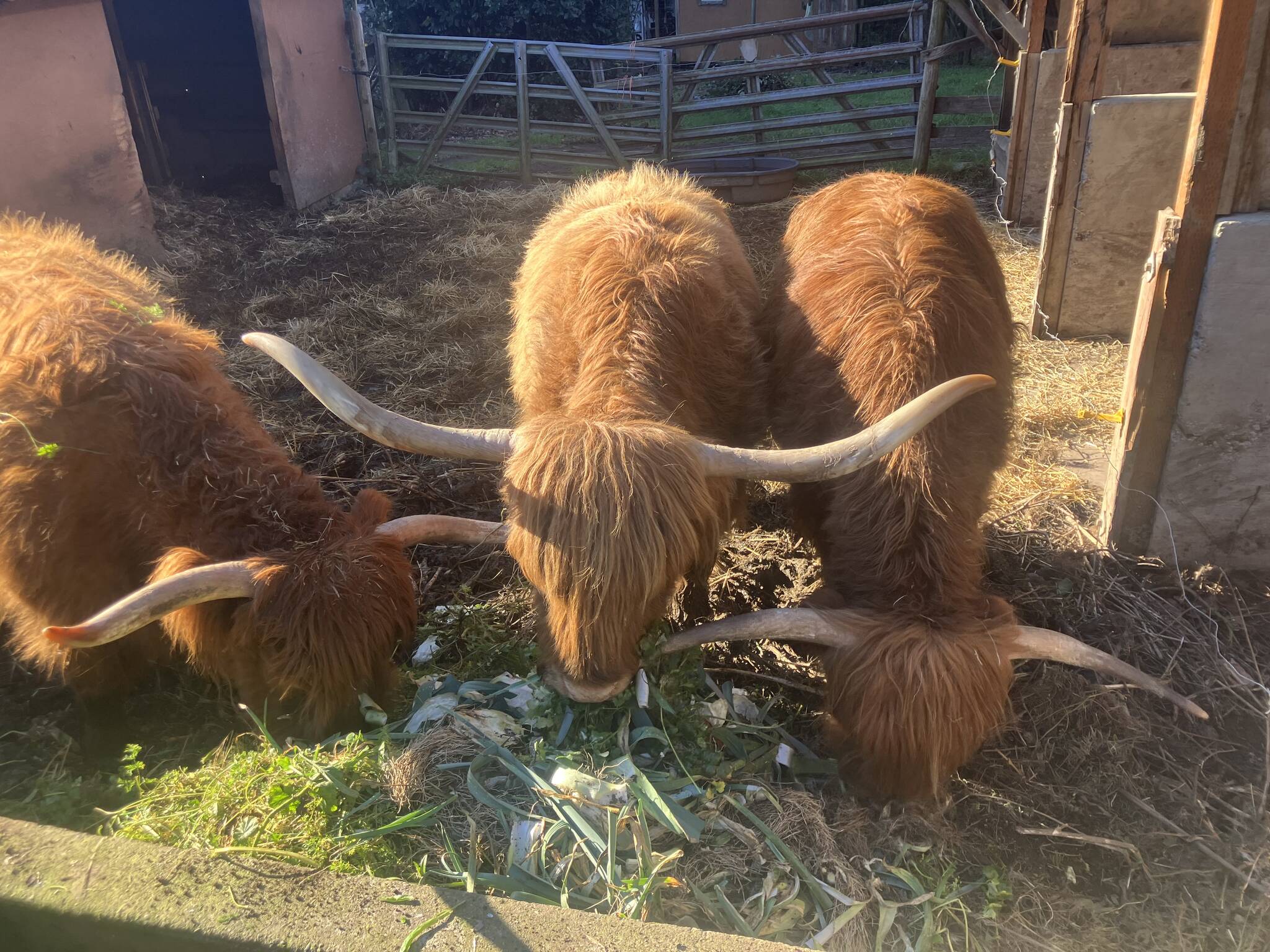
Scottish Highland cows eating harvest scraps. (Leslie Brown Photo)
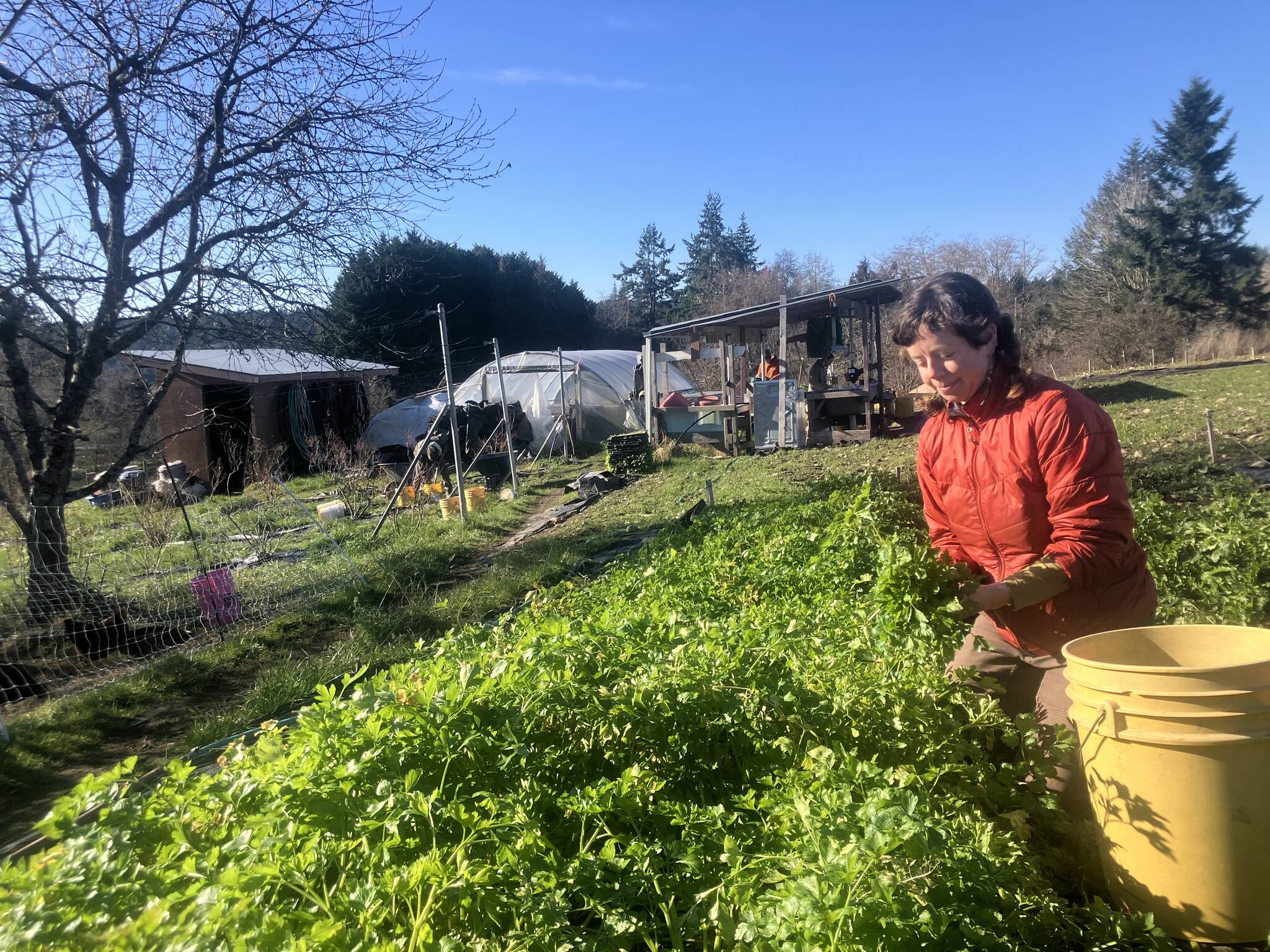
Olivia Mancl harvesting parsley. (Leslie Brown Photo)